


MyExpertWeb Team
September 13, 2026
Mobile App Development for Modern Brands: 2026 Guide
By 2026, the difference between a high-performing digital asset and a costly technical failure often comes down to the depth of the partnership behind the build. Many brands face the frustration of high development costs paired with low ROI, often caused by communication gaps or unscalable code that creates technical debt. Finding the right mobile app development company is about more than just outsourcing a task. It’s a strategic decision that requires a partner who listens to your unique challenges and adapts to your specific business needs.
You’ve likely felt the pressure to launch quickly while worrying if your software can handle the 86.57% market share of iOS 26 or the latest Android 17 updates. This guide helps you move past that uncertainty. You’ll discover how to select a mobile app development company that prioritizes transparency and security from day one. We’ll examine how to build a high-performing mobile app that scales effectively, ensuring your digital presence remains viable as technologies like on-device AI and 5G continue to evolve.
Key Takeaways
- Learn why transitioning from a simple vendor to a strategic mobile app development company ensures your project supports long-term business goals rather than just technical requirements.
- Analyze the cost-to-performance ratio of Native, Hybrid, and Cross-Platform frameworks to select the most efficient tech stack for your specific budget and user needs.
- Identify why the Discovery and Planning phase is the most influential stage of the development lifecycle for maximizing ROI and preventing future technical debt.
- Explore how dedicated development teams can function as a supportive extension of your brand, providing the stability and expertise needed for national-level scaling.
- Gain a methodical framework for evaluating portfolios that prioritizes functional excellence and process transparency over surface-level design aesthetics.
Understanding the Role of a Modern Mobile App Development Company
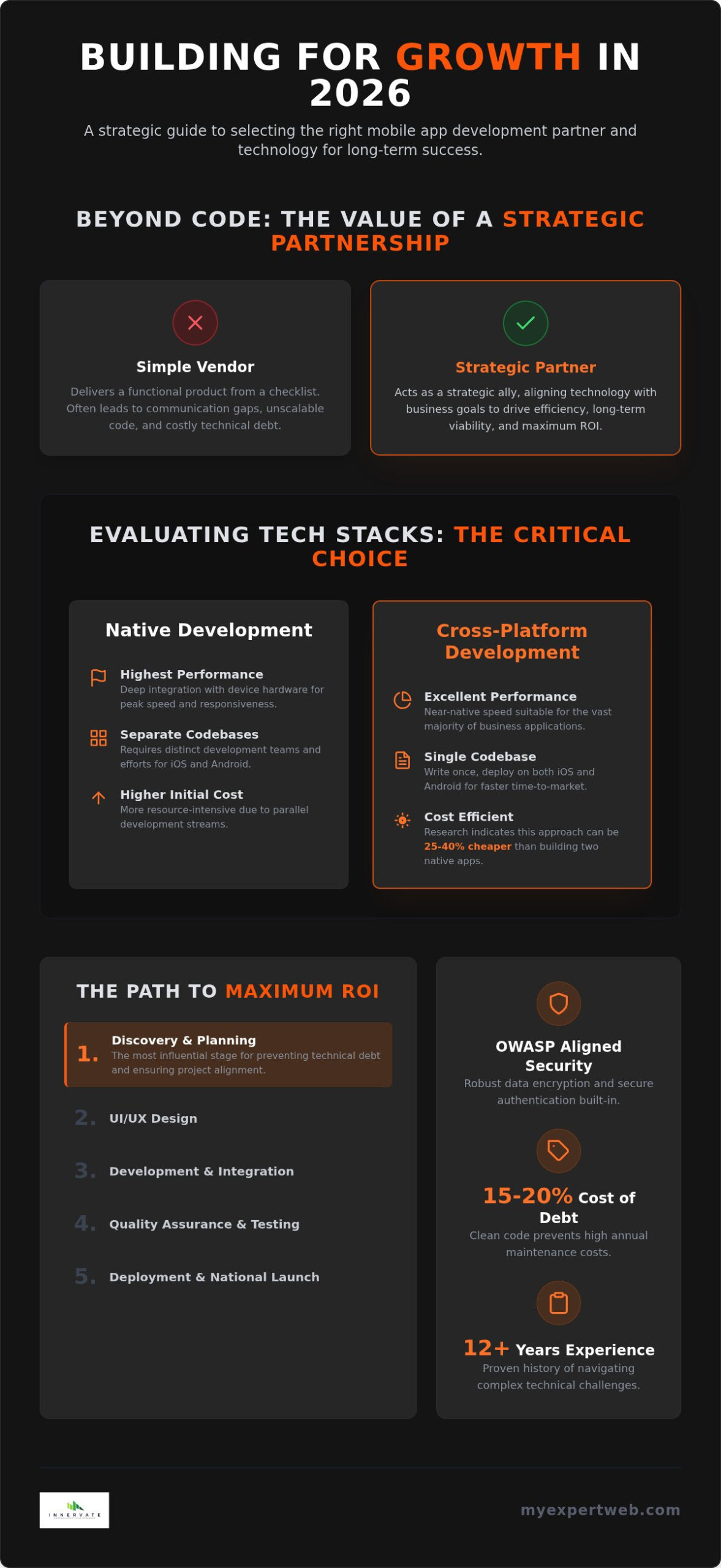
Selecting a mobile app development company in 2026 involves looking past technical specifications to find a partner who understands the mechanics of business growth. While a simple coding vendor might deliver a functional product based on a checklist, a full-service agency acts as a strategic ally. They don’t just build software; they analyze how a mobile application integrates into your existing operations to drive efficiency and long-term viability. This alignment between technology and business goals is what separates a successful digital asset from a costly experiment.
Modern brands use mobile apps as more than just marketing channels. These tools now function as the backbone of operational efficiency, streamlining internal workflows and improving data accuracy. By automating manual tasks, a well-designed app reduces human error and frees up your team for high-value work. This pragmatic approach ensures the development process yields a measurable return on investment rather than just a new line item in your budget.
Beyond Coding: The Value of Strategic Partnership
A reliable mobile app development company understands that a supportive partnership means prioritizing your unique business challenges over the convenience of generic templates. This collaborative process relies on a deep sense of empathy during the initial discovery phase. By listening to your team’s specific hurdles, a methodical guide can tailor a solution that addresses real-world problems. It’s about understanding the “why” behind the app before deciding on the “how.”
Experience plays a critical role in navigating the complexities of modern software. With 12+ years of industry experience, a seasoned development team has seen a wide variety of scenarios and remains unfazed by technical complexity. This history allows them to anticipate and bypass roadblocks that often stall less experienced teams. You aren’t just paying for code; you’re investing in a stable process that values professional aesthetics and functional excellence.
Mobile-First Design as a Business Utility
For brands targeting national visibility in Australia, mobile-friendly designs are no longer optional. Search engines and users alike prioritize performance on handheld devices; this makes mobile-first architecture a baseline requirement for being seen. Beyond visibility, the quality of the user experience (UX) directly impacts customer retention. If an app is difficult to navigate, users will quickly seek alternatives, regardless of the service’s quality.
Mobile-First Design is the strategic practice of prioritizing the mobile user experience during the initial architecture phase to ensure peak performance and 2026 accessibility standards are met across all devices. By focusing on the mobile interface first, developers ensure that the most essential functions are intuitive and accessible. This methodical approach builds trust and reinforces your brand’s image as a stable, organized entity in a competitive digital market.
Evaluating Tech Stacks: Native, Hybrid, or Cross-Platform?
Choosing a technology stack is a foundational decision that influences your app’s performance and your long-term maintenance budget. A professional mobile app development company evaluates your specific business goals to determine whether a native, hybrid, or cross-platform approach is most appropriate. Native development involves building separate codebases for iOS and Android, which offers the highest performance but often increases initial costs. In contrast, cross-platform frameworks like Flutter or React Native allow for a single codebase; research indicates this can be 25-40% cheaper than building two separate native apps.
Security remains a primary concern for business applications. Your partner should integrate security principles, such as those from OWASP, directly into the development cycle. This includes robust data encryption and secure authentication methods. Selecting the right stack also impacts how easily your app can scale. Clean, well-documented code ensures that your digital presence can grow without the burden of excessive technical debt, which typically accounts for 15-20% of the original development cost in annual maintenance.
Native vs. Cross-Platform: Making the Right Choice
Native development is ideal for applications requiring deep integration with device hardware or complex animations. However, cross-platform development has become the default choice for many brands due to its rapid market entry capabilities. If you need to reach both iOS 26 and Android 17 users quickly, this unified approach is often the most pragmatic path. If you’re unsure which path fits your goals, consulting with an experienced mobile app development company can provide the clarity needed to move forward confidently.
| Feature | Native | Cross-Platform | Hybrid |
|---|---|---|---|
| Development Speed | Slower | Faster | Fastest |
| Initial Cost | Higher | Lower | Lowest |
| User Experience | Premium | High | Moderate |
Scalability and Future-Proofing Your App
Future-proofing involves more than just selecting a framework; it requires preparing for the widespread adoption of 5G and AI-powered personalization. 5G enables enhanced AR experiences and real-time streaming, while AI can dynamically adjust content based on user behavior. A reliable strategic partner will help you build a secure, cloud-based infrastructure that supports these advancements. This methodical approach ensures your application remains functional as new mobile operating systems reach the market.
Maintaining a scalable business application requires a focus on backend infrastructure. Secure, cloud-based solutions allow your app to handle traffic spikes without performance degradation. By prioritizing clean code and modular architecture from day one, you ensure that future updates or new feature integrations don’t require a complete rebuild of the existing system.
The App Development Lifecycle: From Concept to National Launch
Success in the mobile market depends on a structured lifecycle that balances technical execution with business strategy. A professional mobile app development company follows a five-stage process: Discovery, Design, Development, Testing, and Growth. While many brands focus heavily on the coding phase, the Discovery stage is actually the most critical for ensuring a high return on investment. It’s during this phase that technical requirements are aligned with operational goals to prevent expensive pivots later in the project.
Quality Assurance (QA) serves as the bridge between a functional product and user trust. In 2026, users expect seamless performance across various devices and OS versions. Rigorous testing ensures that security protocols are solid and that the app performs under real-world conditions. This methodical approach to testing protects your brand’s reputation and reduces the likelihood of negative reviews that can hinder a national launch. Launch day isn’t the finish line; it’s the transition into a phase of active monitoring and user-led improvement.
Discovery and Goal Identification
Working with a methodical guide helps you define clear project milestones that keep the development process on track. This phase involves turning high-level business visions into functional technical requirements. It’s a collaborative effort where empathy for the end-user meets technical expertise. For brands looking to maximize their digital footprint, combining this process with integrated web development and SEO services ensures that the technical foundation supports long-term visibility from day one.
Post-Launch: Growth and Maintenance
Launch day is just the beginning of your mobile app’s journey. Ongoing security updates and performance monitoring are essential to protect user data and maintain speed. As market conditions change, your app must adapt through recurring service retainers that cover everything from bug fixes to new feature rollouts. Ongoing maintenance typically requires a budget of 15-20% of the original development cost annually. Integrating SEO and marketing retainers is also vital to drive consistent app downloads. This long-term perspective ensures that your application remains a viable business utility rather than a static asset.
Scaling with Dedicated Development Teams
Scaling a digital presence often requires more than a one-time project engagement. For many Australian brands, a dedicated development team acts as a seamless extension of their internal operations. This model allows a mobile app development company to provide consistent support. Developers remain familiar with your specific codebase and business logic over the long term. It’s about consistency. By integrating these experts into your workflow, you ensure that the institutional knowledge of your application stays within your reach.
Risk management shouldn’t be an afterthought. A reliable strategic partner mitigates concerns about intellectual property through transparent contracts and established security protocols. By leveraging a proven track record in both Australia and the Philippines, brands can scale their technical capabilities without compromising proprietary data. This methodical approach builds the trust necessary for a long-term partnership. It allows you to focus on market expansion while your technical team handles the complexity of the build.
The Philippines remains a premier destination for high-quality, cost-efficient digital talent. Hourly rates for developers in 2026 generally fall between $25 and $60+, which offers significant savings compared to local hiring. These teams maintain high standards of English proficiency and technical expertise. It’s a pragmatic solution for brands that need to grow quickly without inflating their overhead. You get the benefit of global perspective and adaptability without the high-pressure sales tactics of traditional agencies.
The Dedicated Team Model vs. Project-Based Outsourcing
Unlike project-based outsourcing, which ends once the app is launched, a dedicated team provides continuous product knowledge. This consistency is vital for maintaining the annual performance standards required for modern business applications. Understanding the cost of hiring developers in philippines helps businesses budget for this sustainable growth. Project managers play a crucial role here; they act as a bridge to ensure communication remains clear and milestones are met across different time zones.
Managing Remote Digital Talent Effectively
Effective management of remote teams in 2026 relies on integrated workflows and supportive leadership. An experienced agency handles the administrative burden of staffing, including payroll and local compliance, so you don’t have to. This support significantly improves operational efficiency. Your internal team isn’t bogged down by the complexities of international human resources or technical recruiting. Instead, you gain a steady, results-focused ally that values professional aesthetics and functional excellence.
If you’re ready to expand your technical capacity, you can hire a dedicated development team that integrates directly with your existing workflows to drive long-term growth.
How to Choose the Right Mobile App Development Partner
Selecting a mobile app development company is the final, most critical step in securing your digital future. This decision should be based on a combination of documented experience, process transparency, and a proven portfolio. While many vendors can write code, only a strategic partner will focus on how that code serves your broader business objectives. You need a team that acts as a methodical guide, ensuring every technical milestone contributes to your brand’s long-term viability and operational ease.
Evaluating a portfolio goes beyond surface-level design. It’s essential to look for evidence of functional excellence and how the developer handled complex logic or integration challenges. Ask for case studies that demonstrate how they solved specific business pains, such as reducing manual data entry or improving customer retention through intuitive UX. A partner who can explain the “why” behind their technical choices is far more valuable than one who simply follows a list of features without considering the business utility.
Transparency in pricing and contracts is a hallmark of a reliable strategic partner. Look for balanced agreements that clearly define project milestones, intellectual property rights, and post-launch support. Avoid vendors who provide vague estimates; instead, prioritize those who offer a detailed breakdown of costs, including backend infrastructure and third-party API fees. This clarity builds a foundation of trust and prevents the fear of technical debt or unscalable code from becoming a reality later in the lifecycle.
Vetting Technical Expertise and Business Acumen
Vetting technical expertise involves asking direct questions about security protocols and data privacy. In 2026, compliance with evolving international statutes is mandatory for any serious business application. You should ask potential partners about their approach to data encryption and their adherence to security principles like OWASP. For a deeper look at these criteria, you can refer to our choosing a mobile app development company 2026 guide. A partner with a global perspective is better equipped to adapt to cross-market regulations and cultural nuances.
The Final Decision: Partnership Over Vendor
The final decision often comes down to the quality of the communication and the alignment of values. A supportive and humble tone indicates an agency that’s willing to listen and adapt to your needs rather than forcing a generic solution. This results-focused ally becomes an extension of your own team, valuing your success as much as their own technical achievements. The 2026 standard for a high-quality development partnership is defined by the integration of technical mastery with a deep, empathetic understanding of a brand’s unique operational goals.
If you’re ready to align your digital presence with your long-term business objectives, we invite you to reach out for a consultation to discuss your specific goals and how we can support your growth.
Securing Your Brand’s Digital Future in 2026
The shift toward a mobile-first economy requires more than just functional code; it demands a long-term vision and a methodical approach to growth. By prioritizing the discovery phase and selecting a tech stack that balances performance with maintenance costs, you build a foundation that can handle the complexities of 2026. Whether you’re navigating new app store regulations or integrating AI-powered features, the right mobile app development company acts as a steady ally that evolves alongside your business.
MyExpertWeb brings 12+ years of experience in custom software to every project. Our dedicated development teams across Australia and the Philippines provide secure and scalable business solutions that function as an extension of your own team. We focus on pragmatic results and professional excellence. This ensures your digital presence remains visible and efficient in an increasingly competitive market.
If you’re ready to align your technical infrastructure with your strategic goals, start your project with a free consultation at MyExpertWeb. We look forward to supporting your journey toward a high-performing digital presence that scales with your brand.
Frequently Asked Questions
How much does it cost to hire a mobile app development company in 2026?
Industry data for 2026 indicates that app costs vary significantly based on complexity, features, and platform choices. A basic application requires a different investment level than a mid-level business app or a complex enterprise-grade solution. A professional mobile app development company will provide a detailed quote tailored to your specific goals and technical requirements. This transparency helps you plan for the initial build while accounting for the ongoing maintenance needed to keep the software viable.
How long does the mobile app development process usually take?
The development timeline varies based on complexity, but most custom business applications take between three to nine months from discovery to launch. A Minimum Viable Product (MVP) might be ready in twelve to sixteen weeks. Factors like third-party API integrations, complex backend requirements, and the depth of the testing phase influence the final schedule. A methodical guide ensures that milestones are clearly defined to keep the project moving predictably and efficiently.
What is the difference between a project-based fee and a dedicated team model?
A project-based fee is a one-time cost for a specific scope of work, which is ideal for fixed-term builds with defined requirements. In contrast, the dedicated team model provides developers who act as an extension of your internal staff. This approach offers better consistency and long-term product knowledge. It’s particularly effective for Australian brands that need to scale their technical capacity while maintaining a stable, supportive partnership with their remote talent.
Can I update my app after it has been launched on the App Store?
Yes, updating your app is a critical part of the lifecycle to ensure compatibility with new OS versions like iOS 26 and Android 17. Regular updates allow you to fix bugs, improve performance, and add new features based on user feedback. Most businesses budget a percentage of the original development cost annually for maintenance. This proactive approach keeps your application secure and functional as mobile technology and user expectations continue to evolve.
How do you ensure the security of my custom business application?
Security is integrated from the beginning by following established principles like those from OWASP. We utilize robust data encryption, secure authentication methods, and regular vulnerability testing to protect your custom business application. With new app store accountability statutes in effect as of January 2026, staying compliant with age verification and parental consent regulations is a priority. This methodical focus on security helps build trust and protects your brand’s reputation over the long term.
Will my mobile app work on both iOS and Android?
Most modern apps are built to work on both platforms using cross-platform frameworks like Flutter or React Native. This approach is often 25-40% cheaper than building separate native codebases for iOS and Android. Research indicates that Android holds a 70.6% global market share, while iOS leads in specific markets. Choosing a mobile app development company that understands these market dynamics ensures your app reaches the widest possible audience effectively and stays scalable.
Do I own the source code after the project is completed?
Yes, you should own the source code and all intellectual property once the project is completed and the final payments are made. A reliable strategic partner provides full transparency regarding code ownership in their initial contract. This ensures you have the freedom to scale, update, or move your application in the future without being locked into a single vendor. It’s a fundamental requirement for maintaining control over your brand’s digital assets and data.
What role does SEO play in mobile app development?
SEO plays a vital role in ensuring your app is visible to your target audience. This includes App Store Optimization (ASO) to improve rankings within the stores and integrated web SEO to drive traffic to your landing pages. Using keywords effectively and maintaining mobile-friendly designs help your brand achieve national visibility. Since 86.57% of active iPhones are running the latest iOS version, your SEO strategy must also account for technical performance and accessibility standards.