


MyExpertWeb Team
September 23, 2026
In-House vs Outsourced Digital Marketing Team: The 2026 Strategic Guide
What if the traditional debate surrounding an in-house vs outsourced digital marketing team is asking the wrong question entirely? Most executives treat this decision as an all-or-nothing choice between total direct control and external scalability. In reality, sustainable marketing velocity depends far more on operational alignment and technical capability than rigid staffing dogmas.
You’re likely feeling the strain of that balance right now. Finding and keeping multi-disciplinary talent across analytics, development, and campaign strategy is increasingly difficult, while software tool stacks and management overhead quietly deplete internal bandwidth. Simultaneously, the fear of losing your distinct brand voice or tactical control with an outside vendor is completely justified.
This guide helps you discover whether building an internal marketing unit or partnering with an outsourced team best accelerates your business growth. We’ll explore a practical framework that details the hidden operational investments of each approach, giving you a clear roadmap to execute high-impact digital campaigns without exhausting leadership resources.
Key Takeaways
- Understand the core operational trade-offs of choosing an in-house vs outsourced digital marketing team, balancing day-to-day tactical control against access to broad specialized capabilities.
- Uncover the real organizational demands of internal teams, including recruitment overhead, continuous technical training, and modern enterprise software management.
- Discover how external digital agencies leverage cross-industry campaign insights and established infrastructure to launch multi-disciplinary initiatives without onboarding delays.
- Apply a structured operational framework to evaluate your company’s growth targets, technical complexity, and internal leadership bandwidth accurately.
- Explore how a modern hybrid operational model lets you retain internal brand governance while utilizing dedicated outsourced partners for technical execution.
In-House vs Outsourced Digital Marketing Team: Strategic Overview and Core Differences
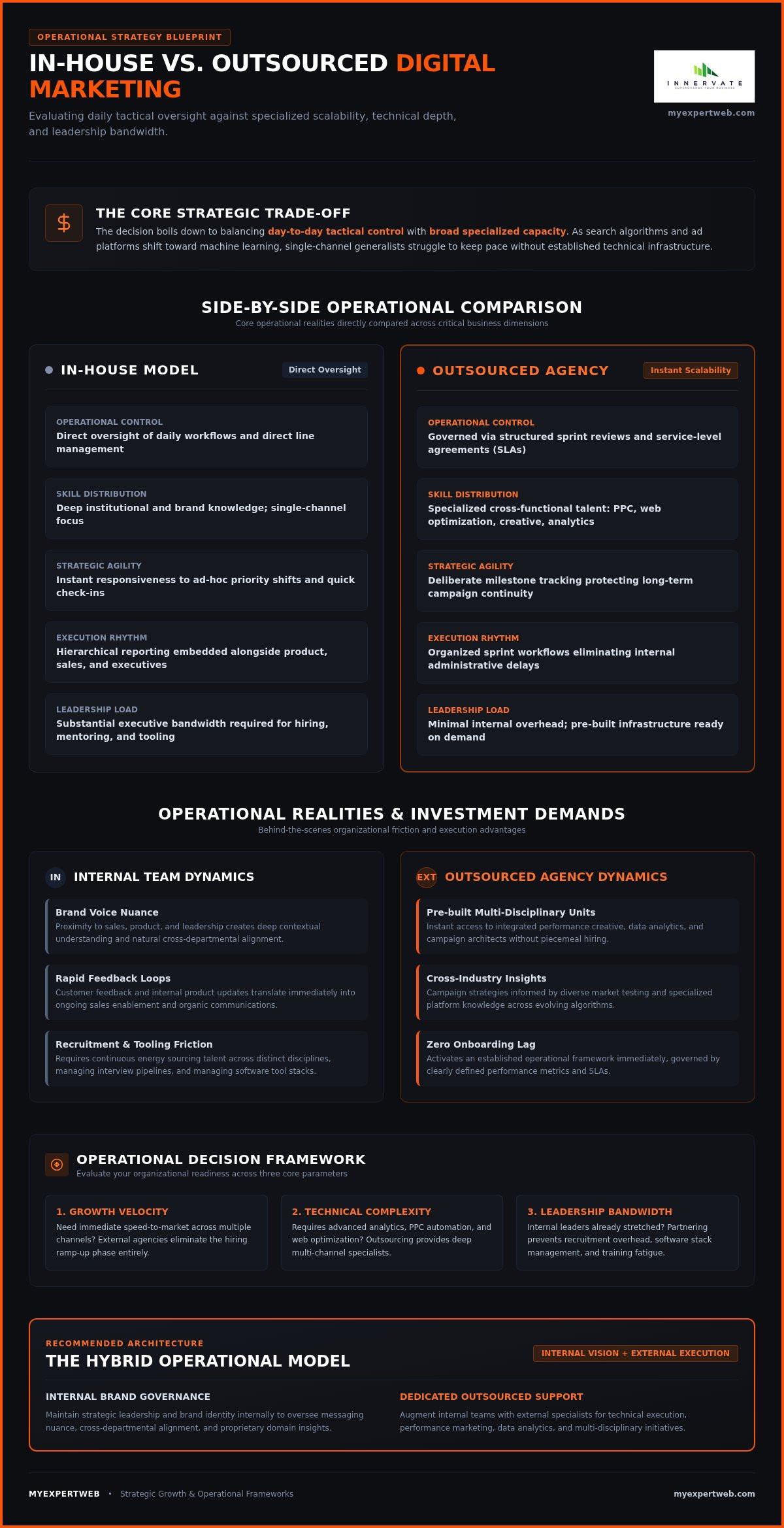
Choosing between an in-house vs outsourced digital marketing team boils down to how your leadership balances daily tactical oversight against broad technical depth. An internal group offers direct operational visibility and immediate responsiveness, while an external agency supplies multi-channel capabilities that are difficult to reproduce internally. As modern search algorithms and ad platforms shift toward machine learning, single-channel generalists struggle to keep up. Marketing leaders must decide whether their central objective is brand immersion or instant specialized capacity.
Communication velocity also plays out differently across these models. An on-site employee can pivot campaign priorities in minutes through a quick desk check-in. In contrast, an external partner relies on organized workflows, sprint cycles, and defined roadmaps. This structured pace trades ad-hoc responsiveness for deliberate execution and measurable discipline.
Defining the In-House Marketing Infrastructure
Internal infrastructure relies on hierarchical reporting, where marketing personnel sit alongside sales, product, and executive leadership. This physical or virtual proximity protects your brand voice across routine communications, from organic social posts to sales enablement collateral. Yet, maintaining this setup demands substantial executive bandwidth. Leadership must dedicate time to mentoring technical talent, resolving cross-departmental bottlenecks, and managing ongoing professional development.
The Mechanics of an Outsourced Digital Marketing Partnership
External engagements leverage established operating systems designed to eliminate execution delays. Through strategic outsourcing, businesses tap cross-functional teams that integrate performance creative, data analytics, and campaign architecture without administrative friction. Rather than building individual roles one by one, your organization activates an entire operational unit governed by specific performance indicators.
To evaluate how these fundamental attributes compare side-by-side, consider their core operational realities:
- Operational Control: In-house delivers direct oversight of daily workflows, whereas agencies execute through structured sprint reviews and service-level agreements.
- Skill Distribution: Internal teams cultivate deep institutional knowledge; outsourced agencies supply specialized talent across pay-per-click management, technical web optimization, and creative development.
- Strategic Agility: Internal hires pivot instantly to ad-hoc requests, while external agencies focus on quarterly milestones to protect strategic continuity.
Understanding these functional boundaries allows you to evaluate your team’s current capacity realistically before committing your long-term capital.
Building an Internal Marketing Department: Capabilities, Culture, and Operational Realities
Establishing an internal department anchors marketing directly into the day-to-day rhythm of your business. When creative and technical personnel operate under your roof, cross-departmental alignment happens naturally. Customer feedback loops tighten, product updates translate quickly into messaging, and brand voice reflects corporate identity with subtle nuance. For organizations operating within highly specialized niches, this immersion creates contextual understanding that outside observers often take months to develop.
Yet, deciding on an in-house vs outsourced digital marketing team requires an honest assessment of the operational friction involved in building a department from scratch. Sourcing specialized talent across distinct disciplines presents significant friction. The administrative energy spent managing recruitment pipelines, technical interviews, and onboarding cycles routinely pulls leadership away from core commercial goals.
Direct Oversight, Deep Brand Immersion, and Internal Focus
Internal teams cultivate proprietary domain knowledge that external vendors rarely duplicate organically. When campaign managers collaborate directly with sales engineers and customer success reps, marketing materials maintain authentic alignment with real client interactions. This proximity simplifies compliance reviews and gives leaders total control over project prioritization without contractual revisions.
Recruitment Lag, Skill Gaps, and Retention Challenges
Modern growth requires distinct technical proficiencies: paid search optimization, automated CRM workflows, technical site architecture, and conversion design. Finding these disparate abilities in a handful of full-time hires is virtually impossible. When a specialized employee departs, momentum halts completely. The business absorbs recruitment delays, lost institutional memory, and protracted onboarding periods before regaining full operational velocity.
Software Licenses, Training, and Ongoing Tooling Commitments
Maintaining competitive in-house marketing demands substantial infrastructure. Organizations must fund and configure complex enterprise tool stacks, including:
- Search and Competitive Intelligence: Enterprise search platforms, backlink analysis indexes, and keyword monitoring software.
- Conversion and Tracking Tools: Behavioral heatmapping, tag management, server-side analytics, and multi-touch attribution systems.
- Creative and Production Software: Design licenses, video rendering suites, and ongoing educational resources to track frequent algorithm updates.
As academic research on organizational design, such as Harvard Business School’s analysis on Rethinking the Sourcing of Advertising Services, illustrates, absorbing these structural fixed costs often creates resource constraints that limit operational flexibility. If your internal leaders want strategic control without bearing the full weight of isolated software licenses and specialized technical hiring, partnering with an established provider like MyExpertWeb offers an agile route to scale campaigns smoothly.
Engaging an Outsourced Digital Agency: Specialization, Scalability, and Industry Insight
Agencies operate at the intersection of diverse campaign data, testing strategies across multiple sectors before bringing refined tactics to your brand. Rather than learning solely through internal trial and error, an external partner applies patterns identified across varied market conditions. This cross-pollination provides immediate strategic clarity, helping businesses avoid costly tactical experiments that drain quarterly budgets.
Evaluating an in-house vs outsourced digital marketing team often centers on how quickly you need specialized execution. Building these capabilities internally requires months of recruitment. An experienced agency deploys a cohesive unit from day one, allowing your leadership to bypass administrative hiring bottlenecks and start executing immediately.
Access to Multi-Disciplinary Digital Specialists Under One Roof
Modern campaigns demand distinct capabilities that rarely exist in a single hire. Outsourced firms combine copywriters, technical search strategists, PPC campaign architects, and front-end developers into unified workflows. This structural breadth ensures technical execution moves smoothly alongside creative production. Businesses can see these compounding benefits through integrated web development and SEO services, where development adjustments directly support search discoverability.
Agile Scalability and Rapid Adaptation to Market Fluctuations
Resource agility protects organizations against volatile market conditions. If your commercial priorities pivot from paid media acquisition to organic organic visibility, an external partner reallocates personnel across those initiatives instantly. You avoid the financial friction of hiring new full-time staff or managing layoffs when channel effectiveness shifts. Retainers adjust as your milestones change, giving you breathing room during seasonal lulls and focused firepower during critical product launches.
Mitigating Misalignment Risks Through Structured Communication Protocols
Despite these strengths, outsourcing introduces distinct friction points if governance remains vague. Communication lags, split agency attention, and diverging strategic expectations can stall progress. Successfully navigating these risks requires structured operational rituals:
- Designated Internal Ownership: Assign an internal liaison who acts as the primary contact, ensuring external deliverables match commercial objectives.
- Standardized Reporting Rhythms: Replace ad-hoc status calls with structured bi-weekly reviews and transparent, live analytics dashboards.
- Explicit Scope Boundaries: Define project deliverables, revision parameters, and turnaround timelines before work begins to keep priorities clear.
When leadership establishes these communication guardrails early, an external agency operates not as a distant vendor, but as a dependable, highly specialized extension of your internal team.
Decision Framework: Evaluating Company Size, Growth Velocity, and Technical Needs
Determining whether to build an in-house vs outsourced digital marketing team requires an objective assessment of your operational maturity. Rather than relying on gut feelings, forward-thinking organizations evaluate their internal leadership capacity alongside technical execution needs. An honest evaluation prevents costly staffing missteps and keeps your marketing investments directly tethered to bottom-line performance.
Your business lifecycle heavily dictates which model delivers optimal returns. Early-stage and rapidly growing companies often require immediate campaign velocity that internal hiring simply cannot match. Conversely, mature enterprises with deeply established market positioning may prioritize internal cultural alignment. Balancing immediate revenue generation against long-term brand development clarifies where your capital should flow.
Audit Internal Resources, Technical Gaps, and Growth Timelines
Begin by measuring the true managerial bandwidth of your leadership team. Directing marketing specialists requires daily strategic governance, performance reviews, and technical feedback. If your executives are already stretched thin managing core product or service operations, adding a marketing unit creates severe managerial drag. Next, audit your internal capability gaps across critical growth channels, calculating whether your revenue goals require instant customer acquisition or deliberate, multi-quarter foundation building.
Analyze Campaign Complexity Across SEO, PPC, and Development Requirements
Campaign sophistication determines your resource needs. Executing advanced multi-location campaigns, such as optimizing footprint reach through local SEO services, requires specialized schema architecture and persistent citation auditing. Similarly, building custom web applications or high-converting conversion funnels demands senior engineering skills rarely found in standard marketing generalists.
Use this practical scoring rubric to evaluate your optimal operational path:
- Managerial Capacity: If internal leaders have fewer than 10 hours weekly to mentor and manage marketing staff, outsourcing delivers faster operational clarity.
- Technical Sophistication: If your strategy requires custom full-stack development, server-side data tracking, and multi-channel paid media, an agency prevents costly skill deficiencies.
- Execution Speed: If you need qualified pipeline growth within 30 to 60 days, established outsourced teams deploy proven workflows immediately.
- Brand Specificity: If your offering requires daily, in-person coordination with clinical or technical production teams, an internal lead protects nuanced messaging.
If your audit reveals significant technical gaps or capacity constraints, you don’t have to navigate that operational complexity alone. You can partner with MyExpertWeb to deploy dedicated digital teams that integrate directly with your organizational workflow.
The Hybrid Approach: Augmenting Internal Vision with Dedicated Outsourced Support
The choice between an in-house vs outsourced digital marketing team does not have to be an either-or compromise. Rather than committing entirely to one extreme, growing organizations frequently adopt a hybrid operational model. This structure preserves internal brand stewardship while deploying external engineering and channel specialists to handle high-friction execution. By pairing internal leadership with external production power, companies maintain strategic control without stretching internal teams past their breaking point.
Under this collaborative framework, your internal leaders direct high-level positioning and product roadmaps. Meanwhile, an agile external partner manages the intricate, day-to-day work required across search, paid advertising, and development infrastructure. This division prevents campaign burnout and keeps executive oversight focused on business growth.
Retaining Core Brand Ownership While Outsourcing Technical Execution
An internal marketing lead ensures every campaign aligns with broader business goals. This leader coordinates cross-functional priorities with executive leadership, sets quarterly milestones, and manages overall commercial messaging. Complex technical execution, such as ongoing pay-per-click account restructuring, technical search optimization, and landing page engineering, is handed off to specialized external teams. This co-sourcing structure provides dependable output while keeping strategic governance safely inside the organization.
Seamless Integration with Dedicated Offshore and Specialized Partner Teams
Modern campaigns rely heavily on dependable software engineering and technical agility. Instead of attempting to hire scarce technical specialists internally, forward-thinking organizations augment their capacity with dedicated offshore engineering units. For companies weighing these technical investments, reviewing the cost of hiring developers in the Philippines reveals how distributed operational models scale technical capacity sustainably.
When multi-channel marketing campaigns require tailored infrastructure, external support expands into backend software delivery. Aligning your marketing strategy with custom business application development ensures custom customer portals, analytics pipelines, and lead funnels perform smoothly together. To determine if this integrated model matches your growth plans, take these pragmatic next steps:
- Audit Internal Capacity: Pinpoint exactly where leadership bandwidth and technical execution collide within your current team.
- Map Technical Needs: Separate core brand-governance tasks from channel execution requirements like web architecture, paid acquisition, and SEO.
- Define Collaboration Guardrails: Establish specific service-level agreements and reporting schedules before initiating partner onboarding.
This balanced operating framework delivers specialized execution on demand, keeping your internal staff focused on high-level strategy and long-term brand equity.
Aligning Your Marketing Operations for Sustainable Growth
Resolving the debate between an in-house vs outsourced digital marketing team is not about following a universal industry formula. It centers on choosing the operational model that matches your current leadership bandwidth, growth velocity, and technical requirements. While an internal department offers cultural integration and direct oversight, building everything on your own introduces heavy recruitment drag, software licensing overhead, and retention risks. Conversely, external partners supply ready-to-deploy technical specialization across search optimization, paid media, and web development from day one.
For many scaling organizations, adopting a collaborative hybrid model delivers the ideal balance. Your internal leadership retains strategic control over core messaging, while an experienced partner executes complex campaigns and technical initiatives efficiently.
With over 12 years of enterprise digital agency and outsourcing expertise, MyExpertWeb provides full-stack delivery that combines technical custom software engineering with dedicated monthly marketing retainers. Whether you need to augment your existing team or deploy dedicated offshore specialists, the right operational partner helps you scale with confidence. Schedule a strategic consultation with MyExpertWeb today to build a resilient marketing roadmap tailored to your business goals.
Frequently Asked Questions
Is it more cost-effective to hire an in-house marketing team or outsource to an agency?
Outsourcing is generally more cost-effective for growing businesses because it eliminates overhead expenses like full-time benefits, recruiting recruitment fees, and recurring enterprise software subscriptions. When evaluating an in-house vs outsourced digital marketing team, internal hiring requires funding multiple full-time salaries to cover disparate technical roles. An agency model pools multi-disciplinary specialists into a single predictable monthly retainer, maximizing budget efficiency.
How do companies protect their brand voice when outsourcing digital marketing campaigns?
Protecting your brand voice requires establishing comprehensive brand guidelines, clear audience personas, and strict editorial approval protocols before production starts. Designating an internal marketing liaison to oversee external deliverables ensures messaging remains authentic. Regular feedback loops during the onboarding phase help external copywriters and designers absorb your industry tone quickly, preventing off-brand collateral from reaching the public.
What is a hybrid digital marketing model and how does it function?
A hybrid digital marketing model pairs an internal strategic leader with an external agency to execute specialized technical campaigns. Your in-house marketing manager directs corporate strategy, sets business priorities, and maintains brand governance across channels. Meanwhile, the outsourced agency manages complex execution, handling technical search engine optimization, pay-per-click management, landing page design, and custom software maintenance.
How quickly can an outsourced digital marketing team launch active campaigns?
Most experienced outsourced agencies launch initial campaigns within two to four weeks following project discovery and technical audits. Building an internal department typically requires two to four months just to recruit, hire, and onboard qualified personnel. External teams use established workflows, dedicated project managers, and pre-configured tool stacks to accelerate campaign deployment without administrative friction.
What technical marketing disciplines are most commonly outsourced by growing businesses?
Businesses most frequently outsource complex disciplines that require heavy software tooling and deep technical expertise. These include paid search management, local SEO architecture, conversion rate optimization, and custom web application development. Because finding individual employees who excel across these diverse channels is rare, organizations delegate these requirements to specialized external partner units.
Can an outsourced marketing agency integrate with our existing internal software and workflows?
Yes, professional agencies routinely connect directly into your company’s preferred project management boards, customer relationship platforms, and communication channels. Experienced partners adapt to tools like Slack, Asana, and enterprise analytics suites during onboarding. This collaborative alignment creates complete transparency, allowing your leadership team to monitor deliverables, campaign adjustments, and performance metrics in real time.
How do businesses evaluate the performance and accountability of an outsourced marketing team?
Evaluating an outsourced team requires setting clear key performance indicators tied directly to business growth rather than surface-level vanity metrics. Effective partnerships rely on transparent reporting dashboards, scheduled bi-weekly review meetings, and established service-level agreements. Tracking qualified lead generation, customer acquisition cost improvements, and organic search visibility ensures your in-house vs outsourced digital marketing team dynamic delivers measurable commercial value.