


MyExpertWeb Team
August 10, 2026
Cost of Hiring Developers in the Philippines: The 2026 Strategic Guide
When a senior developer in Australia commands a salary exceeding A$200,000, the question isn’t just about saving money. It’s about whether your business can actually afford to scale in a market where niche talent is increasingly scarce. You’ve likely felt the pressure of rising domestic wages while worrying that offshore teams might compromise your code quality or intellectual property. It’s a difficult balance to strike when you’re trying to build a reliable tech stack for the long term.
We understand that navigating the cost of hiring developers in philippines requires more than just looking at base salaries. This guide provides a comprehensive breakdown of 2026 developer rates, mandatory employer contributions, and the hidden operational costs that often catch Australian businesses off guard. You’ll gain a clear framework for choosing between freelance models and dedicated teams, alongside a transparent budget for your offshore expansion. We’ll show you how to secure high quality output and IP protection while maintaining the agility your business needs to thrive.
Key Takeaways
- Learn why the Philippines has evolved into a strategic hub for Australian businesses, offering cultural alignment and English proficiency that minimize operational friction.
- Access the latest 2026 salary benchmarks to accurately forecast the cost of hiring developers in philippines across junior, mid-level, and senior roles.
- Master the Total Cost of Ownership by accounting for mandatory benefits, 13th-month pay, and infrastructure needs to build a realistic and sustainable budget.
- Implement a methodical five-step vetting process to secure high-quality technical talent while ensuring your intellectual property remains protected.
- Discover how a managed partnership model provides a reliable bridge between cost efficiency and the high-caliber output required for custom business applications.
The 2026 Landscape: Why the Philippines Remains a Tech Powerhouse
The global shift toward sophisticated remote work models has matured significantly by 2026. For Australian companies, the Philippines has solidified its position as a primary destination for high-tier technical talent. This isn’t just about lower overheads; it’s about access to a workforce that has spent decades integrating with Western business standards. The long history of Business Process Outsourcing in the Philippines has established a foundation of professional excellence and high English proficiency. These factors lead to a direct reduction in the cost of hiring developers in philippines because they eliminate the “communication tax” often found in other offshore regions.
Recent legislative moves, such as the 2026 house bills aimed at enhancing BPO worker protections, have created a more stable and ethical hiring environment. This stability is particularly important for Australian SMEs that need reliable, long-term partners rather than temporary fixes. We’re also seeing a rise in specialized tech hubs in Metro Manila and Cebu that focus specifically on emerging fields like AI and Cyber Security, ensuring that the talent pool evolves alongside global tech trends.
Addressing the Local Skills Gap
Australian businesses continue to struggle with a domestic tech talent shortage that drives salaries for senior roles toward the A$250,000 mark. For many SMEs, this financial burden makes local scaling unsustainable. Filipino developers are increasingly filling these niche roles, offering expertise that is difficult to find in Sydney or Melbourne. By integrating these professionals into your workflow, you can accelerate complex projects such as custom business application development without the recruitment lag times common in the Australian market.
Infrastructure and Connectivity Improvements
The reliability of offshore teams depends heavily on their local environment. By 2026, the Philippines has seen significant upgrades in its digital infrastructure, with expanded fiber optic networks and dedicated tech parks. These facilities provide redundant power and high-speed connectivity, which drastically reduces operational downtime. When you calculate the total cost of hiring developers in philippines, you must factor in these infrastructure improvements as they directly impact your project’s ROI.
While remote work remains popular, there is a growing shift toward hybrid or office-based managed teams. This model offers the security and high-speed environment necessary for data-sensitive projects, giving Australian business owners peace of mind regarding both productivity and data integrity. It’s a pragmatic approach that ensures your offshore team functions as a seamless extension of your local office.
Detailed Salary Guide: Developer Rates by Tech Stack and Seniority
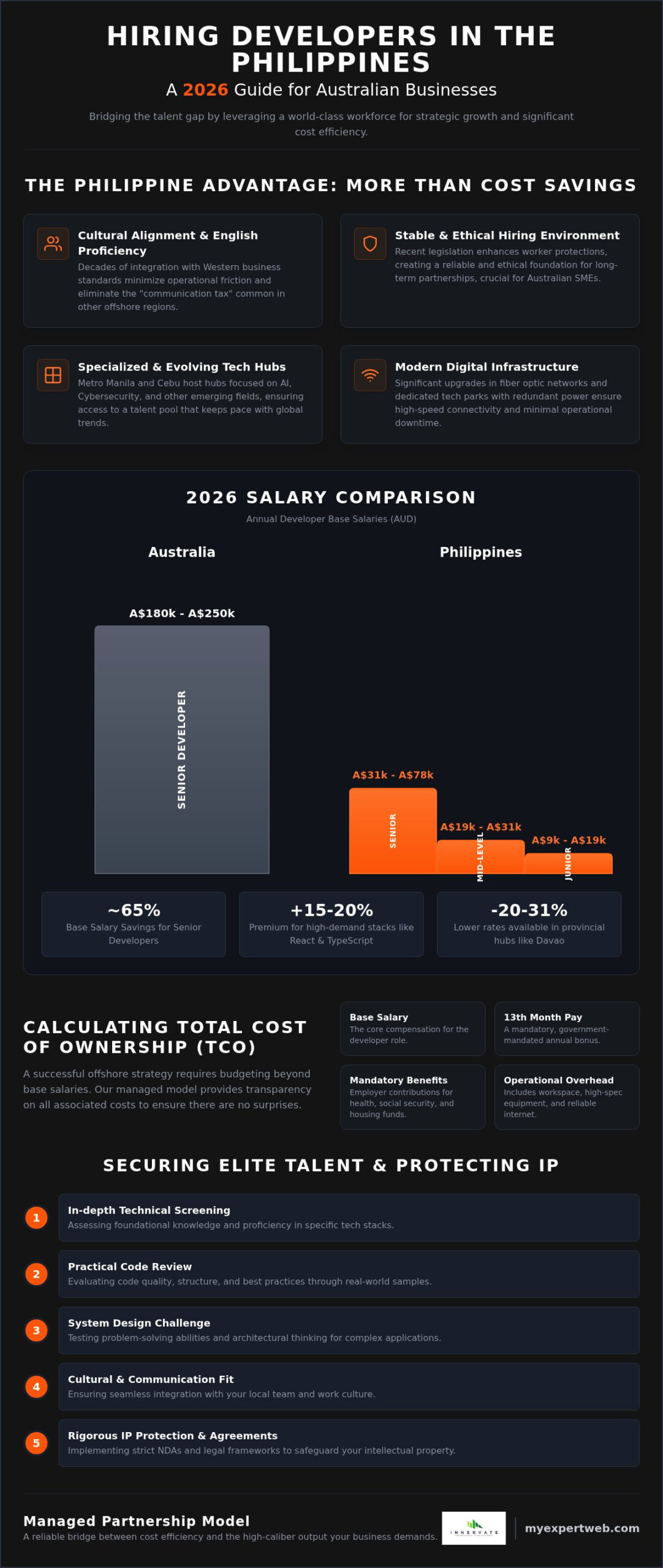
Understanding the cost of hiring developers in philippines requires a look at current market benchmarks. In 2026, a junior developer typically earns between A$780 and A$1,560 per month. Mid-level professionals range from A$1,560 to A$2,600, while senior or lead developers command between A$2,600 and A$6,500 per month. These figures represent base salaries in Metro Manila, which remains the primary hub for high-tier talent. You can often find rates 20% to 31% lower in provincial hubs like Davao or Iloilo, though Manila offers a deeper pool of specialized expertise. This competitive environment is supported by the Philippine Board of Investments IT-BPM Overview, which highlights the country’s robust infrastructure for global service delivery.
Web and Custom Software Development Rates
Common stacks like PHP/Laravel, Python, and JavaScript remain the most popular choices for Australian SMEs. Full-stack developers are particularly valuable for startups because they handle both front-end and back-end requirements, reducing the total headcount needed for a project. Stacks involving React, Next.js, and TypeScript often command a 15% to 20% premium due to high demand. The math is clear. By 2026, hiring a Senior Laravel developer in the Philippines typically results in a base salary saving of approximately 65% when compared to the A$180,000 to A$220,000 range common in Australian capital cities.
Specialized Roles: Mobile, AI, and Cyber Security
As businesses move toward more complex digital solutions, specialized expertise commands higher rates. Mobile app development company standards require developers proficient in Swift or Kotlin, often carrying a 15% premium over standard web roles. AI and data science engineers are among the highest earners, with senior roles frequently exceeding the A$6,500 monthly mark. Integrating security-first developers into your workflow is also becoming a standard requirement for Australian compliance. These professionals focus on building secure, scalable applications from the ground up. If you’re looking to build a resilient tech stack without the overhead of local recruitment, exploring a dedicated outsourcing development team can provide the balance of cost and quality you need.
Calculating the Total Cost of Ownership (TCO) for Offshore Teams
Hiring an offshore team involves more than just matching a salary to a technical skill set. To accurately forecast your budget, you must look at the Total Cost of Ownership (TCO), which includes mandatory contributions, hardware, and the “management tax” of daily coordination. While the base cost of hiring developers in philippines remains attractive, overlooking these secondary expenses can lead to unexpected budget overruns. You also need to consider recruitment fees. These can range from 15% to 25% of the annual salary if you’re engaging a headhunter to find elite, niche talent in a competitive market.
The “management tax” is often the most underestimated line item. It represents the time your local technical leads spend on code reviews, daily stand-ups, and cultural integration. When you analyze the total cost of hiring developers in philippines, you must also look at the software licenses and collaboration tools required to maintain a high-velocity workflow across different time zones.
Mandatory Benefits and Taxes in the Philippines
The Philippine Labor Code is specific about employer obligations. Beyond the monthly salary, you’re responsible for contributions to the Social Security System (SSS), PhilHealth, and the Pag-IBIG Fund. For a senior developer, the employer’s monthly share for these items typically totals around A$165. You also need to account for the mandatory 13th-month pay. This is an additional month’s salary paid by December 24 each year, which effectively means you should budget for 13 months of pay for every 12 months of work. This regulatory framework is part of the broader Philippine Digital Economy Growth, which has led to more standardized and secure labor practices across the IT sector.
Managed Service vs. Direct Hire Costs
Choosing between a direct hire and a managed service is a pivotal decision for your TCO. A direct hire via a freelance platform might seem cheaper initially, but you’ll bear the full burden of HR, payroll compliance, and retention strategies. Conversely, using professional outsourcing services often includes these costs in a flat monthly fee. This approach provides a more predictable budget and reduces the time your local managers spend on administrative tasks. Understanding the nuances of outsourcing or subcontracting helps you see that the slightly higher service fee of an agency often pays for itself through reduced turnover and better hardware reliability. High-quality equipment and a stable office environment are essential to minimize downtime, which is a hidden cost often ignored in DIY models. Before committing to a hiring model, it’s worth reviewing how to evaluate an offshore outsourcing company to ensure you’re selecting a partner that aligns with your compliance, quality, and scalability requirements.
Strategic Vetting: Ensuring Quality and Intellectual Property Security
The financial advantages of the Philippine market only translate to business growth if the talent you hire meets your technical and cultural standards. Vetting is the most critical stage in the hiring process. It’s the filter that prevents the cost of hiring developers in philippines from becoming a hidden expense due to technical debt or high turnover. A methodical, five-step approach ensures you find professionals who don’t just write code but understand your business goals. This process typically includes initial technical screening, a deep-dive coding assessment, an architecture review, a soft skills interview, and a final background check to verify past performance.
Quality Assurance (QA) shouldn’t be viewed as a luxury. It’s a non-negotiable component of the development lifecycle. While some businesses skip dedicated QA to save on initial costs, the long-term impact on your reputation and maintenance budget is often far higher. Integrating QA from the start ensures your product is resilient and user-ready, protecting the ROI of your offshore investment.
Technical Assessment Framework
Choosing between live coding sessions and take-home assignments depends on the role you’re filling. Live coding allows you to observe a developer’s real-time problem-solving logic and communication under pressure. Conversely, take-home assignments provide a better view of how they structure complex projects and maintain clean code standards. You should also vet for specific knowledge in secure architecture to ensure your applications are built to withstand modern threats. Many Australian SMEs find that partnering with experts in software development outsourcing simplifies this stage, as these partners handle the heavy lifting of pre-vetting and technical validation.
IP Protection and Data Security
Protecting your intellectual property in a remote environment requires a combination of legal frameworks and technical safeguards. Your employment contracts must include specific clauses that assign all IP rights to your company, enforceable under both Philippine and Australian law. You also need to ensure compliance with the Australian Privacy Principles (APPs) and, where applicable, GDPR. Implementing secure development environments is equally vital. This often involves:
- Using encrypted VPNs for all development work
- Restricting access to production databases
- Providing managed hardware with remote wipe capabilities
- Regular security audits and NDAs for all team members
If you’re ready to build a secure, high-performing offshore team without the recruitment headache, learn more about how our outsourcing development team can support your next project.
Scaling Your Tech Infrastructure with MyExpertWeb Dedicated Teams
MyExpertWeb acts as a bridge for Australian businesses that need to scale without the friction of traditional offshore models. We understand that the true cost of hiring developers in philippines involves more than just the monthly invoice; it’s about the quality of the partnership and the reliability of the output. Our approach moves beyond the vendor-client dynamic, positioning our team as a seamless extension of your own. This model ensures that the developers we provide are deeply integrated into your company culture and technical standards from day one.
Scaling from a single developer to a full team requires a methodical framework. We’ve seen success stories where Australian SMEs started with one React expert and scaled to a cross-functional team of ten within a single year. This rapid growth is possible because we handle the operational complexities that often stall expansion projects. We manage the risks so you can focus on your core business goals.
Our Managed Outsourcing Model
We take full responsibility for the administrative and logistical aspects of your offshore team. This includes recruitment, HR management, and providing the necessary physical infrastructure in our secure Philippine hubs. Our local project managers act as a vital link, ensuring that delivery timelines are met and that communication remains clear and consistent. This managed approach allows you to focus on your product roadmap while we ensure the talent is there to support it. If your requirements change, our flexible scaling model allows you to add or remove specific skill sets as your roadmap evolves, providing a level of agility that’s difficult to achieve with local hires. Working with a proven offshore outsourcing company gives you the structural support needed to scale confidently while keeping quality and compliance firmly in check.
Beyond Code: A Full-Service Partnership
A successful technical product requires more than just clean code; it needs visibility and long-term resilience. We offer a holistic strategy that combines custom development with ongoing marketing and security support. For instance, integrating our local seo services during the product launch phase ensures your application gains the visibility it needs in the Australian market. We also provide dedicated maintenance and cyber security support to keep your systems secure against evolving threats.
Getting started is a straightforward, supportive process. We begin with a free consultation to understand your unique challenges and technical requirements. From there, we move to a talent matching phase where we present candidates who align with your specific tech stack and business culture. This methodical guidance ensures that when you calculate the cost of hiring developers in philippines, you’re looking at a partnership designed for long-term ROI and operational ease.
Building a Sustainable Tech Roadmap for 2026
Building a high-performing tech team in a competitive market requires a shift from viewing offshore hiring as a temporary fix to seeing it as a strategic partnership. By 2026, the cost of hiring developers in philippines remains a significant advantage for Australian businesses, provided you account for the total cost of ownership. This includes mandatory benefits, high-speed infrastructure, and the methodical vetting required to protect your intellectual property. When you move beyond simple salary comparisons, you can create a resilient team that scales alongside your business goals.
At MyExpertWeb, we provide the bridge you need to navigate this landscape with confidence. With 12+ years of outsourcing excellence, we offer access to vetted top-tier talent and provide comprehensive management and support to ensure your projects stay on track. Whether you’re developing custom business applications or scaling a specialized mobile team, our model is designed to act as a seamless extension of your own office. It’s time to stop struggling with local talent shortages and start building for the future. Scale your tech team with a dedicated Philippine development team today and secure the long-term growth your business deserves.
Frequently Asked Questions
Is it cheaper to hire a freelancer or a dedicated agency in the Philippines?
Hiring a freelancer is often cheaper upfront, but a dedicated agency provides better long-term value through stability and managed infrastructure. Agencies handle recruitment and HR, which reduces the operational burden on your Australian team. This managed model minimizes the risk of sudden turnover and ensures that technical standards are consistently met. It’s a pragmatic choice for businesses that prioritize reliability over the lowest possible initial price point.
What is the average hourly rate for a senior developer in the Philippines in 2026?
The average hourly rate for a senior developer in the Philippines in 2026 typically ranges from A$60 to A$98. This variation depends on the complexity of the tech stack and the developer’s specific expertise in areas like cloud architecture or specialized frameworks. While these rates have increased due to global demand, they still offer substantial savings compared to the Australian market where senior rates often exceed A$150 per hour.
How do I handle the time zone difference when hiring developers in the Philippines?
The two to three-hour time difference between the Philippines and Australian Eastern Standard Time (AEST) makes collaboration relatively seamless. Most offshore teams align their schedules to provide a significant overlap with Australian business hours. This allows for real-time communication during daily stand-ups and ensures that urgent technical issues are addressed within the same working day. It’s one of the primary reasons why the Philippines is a preferred hub for Australian SMEs.
Are Filipino developers proficient in modern AI and machine learning frameworks?
Filipino developers are increasingly proficient in modern AI and machine learning frameworks, particularly those integrated with Python and Django. The local market has seen a rise in specialized talent as global demand for AI-driven business applications grows. When evaluating the cost of hiring developers in philippines, you’ll find that specialists in these emerging fields command a premium but remain more affordable than their counterparts in Sydney or Melbourne.
What are the hidden costs of outsourcing to the Philippines?
Hidden costs often include mandatory employer contributions to SSS, PhilHealth, and Pag-IBIG, alongside the 13th-month pay and night shift differentials. You should also budget for hardware upgrades and specialized software licenses required for secure development. These items can add 20% to 30% to the base salary. Understanding the full cost of hiring developers in philippines helps you build a more realistic and sustainable budget for your offshore team.
How does the Philippine 13th-month pay work for foreign employers?
The 13th-month pay is a mandatory benefit in the Philippines equivalent to one month’s basic salary, usually paid by December 24. Foreign employers must include this in their annual budget to remain compliant with local labor laws. If you use a managed service, this cost is typically factored into your monthly service fee. This approach simplifies your financial planning and ensures your team remains motivated during the holiday season.
Can I legally protect my source code and IP when hiring offshore?
You can legally protect your source code and intellectual property by using robust employment contracts that include specific IP assignment clauses. It is standard practice to use non-disclosure agreements (NDAs) that are enforceable under both Philippine and Australian jurisdictions. Partnering with a managed service provider adds an extra layer of security through controlled development environments and restricted data access, which is essential for protecting your business applications and customer data.
What tech stacks are most commonly available in the Philippine talent pool?
The Philippine talent pool is rich in developers skilled in React, Next.js, TypeScript, and Laravel. You’ll also find a high availability of experts in Python, Ruby on Rails, and AWS cloud certifications. This diversity allows Australian businesses to find the right technical fit for various projects, from simple web platforms to complex custom software. Most developers are also well-versed in Agile methodologies, ensuring they integrate easily into your existing workflows.