


MyExpertWeb Team
September 19, 2026
Mobile-First Design Importance for Australian Businesses in 2026
By 2026, an Australian business that designs for the desktop first isn’t just behind the curve; it’s essentially invisible to its most valuable customers. As mobile devices become the primary gateway for every local search and transaction, the mobile-first design importance for Australian businesses has shifted from a technical recommendation to a core survival requirement. You’ve likely noticed that while your mobile traffic is climbing, your conversion rates aren’t always following suit. It’s frustrating to watch potential leads bounce away because a site feels clunky or slow on a smartphone, especially when you know your services are superior to the competition.
We understand that maintaining a seamless digital presence across multiple devices feels complex and demanding. However, embracing a mobile-first philosophy simplifies your operations. It ensures you don’t lose ground to more agile competitors. This article will show you why a mobile-first approach is the non-negotiable standard for driving growth and conversion in the Australian market. We’ll provide a clear roadmap for modernising your digital presence, explore the tangible ROI of this shift, and outline how to improve your local search visibility across the country.
Key Takeaways
- Identify the shift in Australian consumer habits toward intent-based mobile searching and what it means for your brand’s visibility.
- Learn why designing for the smallest screen first prevents the performance issues and “bloat” common in traditional responsive websites.
- Recognise the mobile-first design importance for Australian businesses seeking to lower bounce rates and improve conversion ROI.
- Gain a practical roadmap for auditing your current site and prioritising the content that drives mobile user action.
- See how a methodical design strategy builds a scalable foundation for national growth and long-term digital viability.
The Australian Digital Landscape: Why Mobile-First Matters in 2026
Australia’s digital environment in 2026 is defined by unprecedented speed and accessibility. With 5G networks and edge computing now standard across the country, user expectations for load times and functional ease have reached a critical tipping point. Consumers no longer wait for a site to catch up to their device. If your digital presence feels like a scaled-down desktop site rather than a purpose-built mobile experience, you risk losing credibility immediately. This shift highlights the mobile-first design importance for Australian businesses that want to maintain a professional and trustworthy image.
While many brands previously relied on basic responsive web design to bridge the gap between devices, the current market demands a more focused strategy. We’ve moved into the era of the mobile-essential site. This means your digital platform isn’t just friendly to phones; it’s built specifically to facilitate the quick, intent-based actions that define the modern Australian consumer journey. When a site works perfectly on a mobile, it builds a psychological sense of reliability and modern capability that desktop-centric designs simply cannot match.
The Rise of Micro-Moments in the Australian Journey
Australians now live in micro-moments. These are the brief, high-intent windows where a user turns to a device to know something, go somewhere, buy a product, or do a task. A mobile-first approach ensures that your most critical information is front and centre during these windows. This isn’t just for retail or B2C brands. In the professional services sector, B2B decision-makers frequently use their transit time to research potential partners or vet custom software solutions. If your service pages are difficult to navigate or slow to load on a smartphone, you’ve lost the opportunity before the first consultation even begins. Capturing these moments requires a design that respects the user’s time and immediate needs.
National Competition and the Cost of Inaction
The competitive landscape across Australia is unforgiving for those who ignore mobile performance. Your competitors are likely already using mobile-first strategies to gain market share and lower their customer acquisition costs (CAC) by providing smoother paths to conversion. Desktop-heavy sites suffer from significantly higher bounce rates, which leads to wasted marketing spend and lower visibility in search results. Understanding the mobile-first design importance for Australian businesses is the first step toward reclaiming your position in the market. The Mobile-First Imperative for 2026 is simple: to remain visible and viable in the national market, your digital presence must lead with the mobile experience.
Mobile-First vs. Responsive Design: Understanding the Difference
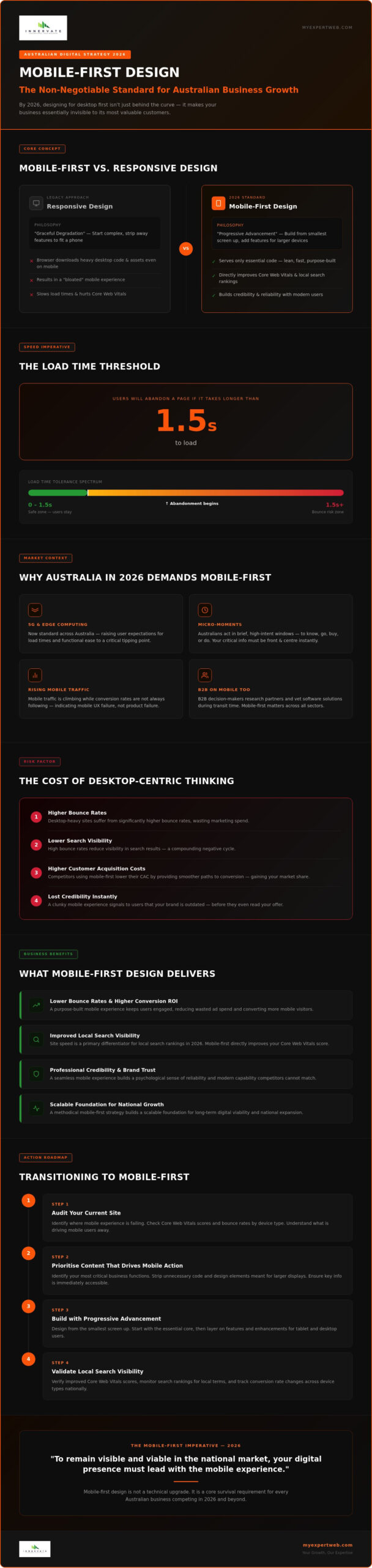
While the terms are often used interchangeably, responsive and mobile-first design represent two distinct philosophies. Responsive design adapts a desktop-centric layout to smaller screens through fluid grids, while mobile-first design builds the foundation for the smallest screen and scales up features for larger devices. Most legacy sites in Australia use responsive design, which often results in a “bloated” mobile experience. This happens because the browser still downloads the heavy code and high-resolution assets intended for a desktop, even if they’re hidden on a smartphone. Choosing a mobile-first approach ensures that your site is lean, fast, and purpose-built for the device your customers use most.
This shift in methodology involves moving from “graceful degradation” to “progressive advancement.” Instead of starting with a complex desktop site and stripping away features until it fits a phone, we start with the essential core. This technical distinction is a primary reason for the mobile-first design importance for Australian businesses aiming for peak efficiency in 2026. By prioritising the smallest screen, you ensure that your most critical business functions are never compromised by unnecessary code or design elements meant for a larger display.
Performance and Speed: The Mobile-First Advantage
By 2026, site speed is a primary differentiator for local search rankings. Mobile-first architecture reduces code weight by serving only what is essential for the mobile user, directly improving your Core Web Vitals. Modern users are notoriously impatient; many will abandon a page if it takes longer than 1.5 seconds to load. According to Australian mobile and internet usage statistics, households increasingly rely on smartphones for daily transactions. If you’re concerned about your current site’s performance, transitioning to a custom digital solution ensures your architecture is built for speed from the ground up.
User Experience (UX) Beyond Scaling
Effective mobile-first design considers how people actually hold their phones. We use thumb-zone heat mapping to place critical buttons within easy reach of a user’s thumb, which is a significant departure from desktop design. Touch-target sizing is also vital; buttons must be large enough to tap without accidental clicks. For the “distracted” mobile browser, navigation should be simplified to its most essential elements. This methodical focus on the handheld experience is why the mobile-first design importance for Australian businesses is so high. It transforms a frustrating browsing session into a seamless conversion path.
The Economic Impact: ROI of Mobile-First for Australian Brands
Investing in a mobile-first approach provides a measurable return on investment by aligning your digital assets with actual consumer behaviour. When a site is built specifically for the handheld experience, it naturally facilitate higher conversion rates because the path to purchase or enquiry is frictionless. This strategic alignment is a key driver of the mobile-first design importance for Australian businesses looking to maximise their marketing spend. By reducing the technical friction that leads to high bounce rates, brands can significantly increase session durations and ensure that every visitor has the opportunity to engage deeply with their content.
The financial benefits extend to operational efficiency as well. According to the latest Australian Bureau of Statistics data on household technology use, the reliance on mobile devices for complex tasks continues to grow across all demographics. A site that fails on mobile isn’t just a minor inconvenience; it’s a direct leak in your revenue stream. Transitioning to a single, scalable codebase also lowers long-term maintenance costs. Your team only needs to manage and update one version of the site, rather than maintaining multiple fragmented platforms for different devices.
Boosting Search Visibility Nationally
Search engines in 2026 have moved beyond simply rewarding “mobile-friendly” sites. They now prioritise architecture that leads with mobile performance, making it a foundational element for effective local SEO services across the country. When your site loads instantly and provides an intuitive handheld interface, Google recognises this as a high-quality user experience. This recognition boosts your organic rankings and improves the overall quality of your leads. Combining this design philosophy with integrated web development and SEO services ensures that your technical infrastructure and visibility goals work in perfect harmony.
Future-Proofing Your Digital Investment
A mobile-first foundation prepares your business for the next wave of hardware, including foldables, wearables, and augmented reality (AR) interfaces. Because these emerging technologies often rely on lean, component-based structures, a mobile-first site is inherently more adaptable to new formats. This methodical approach also provides a robust framework for secure web application development, ensuring that as you scale, your security protocols remain consistent across all devices. By focusing on a platform-agnostic digital presence, you protect your investment from becoming obsolete as the Australian tech landscape continues to evolve.
Transitioning to a Mobile-First Strategy
Moving from a legacy desktop-centric site to a modern mobile-first architecture requires a methodical approach. It begins with a comprehensive mobile-usability audit to identify where Australian users are currently experiencing friction. We examine heat maps, load times, and abandonment points to understand why visitors might be leaving. This process reinforces the mobile-first design importance for Australian businesses by highlighting exactly where revenue is being lost. Once the audit is complete, we select a tech stack that prioritises lightweight delivery and fast execution; this ensures your site remains performant even on congested mobile networks.
Prototyping and user testing are essential stages in this transition. We don’t just scale down; we re-evaluate every interaction. This involves creating low-fidelity wireframes that focus on the core utility of each page. By testing these prototypes with real users, we can refine the navigation and layout before any code is written. Acknowledging the mobile-first design importance for Australian businesses in 2026 means moving beyond generic templates to create truly bespoke solutions. This collaborative phase ensures the final product aligns perfectly with your business goals and your customers’ expectations.
Content Hierarchy and Visual Simplicity
Mobile screens offer limited real estate, which makes visual simplicity a strategic advantage. We eliminate unnecessary “fluff” and secondary information to focus on the primary conversion actions your users need. This involves:
- Designing for accessibility to meet current Australian compliance standards.
- Implementing clear, thumb-friendly Call-to-Actions (CTAs) that guide users toward a resolution.
- Prioritising text legibility and high-contrast elements for outdoor viewing.
Integrating Custom Functionality
As businesses grow, their digital needs often expand into custom business application development. Ensuring these complex tools translate to a mobile interface is a technical challenge that requires careful planning. We focus on managing secure data entry and streamlining complex workflows so they remain functional on smaller screens. This involves rigorous testing across the diverse Australian mobile device market to ensure consistency across various operating systems and screen sizes.
If you’re ready to modernise your digital presence, our team can help you audit your current mobile performance and build a roadmap for growth.
Why Partner with MyExpertWeb for Mobile-First Excellence
With over 12 years of experience in digital transformation, we’ve guided numerous brands through the shift from desktop dominance to the current mobile-essential era. We don’t just build websites; we create high-performance digital solutions that grow alongside your brand. Our methodical approach to both web and mobile app development company services ensures that every technical decision is rooted in business utility rather than just aesthetics. We’ve seen firsthand the mobile-first design importance for Australian businesses, and we use that insight to build platforms that are fast, secure, and intuitive.
Maintaining a competitive edge in 2026 requires more than a one-off project. It demands continuous optimisation and a deep understanding of evolving user habits. By providing a dedicated outsourcing development team, we offer our clients the ability to iterate quickly and maintain peak performance. This partnership model ensures that your digital assets remain secure and up to date with the latest Australian search requirements and security protocols. We handle the technical complexity so you can focus on running your business with total peace of mind.
A Strategic Partner, Not Just a Vendor
We view our relationship with every client as a long-term partnership. This means we act as a seamless extension of your own team, aligning our design and development strategies with your specific revenue goals. We specialise in bridging the gap between custom business applications and mobile-first web design, ensuring that even your most complex internal tools are accessible and functional on a smartphone. Our commitment to clean, scalable codebases means your platform won’t just work today; it’s built to support your national growth for years to come. We prioritise transparency and collaboration, ensuring you’re supported at every stage of your digital journey.
Ready to Lead the Australian Market?
The Australian market in 2026 doesn’t reward hesitation. To capture high-intent users and secure your place in local search results, acknowledging the mobile-first design importance for Australian businesses is the first step toward a successful overhaul. We customise our services to fit your unique operational needs, ensuring that your digital presence reflects the functional excellence of your brand. Starting the process is straightforward. We begin with a consultation to assess your current standing, identify technical bottlenecks, and map out a clear path for improvement. Let’s work together to build a digital foundation that supports your ambitions and drives measurable results across the country.
Securing Your Digital Future in the Australian Market
The shift toward handheld browsing has reached its peak. In 2026, the mobile-first design importance for Australian businesses lies in the ability to capture high-intent micro-moments before a competitor does. By prioritising speed, intuitive navigation, and lean architecture, you create a foundation that supports both local search visibility and long-term operational ease. Transitioning away from bloated legacy sites isn’t just a technical upgrade; it’s a strategic investment in your brand’s credibility and conversion potential. It’s about ensuring your business remains accessible wherever your customers are.
With over 12 years of industry experience and dedicated development teams, we provide a pragmatic, results-focused approach to digital transformation. We’re ready to act as a reliable extension of your team to ensure your platform is built for the modern era. Partner with MyExpertWeb for a mobile-first strategy that drives results and position your business for sustainable growth across the country. We look forward to helping you navigate these changes and build a presence that truly reflects your professional excellence.
Frequently Asked Questions
Is mobile-first design still important for B2B businesses in Australia?
Yes, mobile-first design is critical for B2B businesses because decision-makers often conduct initial research and vetting on mobile devices during transit or between meetings. If your professional services site is difficult to navigate on a smartphone, you risk being eliminated from consideration before a formal enquiry is even made. Providing a seamless handheld experience builds immediate trust and demonstrates that your firm is technologically capable and modern.
Will a mobile-first redesign hurt my existing desktop SEO rankings?
A mobile-first redesign typically improves your search visibility rather than hurting it because Google has used mobile-first indexing as its primary standard for years. By 2026, the mobile-first design importance for Australian businesses is tied directly to how search engines crawl and rank your entire digital presence. A faster, leaner mobile site often leads to better overall performance metrics, which can positively influence your rankings across all device types.
How long does it typically take to transition to a mobile-first site?
The timeline for transitioning to a mobile-first site depends on the complexity of your current infrastructure and custom functionality needs. A standard overhaul for a medium-sized Australian business typically takes between 8 and 16 weeks from the initial audit to the final launch. This period includes essential phases like user testing, prototyping, and ensuring that any custom business applications are fully integrated and performant on smaller screens.
What is the difference between a mobile-friendly site and a mobile-first site?
Mobile-friendly design usually involves taking a desktop site and scaling it down to fit a phone screen, which often results in slow load times and cluttered layouts. In contrast, mobile-first design starts with the smallest screen as the foundation and progressively adds features for larger devices. This approach ensures that the mobile experience is the most efficient and user-centric version of your site, rather than an afterthought or a compromised adaptation.
Does mobile-first design affect website security and data privacy?
Mobile-first design positively affects security because it encourages the use of clean, minimalist codebases that are easier to monitor and protect. When we build for mobile first, we prioritise essential data pathways and secure authentication methods that are robust enough for handheld use. This methodical approach reduces the attack surface of your site, making it a reliable foundation for secure web application development and protecting your customers’ privacy.
How do I know if my current site is truly mobile-optimised for 2026 standards?
You can evaluate your site against 2026 standards by reviewing your Core Web Vitals and testing the “thumb-zone” accessibility of your navigation. If your site takes longer than 1.5 seconds to load or requires users to pinch-and-zoom to read content, it doesn’t meet modern expectations. A truly optimised site should feel like a native app, with large touch targets and a content hierarchy that prioritises the most common user actions.
Can mobile-first design improve my Google Ads (PPC) performance?
Yes, mobile-first design can significantly enhance your PPC performance by improving the Quality Score of your landing pages. When your ads lead to a fast, highly relevant mobile site, search platforms reward you with lower costs per click and better ad placements. Recognising the mobile-first design importance for Australian businesses is essential for any brand running paid campaigns, as a poor mobile landing page will lead to high bounce rates and wasted marketing budget.
What are the accessibility requirements for mobile sites in Australia?
Australian businesses should aim to meet the Web Content Accessibility Guidelines (WCAG) 2.1 or 2.2 standards to ensure their sites are usable for everyone. This includes maintaining high colour contrast, providing alternative text for images, and ensuring that all interactive elements are easily clickable for users with varying levels of motor skill. Compliance isn’t just a legal consideration; it’s a practical way to ensure your site is accessible to the widest possible national audience.