


MyExpertWeb Team
July 27, 2026
Secure Web App Development: Strategic Guide for 2026
If you wait until your software is finished to think about security, you’ve already left the door unlocked for modern threats. It’s a common concern for business leaders who fear that a single data breach could dismantle years of brand trust. You might feel overwhelmed by technical jargon or uncertain about how to properly vet a partner for their security expertise. We understand these challenges; we believe that secure web application development should be a transparent, collaborative process rather than a source of anxiety.
We agree that your focus should be on growth, not on deciphering the complexities of NIST Cybersecurity Framework 2.0 or the latest OWASP standards. This guide provides a strategic roadmap to protect your business assets and user data by integrating security into every stage of the software lifecycle. You’ll learn how to implement secure coding practices and follow a clear framework for managing your next project. By the end, you’ll have the peace of mind that comes from knowing your application is built on a foundation of data safety and compliance.
Key Takeaways
- Understand why shifting to a security-by-design philosophy is essential for protecting your brand reputation and long-term viability in 2026.
- Learn the specific phases of a secure development life cycle, from identifying initial threats to architecting systems with least-privilege principles.
- Address the 2026 vulnerability landscape, including emerging AI-driven threats and the latest OWASP standards, to protect your digital environment.
- Discover practical methods for vetting development partners and setting clear security expectations to ensure secure web application development.
- Gain a practical framework for managing software projects that prioritize data safety, regulatory compliance, and consistent security patching.
What is Secure Web Application Development and Why It Matters in 2026?
Secure web application development isn’t a single tool or a final inspection before launch. It’s a comprehensive methodology where security is baked into the code, infrastructure, and workflows from day one. In 2026, the industry has moved past treating security as a modular feature you can simply “add on” once the application is functional. Instead, we follow The Secure Development Life Cycle (SDLC) to ensure that every architectural decision and line of code prioritizes protection. This holistic process requires a shift in mindset from reactive patching to proactive prevention.
This shift toward “Security by Design” is driven by an increasingly complex threat environment. Modern applications are deeply interconnected via dozens of APIs and third-party services, which creates a much wider attack surface than in previous years. When you prioritize security during the initial planning phase, you reduce the likelihood of expensive retrofits later. It’s a pragmatic approach that saves time and resources while ensuring your business remains resilient against automated vulnerability scanning and AI-powered phishing attacks. Security is no longer a technical luxury; it’s a foundational requirement for any digital asset.
The stakes for small to medium businesses are higher than ever. A single breach can dismantle years of brand equity in a matter of hours. Beyond the immediate loss of data, a security failure signals to your customers that their privacy isn’t your priority. Building long-term user trust requires more than just a great user interface. It requires a visible, consistent commitment to safeguarding the information they entrust to you. High-performing apps in 2026 are those that prove they can be both innovative and incredibly safe.
The Business Case for Prioritizing Security
For many organizations, the primary driver for security is the avoidance of legal penalties. Regulatory frameworks like the GDPR or the Australian Privacy Principles (APPs) carry heavy fines for non-compliance and data mismanagement. However, the business case extends beyond avoiding fines. You must also protect your intellectual property and proprietary business logic, which often represent the core value of your custom software. We also have to consider the financial impact of downtime. A system that is offline due to a cyber attack isn’t just a technical problem; it’s a period of zero revenue and stalled operational efficiency that can devastate your bottom line.
Security as a Competitive Advantage
Investing in a robust security posture does more than just mitigate risk. It opens doors to new opportunities. Enterprise-level clients often require detailed security audits and specific certifications before they’ll even consider a partnership. By demonstrating a mature approach to secure web application development, you position your business as a reliable, strategic ally. This transparency builds deep customer confidence and sets you apart from competitors who may be cutting corners. If you’re looking for more context on how these elements fit into a broader project, you might find the strategic guide to custom business application development in 2026 helpful for aligning your security goals with your overall growth strategy.
The Secure Development Life Cycle (SDLC): A Step-by-Step Approach
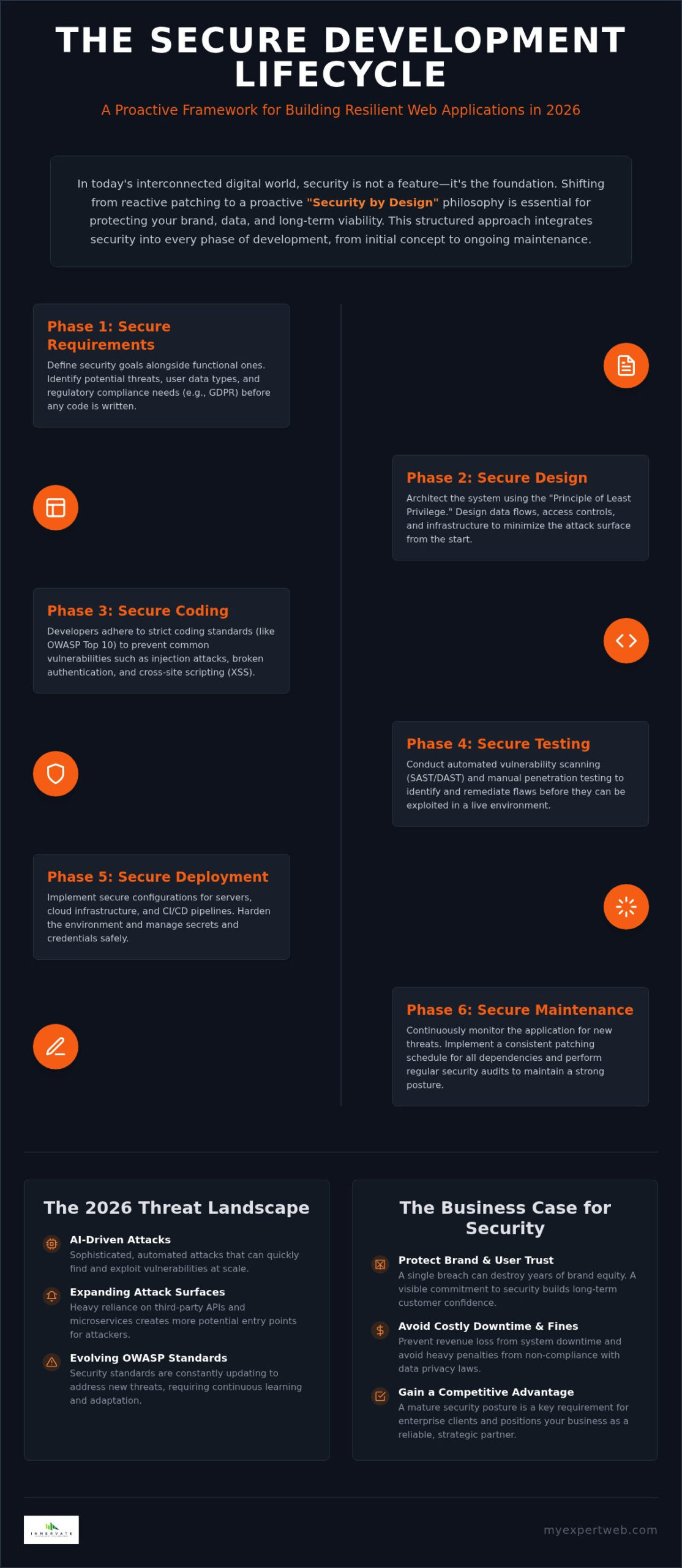
Implementing secure web application development requires a disciplined, multi-phase approach known as the Secure Development Life Cycle (SDLC). This is not just a complex academic theory; it’s a practical roadmap that ensures security is never forgotten during the rush to launch. By following a methodical sequence, we can build applications that are resilient by default. This structured approach allows us to address risks at every turn, from the first whiteboard session to the final deployment and beyond.
- Phase 1: Secure Requirements. We begin by defining security goals alongside functional ones. This involves identifying potential threats and compliance needs before a single line of code is written.
- Phase 2: Secure Design. Here, we architect the system using the principle of least privilege. This ensures that users and processes only have the specific access they need to perform their tasks.
- Phase 3: Secure Coding. Developers adhere to strict standards to mitigate risks within the 2026 Vulnerability Landscape. This prevents common errors like SQL injection or cross-site scripting.
- Phase 4: Security Testing. We employ a mix of automated tools for speed and manual penetration testing for depth. This dual approach uncovers vulnerabilities that software alone might miss.
- Phase 5: Maintenance. True security is a long-term commitment. We provide ongoing monitoring and regular patching to defend against new exploits as they emerge.
Shifting Left: Integrating Security Early
The “Shift Left” philosophy is a cornerstone of modern development. By integrating security checks into the earliest stages of a project, we can identify and resolve issues when they are easiest to fix. Industry data suggests that finding a bug during the requirement phase is often 10x cheaper than fixing it after deployment. Threat modeling allows our team to anticipate hacker behavior, while automated scans in the CI/CD pipeline provide immediate feedback to developers. This methodical preparation is exactly how we approach secure web application development to ensure our clients are protected from the start. It is a core part of our custom software development process that prioritizes stability and safety.
Continuous Monitoring and Post-Launch Defense
Security doesn’t end at deployment. In fact, the work of defending your application is just beginning once it goes live. Regular dependency updates are vital, as vulnerabilities in third-party libraries are discovered daily. We also help you establish an incident response plan. This ensures that if a threat is detected, your team knows exactly how to mitigate the risk quickly and effectively. Consistency in monitoring and patching is the only way to maintain a truly secure environment over time.
Modern Threats and the 2026 Vulnerability Landscape
The 2026 digital landscape is defined by a paradox: while our defensive tools are more advanced, the threats have become equally intelligent. Relying on outdated security models is a risk no business can afford. We’ve moved into an era where secure web application development must account for autonomous systems and highly distributed architectures. The OWASP Top 10 continues to be an essential guide, but the 2026 updates now include specific risks for AI Agents and Smart Contracts. These new categories highlight how the attack surface has expanded beyond traditional web forms into the very logic of our automated systems.
One of the most critical shifts involves API security. APIs are no longer just “connectors”; they are the primary entry points for modern applications. If these interfaces aren’t properly authenticated and rate-limited, they become easy targets for data scraping and unauthorized access. Likewise, software supply chain hygiene is paramount. Your application is only as safe as the third-party libraries it uses. We prioritize pinning dependencies and scanning for vulnerabilities in every external component to ensure that a flaw in a minor library doesn’t lead to a major breach. It’s about maintaining visibility over every piece of code that touches your data.
In 2026, web application security is no longer confined to the application code itself. It is embedded within the broader architecture, spanning development, deployment, runtime, and AI services. This requires a shift toward Zero-Trust principles, where every request is authenticated, authorized, and rate-limited by default. By acknowledging these modern complexities, we can build more resilient systems that protect your business interests and your users’ privacy. A cohesive approach to integrated web development and SEO services ensures that performance, discoverability, and security are all engineered together from the ground up rather than treated as separate concerns. For businesses that also want to capture high-intent customers in specific markets, pairing a secure application with effective local SEO services ensures your digital presence is both protected and visible to the right audiences.
Defending Against Classic Vulnerabilities
Even with new threats, classic vulnerabilities like SQL Injection and Cross-Site Scripting (XSS) remain prevalent. We prevent SQL Injection by using prepared statements and parameterization, which separates data from the command logic. To mitigate XSS, we implement strict output encoding to ensure that malicious scripts can’t be executed in a user’s browser. Broken access control represents a significant risk because it allows users to perform actions or access data outside of their intended permissions. Maintaining a rigid authorization framework is the only way to prevent this type of exposure and ensure data integrity.
The Rise of Sophisticated Bot Attacks
The hackers of 2026 are no longer just individuals; they are often machine-learning models programmed to find weaknesses. These automated bots can bypass standard firewalls by mimicking human browsing patterns with eerie accuracy. To counter this, we implement intelligent rate limiting and advanced CAPTCHA solutions that can distinguish between a human user and a sophisticated script. Multi-Factor Authentication (MFA) is also a standard requirement across all user tiers. It’s a simple yet highly effective layer of defense that remains one of the best ways to protect your business from credential theft and unauthorized entry.
How to Manage and Vet a Secure Development Team
Selecting a partner for secure web application development is a strategic decision that requires more than a simple review of technical skills. You need a collaborator who treats security as a core cultural value rather than a checklist item. This alignment begins with your Service Level Agreement (SLA). A professional contract should clearly define security expectations; this includes mandatory vulnerability scanning frequencies and specific timelines for deploying critical security patches. Without these benchmarks, security can easily be sidelined when project deadlines loom.
Transparency is another non-negotiable component of a successful partnership. A mature development team provides comprehensive documentation and clear audit trails for every code change. This level of accountability ensures that if a vulnerability is discovered, your team can trace its origin and implement a fix quickly. It’s about building a system of mutual trust where data safety is a shared responsibility between you and your developers. You shouldn’t have to guess how your data is being handled; your partner should be eager to show you.
Vetting Your Software Partner
When you’re vetting a potential software partner, start by asking for their documented secure development policy. A reliable agency should be able to explain how they handle data encryption at rest and in transit using plain, accessible language. Requesting case studies that highlight security-first implementations is also a great way to gauge their expertise. These examples should demonstrate how they’ve protected other clients from real-world threats. If a provider cannot provide a clear methodology for protecting your intellectual property, they likely aren’t the right fit for a high-stakes project.
The Role of Dedicated Offshore Teams
Managing a outsourcing development team provides unique advantages for long-term security. Unlike freelancers who often move between disjointed projects, a dedicated team acts as a consistent extension of your internal staff. This continuity is essential for maintaining a secure codebase over several years. A dedicated development team philippines can develop a deep understanding of your specific architecture, making them much more effective at identifying potential risks before they become problems. They also maintain consistent communication protocols that align with your business’s security best practices. By fostering this kind of long-term partnership, you ensure that the people writing your code are the same people responsible for its long-term integrity and safety.
Partnering with MyExpertWeb for Secure Custom Solutions
With over 12 years of industry experience, MyExpertWeb has established a proven track record in delivering high-stakes business applications that stand the test of time. We recognize that secure web application development is the cornerstone of any successful digital transformation. Our approach isn’t about imposing rigid, generic protocols. Instead, we work as a reliable strategic partner to understand your unique business logic and specific risk profile. We integrate security into every stage of our custom software development process, ensuring that protection is a standard deliverable rather than an expensive afterthought.
Our dedicated development team in the Philippines offers a distinct advantage for businesses looking for long-term stability and cost-efficiency. While many providers rely on rotating freelancers, our model emphasizes consistency and deep architectural knowledge. This continuity allows us to maintain rigorous security oversight and provide timely vulnerability monitoring long after the initial launch. We’re committed to writing clean, maintainable code that adheres to the latest global standards, ensuring your application remains mobile-friendly and secure across all devices and platforms.
Our Methodical Approach to Protection
We believe in providing pragmatic solutions that solve real business problems without adding unnecessary complexity. Our team acts as a methodical guide, helping you navigate the technical nuances of modern cybersecurity with quiet confidence. Whether you’re building a complex enterprise tool or a customer-facing portal, we ensure the design is both functional and resilient. Security principles that apply to full-scale applications are equally critical when it comes to landing page development, where performance vulnerabilities and insecure third-party plugins can undermine your conversion goals just as easily as they can compromise a larger system. If you’re currently evaluating potential partners for a new project, we recommend reviewing our insights on choosing a mobile app development company. This resource can help you align your security requirements with your broader development goals.
Building Your Secure Future Together
Every project begins with an honest, supportive conversation about your specific security needs and business objectives. We offer a consultation to discuss your project’s requirements and identify potential areas of risk before they impact your timeline. From there, we develop a customized roadmap that prioritizes both high-end functionality and data safety. Our goal is to provide you with the peace of mind that comes from a secure, scalable, and professionally managed application. If you’re ready to start building a digital asset that protects your brand and your users, we’re here to lead the way. Reach out to our team to learn how our expertise in secure web application development can support your long-term growth and operational ease.
Securing Your Business Growth for the Long Term
Building a resilient digital presence in 2026 requires moving beyond reactive fixes. We’ve explored how a structured Secure Development Life Cycle and a “Security by Design” mindset protect your brand from evolving threats like AI-driven attacks and API vulnerabilities. By prioritizing transparency in your partnerships and setting clear expectations in your SLAs, you can manage technical complexity without the usual anxiety. The landscape of secure web application development is complex, but it doesn’t have to be overwhelming when you have the right framework and a methodical guide in place.
With over 12 years of secure software expertise and dedicated offshore teams in the Philippines for continuous maintenance, we’re ready to help you build with confidence. We focus on a pragmatic, partner-focused approach that aligns with your specific business goals and operational needs. Our team acts as a steady ally to ensure your code remains clean, mobile-friendly, and resilient against future vulnerabilities. Let’s turn your security requirements into a powerful competitive advantage that builds lasting trust with your users. Contact MyExpertWeb for a Free Secure Development Consultation and take the first step toward a safer digital future.
Frequently Asked Questions
What is the most common security threat to web applications in 2026?
Broken access control remains the most prevalent risk according to current industry standards. However, the rise of AI-powered automated vulnerability scanning has fundamentally changed the frequency of attacks. These bots can identify misconfigurations in minutes. Protecting your application requires a combination of strict authorization frameworks and intelligent firewalls that can distinguish between human users and sophisticated machine learning models designed to exploit code.
How much does it cost to add security to web application development?
Integrating security from the start typically adds a modest percentage to the initial development timeline but saves significant costs over the software’s lifespan. Shifting security to the requirements phase prevents expensive architectural retrofits after the app is live. While the upfront investment is higher than building without protection, it acts as essential insurance against the devastating financial impact of a data breach or prolonged system downtime.
Is it safe to outsource secure web development to the Philippines?
Outsourcing to the Philippines is a highly secure option when you partner with an established agency using a dedicated team model. Unlike fragmented freelance work, a dedicated team provides consistent oversight and deep familiarity with your codebase. Our 12 years of experience managing offshore teams ensures that communication protocols and security standards align perfectly with your business requirements and global safety benchmarks.
What is the difference between a security audit and a penetration test?
A security audit is a systematic review of your policies, controls, and configurations to ensure they meet specific standards or compliance requirements. In contrast, a penetration test is a simulated attack where experts attempt to exploit vulnerabilities just as a hacker would. Both are essential for secure web application development, as the audit confirms your defensive plan while the pen test verifies its real-world effectiveness.
Does my small business really need enterprise-grade web security?
Small businesses absolutely require high-level security because automated bot attacks don’t discriminate based on company size. In fact, smaller organizations are often targeted specifically because hackers assume they have weaker defenses. Implementing enterprise-grade practices ensures you protect your customer data and maintain the professional reputation required to compete with larger entities. Security is a foundational requirement for any business that handles sensitive user information.
How often should I update the security of my web application?
Security should be an ongoing process rather than a scheduled event. We recommend continuous monitoring for immediate threats and monthly patching for all third-party libraries and dependencies. Additionally, performing a comprehensive security review at least once a year or after any major feature update ensures your application remains resilient against the latest exploits. Regular updates are the only way to stay ahead of rapidly evolving digital threats.
Can AI help in making web application development more secure?
AI is a powerful tool for secure web application development when used for automated code reviews and real-time threat detection. It can scan thousands of lines of code for patterns that indicate vulnerabilities much faster than a human developer. However, AI should always be paired with expert manual oversight to ensure that the context of your specific business logic is fully understood and protected from logic-based exploits.
What are the legal requirements for web application security in Australia?
Australian businesses must comply with the Privacy Act 1988 and the Australian Privacy Principles (APPs), which mandate the protection of personal information. You are also legally required to follow the Notifiable Data Breaches (NDB) scheme. This requires notifying individuals and the OAIC if a breach occurs that is likely to cause serious harm. Maintaining robust security helps you meet these legal obligations and avoid heavy regulatory penalties.