


MyExpertWeb Team
September 20, 2026
Improving Website User Experience to Increase Conversions: The 2026 Strategic Guide
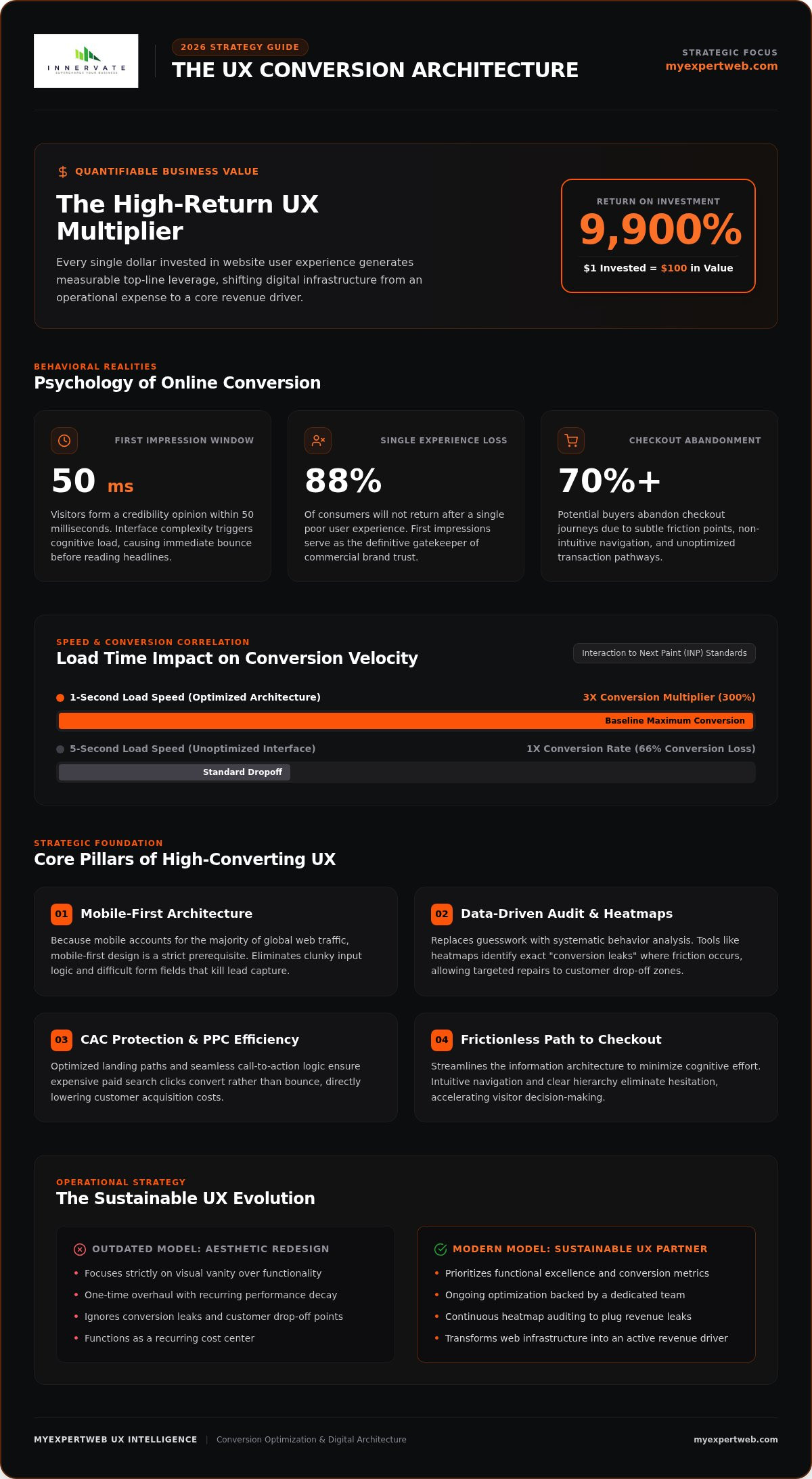
Did you know that every dollar you invest in your website’s user experience can return up to $100 in value? This 9,900% ROI highlights why improving website user experience to increase conversions is the most effective way to protect your marketing spend. You likely already understand the frustration of watching high bounce rates eat into your budget or seeing potential customers abandon their carts at a rate of 70% or higher. It’s discouraging when expensive PPC traffic fails to convert because of subtle friction points that create confusion rather than clarity.
We’re here to help you move past technical jargon and inconsistent results. This 2026 strategic guide provides a clear roadmap for UX improvements, from meeting the latest Interaction to Next Paint (INP) standards to creating accessible, frictionless checkout paths. We’ll examine how a methodical approach to design lowers your customer acquisition costs and builds professional authority. By the end of this article, you’ll know exactly how to transform your digital presence into a high-performing engine that supports your long-term business goals.
Key Takeaways
- Learn why prioritizing functional excellence over simple aesthetics creates a digital ecosystem that consistently meets your business goals.
- Discover how to use data-driven tools like heatmaps to identify and repair the specific “conversion leaks” that are currently costing you revenue.
- Establish a methodical roadmap for improving website user experience to increase conversions by aligning your site’s technical performance with modern user expectations.
- Understand the benefits of moving from a one-time redesign to a sustainable, ongoing strategy supported by a dedicated development team.
- Gain insights into how mobile-first architecture and optimized call-to-action placement can lower your customer acquisition costs.
The Direct Link Between User Experience and Conversion ROI in 2026
User experience (UX) represents the totality of a person’s interaction with your brand’s digital ecosystem. It isn’t just about the color of a button or the layout of a menu; it’s the invisible thread that connects a user’s initial interest to a final purchase. In 2026, many businesses face a “Conversion Gap” where high traffic volumes fail to translate into meaningful revenue. This happens when marketing teams focus solely on acquisition while ignoring the friction points that drive visitors away. By prioritizing improving website user experience to increase conversions, you shift your website from a passive brochure to an active revenue driver.
In a crowded digital marketplace, functional excellence is the primary differentiator. While competitors might rely on loud marketing tactics, a methodical approach to UX builds a foundation of trust. It moves the conversation away from visual vanity and toward business utility. When your site works exactly how a user expects it to, you remove the barriers that prevent them from saying “yes.” This transformation turns your digital presence into a long-term revenue driver rather than a recurring cost center.
Understanding the Psychology of Online Conversion
Digital users in 2026 operate with unprecedented speed and skepticism. Research shows that visitors form a credibility opinion within just 50 milliseconds. If your site feels sluggish or confusing, they’ll leave before they even read your headline. This immediate abandonment is often a psychological response to “cognitive load,” where a complex interface forces the brain to work too hard. Successful brands establish authority through functional excellence, ensuring that every interaction feels intuitive. Because 88% of consumers won’t return after a single poor experience, your first impression is often your only chance to build trust.
Measuring UX Success Through Business Metrics
To treat UX as a strategic asset, we must look beyond vanity metrics like “time on page.” True success is measured through goal completion rates and the efficiency of your marketing spend. When you apply established conversion rate optimization (CRO) principles, you’re essentially auditing the user journey for efficiency. This has a direct impact on your bottom line. For instance, a site that loads in one second converts at triple the rate of a site that takes five seconds.
Refining your site’s usability also protects your PPC budget. If you’re paying for clicks that land on a confusing page, you’re wasting capital. Professional UX lowers your customer acquisition costs (CAC) by ensuring more visitors complete their journey. When viewed through this lens, improving website user experience to increase conversions is a methodical investment that generates long-term viability. Every dollar spent on UX isn’t just an expense; it’s a way to ensure your marketing efforts actually pay off.
Core Pillars of High-Converting UX: Beyond Visual Design
While a visually appealing site might capture attention, it’s functional excellence that retains it. In 2026, the focus has shifted from “making it pretty” to ensuring every element serves a specific purpose. High-performing websites prioritize speed and performance as the primary foundation of user trust. If your site’s architecture is sluggish, users will perceive your brand as outdated or unreliable. According to Nielsen Norman Group’s analysis on conversion rates, even minor improvements in usability can lead to significant gains in ROI. By improving website user experience to increase conversions, you’re investing in a secure, scalable platform that supports the user’s journey from discovery to checkout.
Mobile-First Design and Responsive Logic
Mobile devices account for the majority of global web traffic, making mobile-first architecture a non-negotiable requirement for search visibility. A clunky mobile interface doesn’t just frustrate users; it actively hinders lead generation by making forms difficult to complete or buttons impossible to tap. If your mobile experience feels like an afterthought, you’re likely losing a significant portion of your audience. For those looking to refine their approach, our guide on choosing a mobile app development company offers deeper insights into building high-performance mobile environments.
Cognitive Load and Information Architecture
The best websites guide users with minimal effort. This involves simplifying your navigation and adhering to the “Three-Click Rule,” which suggests that a user should never be more than three clicks away from the information they need. When you structure content to answer common questions before they arise, you reduce the mental energy required to browse. This methodical approach to information architecture ensures that improving website user experience to increase conversions remains a logical, data-driven process. It’s about creating a steady flow that removes hesitation.
Trust Signals and Security as UX Elements
Security is often overlooked as a UX element, but it’s essential for user confidence. Visible trust signals, such as SSL certificates and secure payment forms, reassure visitors that their data is protected. When a user feels safe, they’re more likely to engage with your brand. Professional aesthetics and social proof also play a role, but the technical backend must be equally robust. You can explore modern standards in our secure web app development guide to see how technical integrity bolsters user trust. If you’re ready to enhance your digital presence, a strategic partnership can help you implement these pillars effectively.
Identifying Conversion Leaks: How to Audit Your Website Experience
Auditing is the essential first step toward improving website user experience to increase conversions. It requires more than just a cursory glance at your homepage; you need a structured framework to see exactly where users are hitting walls. While many competitors rely solely on automated AI tools to find “leaks,” a methodical human-led audit provides the strategic context those tools miss. By utilizing heatmaps and session recordings, you can observe where people click, how far they scroll, and where they hesitate. These visual insights reveal the “why” behind the numbers, showing you the specific frustrations that lead to site abandonment.
Quantitative data from Google Analytics and Search Console provides the necessary “what,” but it’s only half the story. To truly understand the user journey, you should conduct user testing with real-world scenarios. Observing a person attempt to complete a specific task allows you to find friction points that data alone might overlook. We recommend following the Digital.gov usability testing guidelines to ensure your audit remains focused on task completion and ease of use. This balanced approach ensures your improvements are based on actual user behavior rather than guesswork.
Analysing the Conversion Funnel
Your conversion funnel is the path from a visitor’s first click to their final confirmation. By identifying the specific pages where users drop off, you can pinpoint where your messaging or technical layout is failing. It’s helpful to compare landing page performance across different traffic sources to see if your PPC visitors are bouncing faster than your organic audience. A conversion leak is a specific point where user intent meets technical friction. These leaks often occur on complex lead forms or during the checkout sequence where unnecessary fields create mental fatigue and drive potential customers away.
Technical Performance Audits
Technical stability serves as the backbone of a professional user experience. A deep-dive audit must include a thorough check of Core Web Vitals, specifically Largest Contentful Paint (LCP) and Interaction to Next Paint (INP). Broken links, slow-loading assets, and mobile-specific errors act as silent killers for your conversion rate. While some issues are easy to fix, others require a dedicated development team to investigate the underlying code. A methodical technical audit ensures that your site remains a stable, high-performing engine for improving website user experience to increase conversions, protecting your marketing investment for the long term.
Strategic UX Improvements to Drive Immediate Results
Once you’ve identified where users are dropping off, the next step is prioritizing fixes based on potential ROI and ease of implementation. You don’t need to overhaul your entire site at once. Instead, focus on high-impact areas like your primary checkout flow or lead generation forms. By improving website user experience to increase conversions in these specific zones, you can see measurable gains in revenue without waiting months for a full redesign. Effective optimization often involves refining your Call-to-Action (CTA) placement and ensuring the messaging aligns perfectly with the user’s intent at that exact moment.
It’s also essential that your frontend UX aligns with your backend logic. For many organizations, this means integrating your site with custom business application development to ensure data integrity. When your website and your internal business software work in harmony, you eliminate the manual data entry errors that often occur when disparate systems try to communicate. This methodical alignment between design and technical logic is what separates a standard website from a high-performing conversion engine.
Optimising High-Value Landing Pages
A high-converting landing page in 2026 balances persuasive copy with clean, professional aesthetics. You should avoid cluttering the page with too many competing elements; every pixel must serve the primary goal. We’ve found that using subtle “Micro-Interactions,” such as progress indicators on longer forms or hover states that provide instant feedback, keeps users engaged without causing distraction. These small touches build a sense of momentum, guiding the visitor toward the final conversion point with quiet confidence.
Streamlining the User Journey
Every unnecessary step in your path to purchase is an opportunity for a customer to leave. You can streamline this journey by implementing “Smart Forms” that utilize autocomplete and conditional logic to reduce manual entry. This is where improving website user experience to increase conversions meets technical innovation. Custom software can automate backend processes, such as instantly verifying addresses or checking inventory, which improves the frontend experience by providing real-time information. If you’re ready to refine your digital journey, our custom software development team can help you build the automated systems needed to support a frictionless user experience.
Building a Sustainable UX Strategy with a Strategic Partner
Effective UX optimization is a continuous cycle of refinement rather than a one-time project. As user behaviors shift and new technical standards emerge, your digital presence must adapt to maintain its edge. Markets aren’t static; therefore, your approach to improving website user experience to increase conversions shouldn’t be either. By moving away from a “fix and forget” mentality, you can transition from merely solving existing problems to actively innovating for growth. This sustainable mindset ensures your website remains a high-performing asset that evolves alongside your business goals.
A significant advantage comes from an integrated web development and SEO services approach. When your UX strategy and search visibility efforts are handled by the same methodical partner, you eliminate the silos that often lead to conflicting technical priorities. For instance, a design change meant to improve engagement shouldn’t inadvertently hurt your search rankings. A dedicated development team can provide the ongoing maintenance and testing required to keep these elements in perfect balance, protecting your long-term viability in a competitive digital landscape.
The Role of Continuous A/B Testing
Data-driven decisions consistently outperform “gut feelings” in modern design. Continuous A/B testing allows you to make iterative improvements based on real-time user behavior rather than assumptions. By testing different headlines, button placements, or layout structures, you can find the exact combinations that resonate with your specific audience. We help you set up a testing framework that operates seamlessly in the background, ensuring that these experiments don’t disrupt your daily operations. This methodical testing ensures that every update contributes directly to improving website user experience to increase conversions.
Choosing the Right UX and Development Partner
Selecting a partner requires looking beyond simple technical skills. You need a team that demonstrates transparency, deep technical expertise, and genuine business empathy. With over 12 years of experience in global markets, we’ve seen how complex digital challenges require a steady, results-focused ally rather than a generic vendor. A reliable strategic partner acts as an extension of your own team, valuing functional excellence and professional aesthetics in equal measure. This collaborative approach ensures that your website isn’t just a technical tool but a reflection of your professional authority. If you’re ready to see how your site measures up against 2026 standards, you can contact MyExpertWeb to audit your website’s conversion potential.
Future-Proofing Your Digital Conversion Strategy
Transforming your website into a high-performing conversion engine is a journey that requires both technical precision and strategic empathy. By systematically improving website user experience to increase conversions, you’re doing more than just updating a layout; you’re building a foundation for sustainable growth. We’ve seen that the most successful digital presences are those that treat functional excellence as a core business priority, ensuring that every user interaction feels intuitive and secure. Whether you’re refining mobile navigation or automating backend processes, the goal remains the same: removing the friction that stands between your visitor and their next step.
Success in 2026 relies on a methodical partnership that balances design with operational utility. With over 12 years of experience, our dedicated development teams specialize in the seamless integration of custom software and SEO to protect your marketing investment. Your growth starts with clarity. We invite you to Partner with MyExpertWeb for a Strategic UX Audit to identify your specific opportunities. Moving from identifying leaks to implementing innovation is the key to long-term viability. We look forward to helping you build a digital presence that reflects your professional authority and drives consistent results.
Frequently Asked Questions
What is the difference between UI and UX for conversions?
UI covers the visual elements like buttons and color schemes, while UX encompasses the entire journey a visitor takes. Think of UI as the driver’s seat and UX as the experience of driving the car. In the context of improving website user experience to increase conversions, UX focuses on reducing the mental effort required to complete a purchase. A beautiful UI might look professional, but without a methodical UX strategy, users may still struggle to find the checkout button.
How long does it take to see results from UX improvements?
You can often see immediate improvements in technical metrics like page load speed or bounce rates after implementing fixes. However, behavioral changes and conversion rate increases typically require four to twelve weeks of data collection to confirm statistical significance. This timeframe allows you to account for weekly traffic fluctuations and different user segments. A methodical approach ensures that you’re measuring genuine growth rather than temporary spikes caused by external marketing campaigns or seasonal trends.
Will changing my website UX affect my current SEO rankings?
Improving your website’s usability generally has a positive impact on your search visibility. Google’s algorithms heavily weight Core Web Vitals, such as loading speed and visual stability, as ranking signals. When you focus on improving website user experience to increase conversions, you naturally enhance engagement metrics like time on site and pages per session. These signals tell search engines that your content is valuable and easy to navigate, which often leads to higher rankings over time.
How do I know if my website has a poor user experience?
High bounce rates on key landing pages and a significant gap between traffic and conversions are clear indicators of a poor experience. You can also look for “rage clicks” in session recordings, where users click the same element repeatedly out of frustration. If your mobile visitors leave at a much higher rate than desktop users, your mobile-first architecture likely needs refinement. A professional audit can help you distinguish between a traffic quality issue and a genuine technical friction point.
What are the most common UX mistakes that kill conversions?
Several common errors can stall your conversion engine:
- Slow page load times that cause visitors to abandon the site within seconds.
- Complex lead forms with too many mandatory fields that create cognitive load.
- Cluttered layouts that hide your primary Call-to-Action (CTA) among too many competing elements.
- Non-responsive designs that make buttons difficult to tap on mobile devices.
Each of these mistakes creates a barrier that prevents a user from completing their intended action.
Can UX improvements help lower my Google Ads costs?
Improving your landing page experience directly impacts your Google Ads Quality Score. When your website is easy to navigate and highly relevant to the user’s search query, Google rewards you with a higher score. This can lead to a lower Cost-Per-Click (CPC) and better ad positioning. By ensuring your PPC traffic lands on a high-performing page, you maximize the value of every dollar spent on paid acquisition while reducing wasted marketing capital.
Do I need a full redesign to improve my website UX?
You don’t necessarily need a complete overhaul to see significant results. Many businesses find success through iterative improvements, such as streamlining a checkout process or optimizing a single landing page. This methodical approach allows you to test specific changes and measure their impact before committing to a larger project. However, if your current site’s architecture is fundamentally broken or outdated, a more comprehensive redesign might be the most cost-effective way to support long-term business growth.
How often should I perform a UX audit on my business website?
We recommend conducting a comprehensive UX audit at least twice a year to keep up with evolving user expectations and technical standards. Digital environments change rapidly, and what worked twelve months ago might now be considered a friction point. With more than 12 years of experience, we’ve found that regular audits help you identify new conversion leaks and ensure your site remains compliant with the latest accessibility regulations. This ongoing maintenance is essential for building a sustainable digital presence.