


MyExpertWeb Team
July 26, 2026
Choosing a Mobile App Development Company: 2026 Guide
What if the biggest risk to your digital transformation isn’t a failed launch, but a successful app built on a foundation of technical debt and security gaps? Many Australian business leaders recognize that a mobile presence is essential, yet they often struggle with the fear of hidden costs and a lack of transparent communication during the build. Selecting the right mobile app development company is no longer just about finding someone to write code; it’s about securing a strategic partner who understands your long-term vision and the strict 2026 privacy regulations.
We understand that you need more than just a vendor; you need a methodical guide to help you manage the complexities of modern software. This guide will show you how to identify a development partner that aligns with your business goals, ensures your data remains secure, and delivers a high-ROI digital product. You’ll learn what to look for in a transparent development process and how to ensure your app is both scalable and resilient in an evolving market. We’ll examine how a collaborative approach can turn a simple project into a long-term strategic asset for your company.
Key Takeaways
- Understand why a modern mobile app development company should act as a strategic consultant rather than just a coding vendor to ensure your digital product aligns with long-term business objectives.
- Learn how to choose between Native, Cross-Platform, and PWA frameworks to balance performance, development speed, and cost-efficiency for the Australian market.
- Identify the critical communication protocols and project management standards that differentiate a reliable strategic partner from a high-risk provider.
- Explore the essential stages of the development lifecycle, from initial product discovery to UI/UX design, ensuring every feature serves a clear user need.
- Determine whether a project-based fee or a dedicated development team model best suits your internal capacity and scaling requirements for 2026.
What is a Mobile App Development Company in 2026?
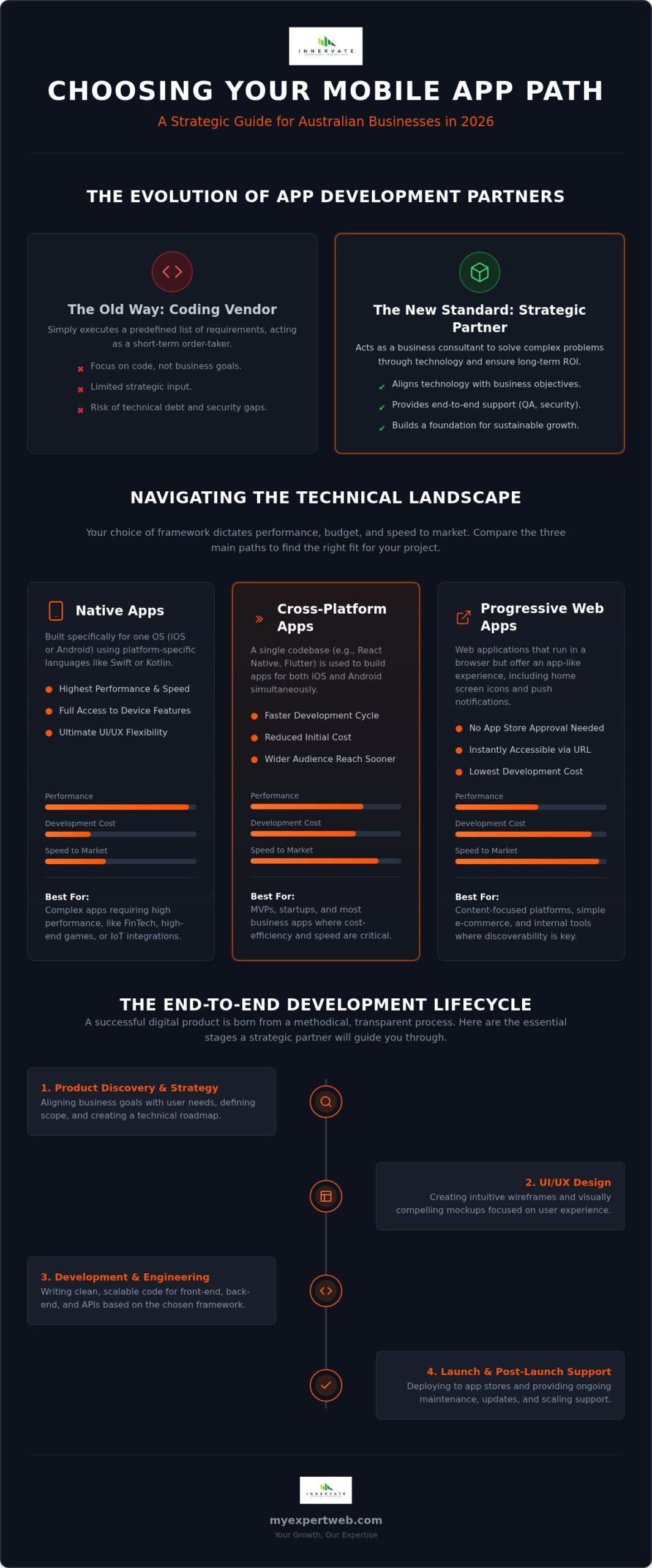
The role of a mobile app development company has undergone a significant transformation. In years past, businesses often approached developers with a finished list of requirements and expected a functional piece of software in return. Today, a professional agency acts as a strategic business consultant rather than a simple vendor. This shift reflects a move from basic “coding shops” to end-to-end digital transformation agencies that prioritize your business objectives and long-term operational efficiency. They don’t just build tools; they solve complex business problems through technology.
Choosing a full-service partner over a freelance developer provides a level of stability and comprehensive support that individual contractors often cannot match. While a freelancer might excel at a specific task, a company offers collective expertise that includes project management, quality assurance, and high-level cyber security. This holistic approach ensures that the mobile app development process aligns perfectly with your broader technical infrastructure. By positioning themselves as an extension of your internal team, these partners help you avoid technical debt and build a foundation for sustainable growth in the Australian market.
The Evolution of Mobile First Strategy
Australian businesses are rapidly moving away from desktop-only workflows as users demand information and services on the go. Mobile accessibility is no longer just a convenience; it’s a primary driver for customer retention and lead generation in a competitive environment. If your internal processes or customer-facing tools aren’t optimized for handheld devices, you risk losing visibility and engagement. In 2026, mobile-first design is a business-critical requirement that ensures your digital presence is functional, accessible, and high-performing on the devices your audience uses most.
Custom Solutions vs. Template-Based Apps
While “no-code” platforms and template builders might seem like a cost-effective entry point, they often present significant limitations for scaling businesses. These tools typically restrict your ability to implement unique business logic or handle proprietary data securely. A custom-built architecture allows for a tailored solution that fits your specific operational needs without the constraints of a pre-set framework. This flexibility is essential for companies that need to integrate their app with existing legacy systems or specialized databases.
Investing in custom software also offers the long-term benefit of owning your source code. This ownership eliminates ongoing licensing fees associated with some proprietary platforms and gives you the freedom to adapt your app as your business evolves. By choosing a custom path with a dedicated mobile app development company, you ensure that your digital investment remains a valuable asset that you control entirely, rather than a rented service that could be altered or discontinued without your input.
Navigating the Technical Landscape: Native, Hybrid, and PWA
Selecting the right technical framework is one of the most critical decisions you’ll make alongside your chosen mobile app development company. This choice isn’t just a technical detail; it’s a strategic move that dictates your initial budget, your speed to market, and your ability to scale. While every project has unique requirements, the decision usually boils down to three main paths: native, cross-platform, or progressive web apps. Each path offers distinct advantages depending on whether you prioritize raw performance, cost-efficiency, or ease of access.
Your choice of tech stack directly influences the long-term viability of your digital product. For instance, a complex fintech application requiring biometric security and intense data processing will demand a different foundation than a simple retail loyalty app. Understanding where these choices fit within the broader mobile app development life cycle helps you prepare for the rigorous testing and maintenance phases that follow a launch. If you’re unsure which path fits your specific goals, consulting with an experienced mobile app development partner can clarify the trade-offs before you commit to a build.
Behind every smooth interface lies a robust back-end infrastructure. Without secure APIs and scalable server logic, even the most beautiful native app will fail under load. A reliable mobile app development company will prioritize this invisible architecture just as much as the visible design. They ensure your data remains protected and your app stays responsive, even as your user base grows across Australia and beyond.
Native Development for High Performance
When your project requires maximum hardware access, native development remains the gold standard. By using Swift for iOS or Kotlin for Android, developers can tap into the full potential of a device’s processor and sensors. This is essential for high-computation environments or apps that rely heavily on complex animations and high-security features. Native components also provide a familiar user experience (UX), as they adhere strictly to the design guidelines of each operating system.
Cross-Platform Frameworks: Speed and Efficiency
Frameworks like Flutter and React Native have matured significantly, allowing a single codebase to serve both iOS and Android users. For many Australian startups and SMEs, this approach offers substantial cost savings without sacrificing quality. Managing one code repository instead of two simplifies the maintenance process and ensures that updates are rolled out simultaneously across all devices. This efficiency allows you to focus your resources on refining features rather than managing separate development tracks.
How to Evaluate a Mobile App Development Partner
Vetting a mobile app development company requires looking past the surface level of a polished portfolio. While past work demonstrates aesthetic capability, it rarely reveals the operational integrity of the team behind it. You need to understand how a partner manages complexity and maintains communication when challenges arise. A truly reliable partner acts as an extension of your team, utilizing robust project management tools like Jira or Trello to ensure every milestone is visible and every decision is documented. This level of transparency prevents the frustration of “black box” development where progress remains invisible for weeks at a time.
Cyber security must be a non-negotiable pillar of your selection process. In an era of increasing data breaches and strict Australian privacy regulations, a “build now, secure later” mentality is a significant business liability. Your partner should demonstrate a deep understanding of custom business application development, where security is baked into the initial architecture. This includes everything from encrypted data storage to secure user authentication protocols that protect both your company and your users.
Security and Data Protection Standards
Secure API integration serves as the backbone of modern mobile applications. It’s the primary point of vulnerability where your app communicates with external servers and databases. When interviewing a mobile app development company, ask specifically about their approach to data encryption and how they comply with the Australian Privacy Principles (APPs). Don’t overlook the necessity of ongoing maintenance. Security isn’t a one-time setup; it’s a continuous process of patching vulnerabilities and updating libraries to stay ahead of emerging threats. A partner who ignores post-launch security is not offering a complete professional solution. For a deeper understanding of how to integrate protection into every stage of your build, our guide on secure web application development provides a comprehensive strategic framework for 2026.
Transparency and the Agile Methodology
Fixed-price contracts often create a conflict of interest between quality and profit. If a project proves more complex than anticipated, a developer on a fixed fee might cut corners to stay within budget. In contrast, the Agile methodology uses short “sprints” to deliver functional updates every few weeks. This approach allows you to review progress in real-time and adjust the product direction based on actual user feedback or shifting market conditions. Ensure your contract guarantees full code ownership from day one, along with clear technical documentation. This ensures that your digital investment remains a portable asset that your internal team can manage or scale in the future. Just as you would carefully vet a web design agency for alignment between aesthetics and business logic, the same rigorous evaluation applies when selecting a mobile development partner.
The App Development Lifecycle: Concept to Launch
A structured approach is the difference between a high-performing digital asset and a costly technical failure. A professional mobile app development company views the lifecycle as a series of strategic checkpoints designed to mitigate risk and maximize ROI. This process begins long before the first line of code is written and extends well beyond the app store submission. By following a methodical path, you ensure that every feature serves a specific business purpose and meets the high expectations of Australian users.
- Step 1: Product Discovery: Deep-dive sessions to gather requirements and align the technical roadmap with your commercial objectives.
- Step 2: UI/UX Design: Creating intuitive user journeys and high-fidelity prototypes that maintain brand consistency across all platforms.
- Step 3: MVP Development: Building a functional version with core features to gather real-world data without over-extending your initial budget.
- Step 4: Quality Assurance: Rigorous automated and manual testing across various iOS and Android devices to ensure stability and performance.
- Step 5: Deployment and Support: Managing the launch and providing ongoing updates to adapt to user feedback and OS changes.
The Power of Product Discovery
Building an app without a clear roadmap is the leading cause of project failure in the software industry. Discovery sessions allow you to define user personas and core features early, which prevents expensive mid-project pivots. When you invest time in this phase, you establish a shared understanding of what success looks like for your brand. Some industry reports suggest that thorough discovery sessions can reduce overall development costs by approximately 30% by eliminating unnecessary features and refining the technical architecture before construction begins.
MVP Development: Launching Smarter
The philosophy of building small to scale big allows you to enter the market quickly and efficiently. By identifying “must-have” features versus “nice-to-have” additions, you can launch a Minimum Viable Product (MVP) that provides immediate value to your customers. This approach uses real-world user feedback to drive the phase two roadmap, ensuring that future investments are based on data rather than assumptions. To see how this methodology plays out in practice, exploring strategic app development real-world examples and business growth outcomes can help you validate your investment decisions with proven results. It’s a pragmatic way to manage your A$ investment while building a scalable foundation for the future. If you’re ready to start your journey with a partner that prioritizes this methodical approach, you can contact our mobile app development experts today to discuss your vision.
Scaling Your Tech: Project-Based vs. Dedicated Teams
Choosing between a project-based engagement and a dedicated team model is a pivotal decision for any growing Australian business. A one-time project fee works well for a clearly defined MVP or a standalone tool with a fixed scope. This model provides certainty for a specific delivery timeline and a set budget. However, as your digital presence matures, you might find that a dedicated mobile app development company provides the continuity needed to scale effectively. This model offers a consistent group of developers who understand your specific business logic and technical environment, which reduces the friction often found in handovers between different vendors.
A dedicated team acts as a natural extension of your staff, offering a level of institutional knowledge that a standard project-based contract cannot match. This partnership allows you to transition from managing a single app to overseeing a comprehensive digital ecosystem. By integrating your mobile solutions with broader business applications and legacy systems, you ensure that data flows seamlessly across your entire organization. This holistic view of technology prevents data silos and helps you maintain a competitive edge in an increasingly connected market. Pairing your mobile investment with integrated web development and SEO services ensures that your entire digital presence is built on a cohesive, high-performance foundation.
When a Dedicated Team is the Right Choice
For companies managing long-term product roadmaps, a dedicated team ensures that feature updates and maintenance are handled by experts who are already familiar with your codebase. This approach is particularly cost-effective when leveraging high-quality offshore talent for ongoing support and iterative development. To maintain quality control with remote digital talent, it’s essential to establish clear performance metrics and integrate the team into your daily communication channels. This ensures that every developer remains aligned with your brand’s standards and operational pace, regardless of their physical location.
The MyExpertWeb Approach: Partnership Over Provision
With over 12 years of industry experience, MyExpertWeb supports both project-based delivery and dedicated team models. We’re committed to building clean, secure, and scalable mobile applications that serve as long-term business assets. Our strategy often involves integrating your mobile tools with existing business management software, ensuring that your new app works in harmony with the systems you already rely on. This focus on functional excellence helps you manage your A$ investment wisely while preparing for future growth. If you’re ready to build a resilient digital future, contact MyExpertWeb for a free consultation on your mobile project. We’ll help you determine which model best fits your current goals and scaling requirements.
Building a Resilient Digital Future for Your Brand
Navigating the complexities of modern software requires more than just a technical vendor; it demands a reliable strategic partner. By focusing on a thorough product discovery phase and prioritizing cyber security from the outset, you can avoid the common pitfalls of technical debt and hidden operational costs. Whether you opt for a cross-platform framework to accelerate your market entry or a native build for maximum performance, your choice of a mobile app development company will ultimately determine the long-term scalability and security of your digital investment.
At MyExpertWeb, we bring over 12 years of custom software expertise to every collaboration. We specialize in developing secure business applications and providing scalable dedicated development teams that function as a true extension of your internal staff. If you’re ready to transform your vision into a high-ROI digital product with a transparent and methodical team, we’re here to guide you through every step of the lifecycle. Book a Free Strategic Consultation with MyExpertWeb to discuss your project requirements. Your journey toward a more efficient and visible digital presence starts with a single, well-planned step.
Frequently Asked Questions
How much does it cost to hire a mobile app development company in 2026?
The investment required for a mobile project varies significantly based on the complexity of the features, the number of platforms supported, and the depth of the back-end infrastructure. A simple internal business tool requires a different budget than a complex consumer application with integrated payment systems and biometric security. Most professional firms provide a detailed quote following a discovery phase to ensure the costs align with your specific commercial objectives.
How long does the typical app development process take from start to finish?
A standard development cycle typically spans four to nine months for a fully functional product. This timeline includes the essential stages of product discovery, UI/UX design, development, and rigorous quality assurance testing. If your business needs to enter the market quickly, launching a Minimum Viable Product (MVP) can often be achieved in a shorter timeframe, allowing for iterative updates based on actual user data.
What is the difference between native and cross-platform app development?
Native development uses platform-specific languages like Swift for iOS or Kotlin for Android to achieve maximum performance and full hardware access. Cross-platform development utilizes frameworks like Flutter or React Native to build a single codebase that runs on both operating systems. Selecting a mobile app development company that understands both paths helps you balance the need for high-end performance with the efficiency of a unified development track.
Do I own the source code once the mobile app is finished?
You should maintain full ownership of the source code, design assets, and all intellectual property once the project is completed. A transparent partnership agreement will explicitly state that these assets belong to your company upon final payment. This ownership is vital for ensuring your digital product remains a portable business asset that you can scale or modify as your organization grows.
How do mobile app development companies handle ongoing maintenance and updates?
Maintenance is typically managed through either a monthly support retainer or a dedicated team model that provides continuous feature updates. This ongoing work is essential for patching security vulnerabilities, ensuring compatibility with new iOS and Android versions, and refining the user experience. Regular updates prevent technical debt and help your application stay relevant in a competitive digital market.
Can a mobile app integrate with my existing business software or CRM?
Modern mobile applications are designed to integrate seamlessly with existing CRMs, ERPs, and legacy business management systems through secure APIs. This connectivity ensures that data remains synchronized across your entire organization in real-time. Effective integration reduces manual data entry and provides your staff or customers with a unified experience across all digital touchpoints.
What security measures should a development company implement?
A professional partner must implement multi-layered security protocols, including end-to-end data encryption, secure user authentication, and regular penetration testing. They should also ensure that all data handling practices comply with the Australian Privacy Principles (APPs). Building security into the initial architecture protects your proprietary information and safeguards the sensitive data of your Australian users.
Is it better to hire a local agency or an offshore dedicated team?
The choice depends on your internal capacity and your need for face-to-face collaboration versus cost-efficiency. Local agencies provide easier physical meetings, while an offshore dedicated team from a reputable mobile app development company offers significant cost savings and access to a broader talent pool. Many successful Australian firms utilize a managed offshore model to combine strategic oversight with a highly efficient delivery structure.