


MyExpertWeb Team
August 2, 2026
Strategic App Development: Real-World Examples and Business Growth in 2026
By 2026, relying on a patchwork of generic SaaS subscriptions isn’t just a budget drain; it’s a ceiling on your company’s potential for growth. Many business leaders feel the constant friction of manual processes that don’t scale and the underlying anxiety of hosting sensitive data on platforms they don’t truly control. If you’ve questioned whether custom app development could solve these inefficiencies, you’re already thinking like a market leader who values long-term viability over quick fixes.
This article shows how strategic digital tools transform operational hurdles into competitive advantages through custom, secure, and scalable solutions. You’ll discover how tailored software can improve customer engagement and streamline your internal workflows without the high costs of generic subscriptions. We will walk through practical real-world examples, proven strategic frameworks, and the essential stages of the development lifecycle to help you build a mobile-first future with confidence.
Key Takeaways
- Understand why modern business applications have evolved from optional tools into mission-critical infrastructure for the 2026 landscape.
- Explore real-world examples of how custom software replaces manual spreadsheets and improves security in professional services.
- Recognize the “SaaS trap” and learn why custom solutions provide better long-term ownership and data sovereignty.
- Follow a structured framework from the initial discovery phase to the creation of a Minimum Viable Product (MVP).
- Discover how strategic app development partnerships provide the balance of local guidance and efficient offshore execution.
The Evolution of App Development for the 2026 Business Landscape
By 2026, the definition of software has shifted significantly. It’s no longer just about creating an icon that sits on a smartphone screen; it’s about building an integrated business ecosystem that connects every facet of an organization. The Evolution of App Development has moved from providing simple standalone tools to creating mission-critical infrastructure. If your business still relies on manual data entry or disconnected spreadsheets, you’re likely facing operational bottlenecks that your competitors have already solved through automation. Modern app development ensures that data flows seamlessly between your sales team, your warehouse, and your clients, creating a unified source of truth.
This shift has been supported by the maturation of cross-platform frameworks like Flutter and React Native. These technologies have standardized high-quality performance, allowing businesses to maintain a single codebase that works perfectly across various devices. This efficiency means you don’t have to choose between reaching iOS or Android users; you can support both while directing more of your budget toward high-value features. Alongside these technical gains, there’s a growing emphasis on data sovereignty. Many SMEs are moving away from generic public clouds in favor of private cloud hosting. This ensures that the business maintains absolute ownership and security over its proprietary data, rather than being locked into a third-party provider’s restrictive ecosystem.
Mobile-First vs. Mobile-Only Strategies
While some consumer-facing brands might thrive on a mobile-only approach, most 2026 businesses find success through a mobile-first strategy. This design philosophy acknowledges that while a customer might start an interaction on a mobile device, an employee might need to complete the task on a desktop or tablet. Progressive Web Apps (PWAs) have become a vital bridge in this space, offering the speed of a native application with the accessibility of a standard web browser. This flexible approach to custom business application development ensures that your digital tools are responsive and functional, regardless of the hardware your team or customers prefer to use.
Integrating AI and Machine Learning
AI is no longer a bolt-on feature; it’s a practical requirement for any modern business tool. In 2026, predictive analytics is a standard component of app development, helping managers anticipate inventory shortages or shifts in market demand before they become problems. Intelligent interfaces now automate the tedious aspects of manual data entry by extracting information directly from photos, documents, or voice commands. This reduces the risk of human error and allows your staff to focus on more complex, strategic tasks. By using machine learning to enhance personalization, your applications can adapt to individual user behaviors, making every digital interaction feel more intuitive and efficient.
High-Impact App Development Examples for Modern Industries
Understanding the theory of modern software is helpful, but seeing it in action clarifies its true value. Many businesses find that generic software leaves gaps in their specific workflows. Custom app development bridges these gaps by addressing industry-specific challenges with precision. For instance, in inventory and logistics, real-time tracking applications are replacing manual spreadsheets; this transition eliminates the human error associated with delayed data entry. Professional services firms now utilize custom client portals to share sensitive documents securely, while healthcare providers integrate telehealth features directly into patient scheduling apps to improve accessibility.
The retail sector has seen a significant shift toward loyalty apps that drive recurring revenue through personalized push notifications. Similarly, field service companies use mobile tools that allow remote teams to log hours and upload job site photos instantly. Moving From Concept to Successful Launch requires identifying which of these high-impact areas will provide the most immediate relief for your operational pains. If you’re unsure which tool would best serve your current team, consulting with a partner at MyExpertWeb can help clarify your digital roadmap.
Internal Operational Tools for SMEs
Small and medium enterprises often face high overhead costs due to inefficient HR and sales processes. A custom CRM that aligns perfectly with your unique sales workflow ensures that no lead is dropped; it functions exactly how your team thinks. Employee onboarding platforms also reduce administrative burden by automating the collection of tax forms and certifications. These internal tools don’t just save time. They improve data accuracy across the entire organization, ensuring that management makes decisions based on reliable, real-time information.
Customer-Facing Loyalty and Service Platforms
Building brand affinity in 2026 requires more than just a digital presence; it requires a personalized mobile experience. Customers now expect to interact with services through intuitive apps rather than navigating complex websites on a small screen. This transition from simple landing pages to interactive platforms means you must integrate strategic design principles into your mobile UI. Choosing a qualified web design agency is essential here, as the visual and functional elements of your app must mirror the professional standards of your brand while providing a seamless user journey.
Custom Business Applications vs. Off-the-Shelf SaaS
Deciding whether to buy a subscription or build a unique tool is one of the most significant choices a business leader makes. While off-the-shelf Software as a Service (SaaS) offers a quick start, many organizations eventually fall into the “SaaS Trap.” This occurs when per-user licensing fees grow alongside your team, turning a manageable monthly expense into a heavy financial burden. Custom app development offers an alternative by allowing you to invest in a tool that you own completely. You own the code. When you own the source code and intellectual property, you’re no longer at the mercy of a third-party provider’s price hikes or sudden feature removals.
A tailored application can be far less complex for a small business than a bloated generic platform. Generic tools try to be everything to everyone, which often results in a cluttered interface that confuses employees. By focusing on your specific operational needs, you can create a streamlined tool that does exactly what it’s supposed to do. This clarity doesn’t just improve morale; it builds a foundation for long-term ROI that subscriptions simply can’t match. It’s about building for your specific future rather than renting someone else’s past.
Evaluating the Total Cost of Ownership (TCO)
To understand the true value of your digital tools, you must look beyond the initial price tag. Evaluating the total cost of ownership is essential when considering app development as a long-term strategy. Monthly subscription fees are permanent, whereas custom development is a strategic capital investment. You should also account for the cost of “workarounds.” If your staff spends hours every week manually syncing data between two incompatible generic apps, those lost wages are part of your TCO. Custom applications eliminate these hidden costs by providing direct, automated solutions. You stop paying for redundant features that your team never uses. You start investing in functionality that drives growth.
Scalability and Data Ownership
As your business scales, your software should become more efficient, not more expensive. Custom applications grow with you without the penalty of increasing per-user costs. This scalability is closely tied to how you handle sensitive information. By prioritizing secure web application development, you protect your proprietary data within a private environment. This level of control is rarely possible with generic SaaS providers who host your data alongside thousands of other companies. Custom builds also allow for seamless integration with your existing legacy systems, ensuring that your new tool enhances your current infrastructure rather than replacing it entirely.
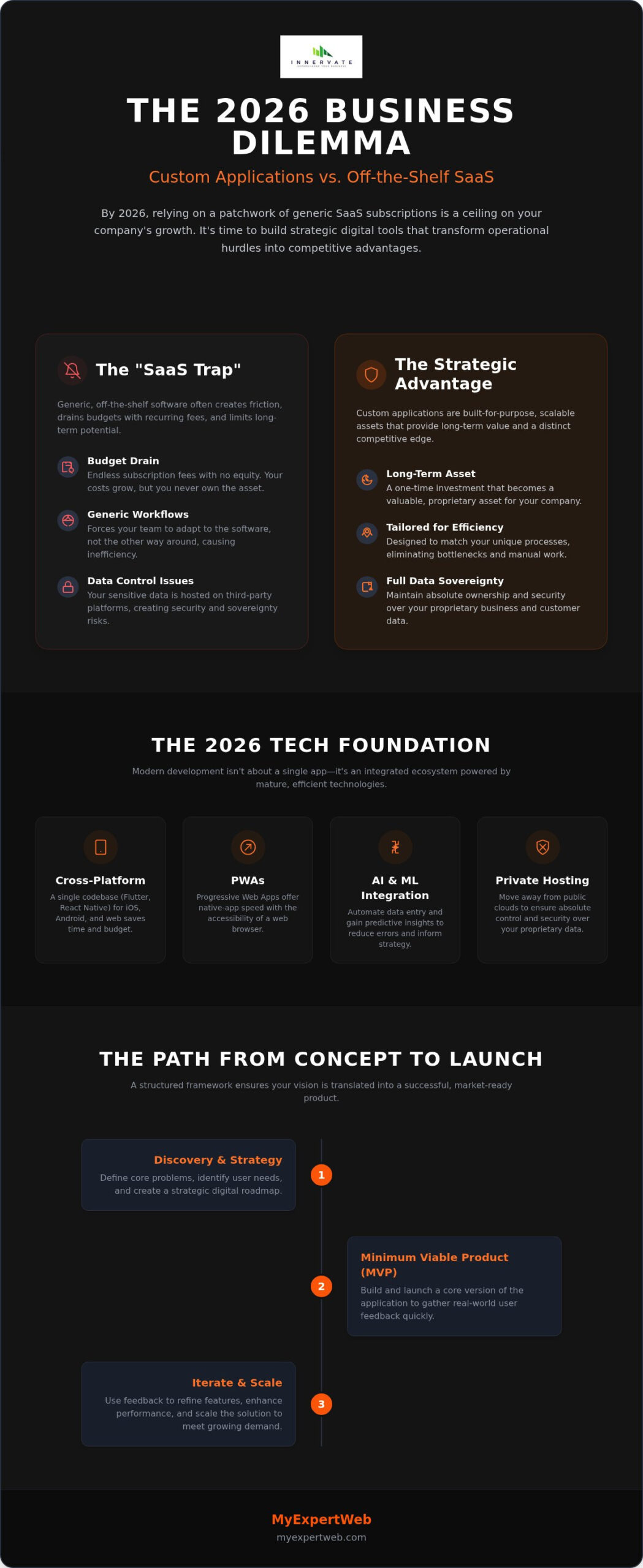
The Methodical Path: From Concept to Successful Launch
Successful software doesn’t happen by accident. It’s the result of a disciplined, five-phase app development process that aligns your vision with practical execution. The journey begins with Product Discovery, where we define the Minimum Viable Product (MVP). This approach allows you to launch core features quickly, gather real-world data, and avoid over-investing in tools your team doesn’t actually need. Once the roadmap is clear, we move into UX/UI Design. Here, the focus is on creating intuitive paths for complex business tasks, ensuring that your employees or customers don’t feel overwhelmed by the new technology.
The actual build happens during Development and Agile Sprints. This phase prioritizes transparency, giving you regular updates so the project remains adaptable to your changing needs. Before any code goes live, Quality Assurance (QA) and User Acceptance Testing (UAT) ensure the system is robust and secure. Finally, Deployment marks the beginning of the app’s life. Ongoing maintenance is essential for long-term viability, keeping your tool compatible with new operating systems and security standards. This methodical approach to app development minimizes risk and maximizes your return on investment. This structure provides a clear roadmap for stakeholders, ensuring that everyone understands the milestones and expected outcomes.
Why Discovery is the Most Critical Phase
Skipping the discovery phase is an expensive mistake. This stage aligns technical requirements with your core business objectives. We identify potential bottlenecks before a single line of code is written, saving you from costly revisions. Choosing the right mobile app development company ensures this phase is handled with depth. A partner who understands your industry will help you build a tool that actually solves your problems rather than adding another layer of complexity to your workflow.
Agile Methodology and Iterative Testing
We use 2-week sprints to keep projects on track and within budget. This iterative approach means you see progress every fortnight, which allows for continuous feedback. If a user interface element doesn’t feel right in practice, we refine it immediately. This constant testing ensures the app remains functional across all modern devices and OS versions. It’s about being proactive rather than reactive. If you’re ready to start your own journey, contact MyExpertWeb today to discuss your project requirements with our strategic team.
Scaling Your Vision with a Strategic Development Partner
Building a custom application is a significant milestone, but the true test of its value lies in how it scales alongside your business. A strategic partner doesn’t just deliver a finished product and disappear; they act as a methodical guide to ensure that your digital infrastructure remains resilient as your user base grows. By leveraging a hybrid team model, you benefit from local strategic guidance paired with the efficiency of offshore execution. This approach allows you to maintain high standards of quality while managing costs effectively. With over 12 years of industry experience, we’ve seen how the right app development strategy can turn a simple tool into a core business asset. We prioritize understanding your unique challenges to provide solutions that are both authoritative and adaptable.
The Dedicated Team Model: Quality at Scale
Hiring an in-house team is often a slow and expensive process that distracts leadership from core business operations. Utilizing a dedicated Outsourcing Development Team offers a more efficient alternative. This model provides immediate access to specialized talent without the administrative overhead of local recruitment or the risks of unmanaged freelance platforms. MyExpertWeb manages these remote teams directly to ensure they meet strict Australian standards of quality and professional communication. This ensures that your developers act as a seamless extension of your own staff. To maximize the impact of your new platform, many businesses opt for integrated web development and SEO services. This holistic approach ensures that your application is not only functional but also highly visible to your target audience.
Ensuring Long-Term Viability and Security
The 2026 threat landscape requires proactive, ongoing support to remain effective. Security is not a one-time setup; it is a continuous process of refinement. Regular security audits and firmware updates are essential to protect your proprietary data from emerging vulnerabilities. Strategic app development involves planning for these future requirements during the initial design phase. We focus on scalability planning, which prepares your application for future feature expansions without the need for a complete architectural rewrite. A supportive, long-term partnership ensures that your technology remains a steady asset rather than a technical liability. This commitment to consistency and professional excellence is what allows a business to grow with confidence, knowing their digital foundation is secure and managed by experts who value their success.
Building Your Digital Future with Strategic Precision
The transition from fragmented generic software to a unified digital ecosystem is the defining shift for successful businesses in 2026. By prioritizing custom app development, you move beyond the limitations of rigid SaaS subscriptions and regain absolute control over your data and operational workflows. We’ve explored how a methodical path, starting with a deep discovery phase and supported by agile execution, ensures that your technology remains a high-value asset rather than a recurring expense.
With over 12 years of industry experience, MyExpertWeb serves as a reliable strategic partner to help you navigate these complexities. Our model combines local strategic guidance with dedicated offshore development teams to provide comprehensive custom software expertise that scales with your ambition. Whether you’re looking to automate manual logistics or build a personalized client portal, we’re here to guide you through every stage of the lifecycle. Contact MyExpertWeb for a free consultation on your next app development project and take the first step toward a more efficient, secure, and scalable future. Your vision deserves a foundation built for long-term excellence.
Frequently Asked Questions
How much does custom app development cost for an Australian business in 2026?
The cost of app development for an Australian business depends on the project scope and the complexity of the specific features required. We prioritize a pragmatic discovery process rather than fixed price lists to ensure your investment matches your actual operational needs. Factors such as the number of custom integrations, user roles, and data security requirements will influence the final development budget.
What is the difference between a mobile app and a progressive web app (PWA)?
A native mobile app is built for a specific operating system and downloaded through an app store, whereas a Progressive Web App (PWA) is accessed via a web browser. Native apps offer deeper hardware integration and better performance for complex tasks. PWAs provide a more accessible, browser based experience that is often faster to deploy across multiple different devices.
How long does the typical app development lifecycle take from start to finish?
The timeline for a typical app development project usually ranges from three to nine months from the initial discovery phase to the final launch. This duration depends on the complexity of the features and the number of third party integrations required. Our methodical use of two week agile sprints ensures that you see consistent, functional progress throughout the entire build process.
Do I own the source code for the application MyExpertWeb builds for me?
You maintain full ownership of the source code and all intellectual property associated with your application upon project completion and final payment. MyExpertWeb operates as a strategic partner, ensuring that you have total control over your digital assets. This ownership is vital for business security and allows you to modify or expand your software as your company evolves.
Can a custom business application integrate with my existing accounting or CRM software?
Custom business applications are designed to communicate directly with your existing accounting, CRM, or legacy software through secure API integrations. This allows for real time data synchronization between your new app and platforms like Xero or HubSpot. By connecting these systems, you reduce manual data entry and improve the overall accuracy of your internal business reporting.
What is a Minimum Viable Product (MVP), and why is it recommended for startups?
A Minimum Viable Product (MVP) is a version of your software that contains only the essential features needed to satisfy early users and solve a core problem. We recommend this approach for startups because it facilitates a faster launch and reduces initial financial risk. It allows you to validate your business concept with real users before investing in complex features.
How does MyExpertWeb ensure the security of my custom application?
We ensure the security of your application by implementing end to end encryption, secure authentication protocols, and regular vulnerability testing. Our team leverages over 12 years of industry experience to build robust architectures that protect sensitive business data. We also provide ongoing maintenance to address the evolving security threats that businesses face in the 2026 digital environment.
Is it better to build for iOS or Android first for a business tool?
The choice between iOS and Android depends on the device habits of your primary users and your specific business goals. For many Australian organizations, we utilize cross platform frameworks to develop for both systems simultaneously from a single codebase. This approach ensures a consistent user experience across all devices while reducing the time and cost required for separate builds.