


MyExpertWeb Team
August 20, 2026
How Much Should a Small Business Website Cost in Australia 2026?
What if the most expensive mistake you make this year isn’t overpaying for a website, but underinvesting in a tool that actually works? Many Australian business owners find themselves staring at multiple quotes with massive price gaps, wondering why the numbers don’t align. It’s frustrating to feel like you’re guessing when asking how much should a small business website cost in Australia 2026. You want a digital presence that builds trust and generates leads, yet the fear of hidden fees or paying for features you don’t need often leads to analysis paralysis.
We understand that your website is a functional asset, not just a digital business card. This guide provides a comprehensive framework to help you navigate Australian web design pricing with confidence. You’ll learn to distinguish between basic brochure sites and high-performance lead-generation engines, ensuring your investment aligns with your specific growth goals. We’ll also uncover the ongoing costs often left out of initial quotes, from security updates to integrated local SEO. By the end, you’ll have a clear roadmap to find a reliable partner who prioritises your long-term viability over a quick sale.
Key Takeaways
- Understand the transition from static brochure sites to integrated business applications and why this shift is essential for Australian SMEs in 2026.
- Discover exactly how much should a small business website cost in Australia 2026 by exploring detailed budget frameworks for basic, professional, and custom builds.
- Learn to identify and avoid common pricing traps, including proprietary CMS lock-ins and “free” website offers that carry high long-term maintenance fees.
- Recognise the strategic value of UX/UI design and pre-project planning in transforming a standard website into a high-performance lead-generation tool.
- Explore how a hybrid model combining local strategic guidance with offshore development expertise can significantly improve your digital return on investment.
The Australian Small Business Website Market in 2026
The digital landscape for Australian SMEs has matured. In previous years, business owners often asked about location-based pricing, assuming an agency in a major city would always cost more. By 2026, this geographical gap has closed. What matters now is the technical capability and strategic value a partner brings to the table, regardless of where they’re physically based. When you evaluate how much should a small business website cost in Australia 2026, you’re no longer buying a digital brochure. You’re investing in a functional business application that serves as your primary sales and operations hub.
Modern what web development involves more than just aesthetics; it requires a deep integration of security, user experience, and automated lead generation. Every professional build now prioritises mobile-first design and SEO-ready foundations as standard requirements. The market generally falls into three distinct tiers:
- DIY Builders: Best for micro-businesses testing a simple concept with minimal functional needs.
- Independent Freelancers: Suitable for standard sites with limited custom features or basic informational needs.
- Professional Agencies: Essential for businesses requiring custom application development, integrated local SEO, and scalable growth.
Why 2026 Pricing Differs from Previous Years
AI-assisted development has fundamentally changed the baseline. While AI helps speed up the initial coding process, it hasn’t necessarily made high-quality websites cheaper. Instead, it’s shifted the focus toward strategy and security. Australian businesses now face stricter data privacy expectations and cyber security requirements. A professional build in 2026 includes robust protection against vulnerabilities that weren’t as prevalent a few years ago. Additionally, the shift toward lead generation means every page must be engineered for conversion, not just display.
The Real Cost of “Free” or DIY Website Builders
The allure of a “free” or low-cost DIY builder is often a trap for growing businesses. While the entry price might be $200 to $800 per year, the hidden costs are substantial. You’ll spend dozens of hours trying to master the platform, often resulting in a site that lacks the professional finish needed to build trust. These platforms frequently lock you into proprietary ecosystems, making it difficult to migrate your data if you outgrow the service. Poor SEO performance on these builders can also mean your business remains invisible to the very customers you’re trying to reach. For most, understanding how much should a small business website cost in Australia 2026 requires looking past the initial sticker price to the long-term value of the asset.
Average Cost Breakdown by Website Complexity
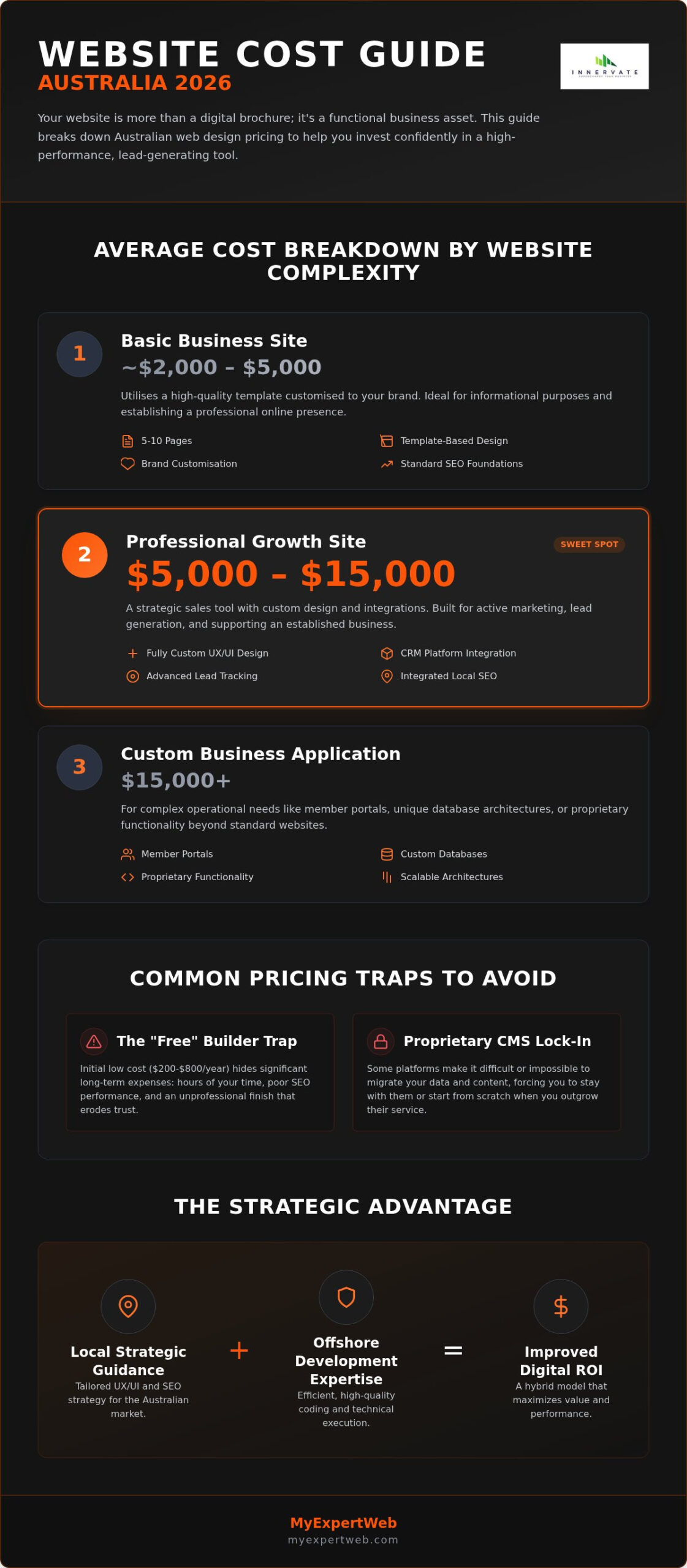
Determining how much should a small business website cost in Australia 2026 involves more than just comparing initial quotes. It requires a clear understanding of what each investment level actually delivers for your business operations. While every project is unique, the market generally organises itself into three primary categories based on the technical requirements and the strategic depth involved. A well-planned budget ensures you don’t underinvest in a tool that fails to convert, or overpay for features your business isn’t yet ready to utilise.
- Basic Business Site: Typically includes 5 to 10 pages, utilising a high-quality template that is customised to your brand. It provides standard SEO foundations and a clean, professional interface for informational purposes.
- Professional Growth Site: Features a fully custom UX/UI design, integration with CRM platforms, and advanced lead-tracking capabilities to support active marketing efforts.
- Custom Business Application: Designed for complex requirements such as member portals, unique database architectures, or proprietary functionality that simple CMS platforms cannot handle.
The Professional SME Tier ($5,000 – $15,000)
For most established small businesses, this tier represents the “sweet spot” for high-performance results. At this level, the focus shifts from just having a website to creating a strategic sales tool. We prioritise custom UX/UI design to ensure the user journey is tailored specifically to your Australian customer base. This tier also includes the integration of local SEO services during the development phase. By building with search visibility in mind, your site is prepared to rank for relevant local queries the moment it goes live. You can also expect seamless connections to marketing automation tools, allowing you to track leads from the first click to the final sale.
Custom Enterprise & Application Solutions ($15,000+)
When your business requirements exceed the capabilities of standard templates or plugins, you move into the realm of custom business application development. This investment is focused on operational efficiency and long-term scalability. If you’re planning a national expansion or need to manage complex data handling, a bespoke solution is essential. These builds feature dedicated database architectures and advanced security protocols to protect sensitive client information. This level of development ensures your digital infrastructure can grow alongside your team without the limitations of off-the-shelf software. If you’re unsure which tier fits your current trajectory, our consultative team can help you map out a scalable digital roadmap.
Ultimately, when asking how much should a small business website cost in Australia 2026, the answer depends on your growth targets. A professional build is a foundational asset that reduces manual work and increases your market visibility over time.
Core Components That Drive Professional Quotes
Professional quotes for web projects are rarely arbitrary. They reflect a methodical breakdown of the specific skill sets required to build a high-performing digital asset. When you evaluate how much should a small business website cost in Australia 2026, you’re paying for a coordinated effort between specialists who ensure your site is secure, fast, and capable of converting traffic. Understanding these components helps you see the difference between a generic template and a strategic business tool.
- Strategy and Planning: This is the blueprint phase. It involves mapping out user flows and technical requirements before a single line of code is written. Proper planning prevents costly mid-project changes and ensures the final product aligns with your operational goals.
- UX/UI Design: User Experience (UX) and User Interface (UI) design focus on crafting a journey that feels intuitive for Australian customers. It’s about more than aesthetics; it’s about guiding a visitor toward a specific action, such as a phone call or a form submission.
- Development and Coding: Professional developers write clean, efficient code that prioritises speed and mobile responsiveness. This foundational work ensures your site loads quickly on all devices, which is a critical factor for both user retention and search rankings.
- Content and SEO: High-quality web content serves two masters: your human audience and search engine algorithms. Specialised writing ensures your brand voice is consistent while your pages are optimised for visibility.
Design vs. Development: Understanding the Labour
It’s a common misconception that web design and development are the same thing. A graphic designer focuses on the visual identity and user journey, while a developer builds the functional engine that makes those designs work. Investing in custom coding rather than relying on bloated third-party plugins provides long-term flexibility and superior site speed. Success in 2026 often depends on integrated web development and SEO services, where the technical build and the visibility strategy are developed in tandem rather than as separate afterthoughts.
The Infrastructure: Hosting, Domains, and Security
Your website needs a reliable home to stay accessible and secure. Premium Australian-based hosting is typically preferred over budget international options because it reduces latency for local users, leading to a snappier experience. Beyond hosting, security is a mandatory investment. Every professional quote should include SSL certificates and follow principles of secure web application development to protect your business and your customers from data breaches. Finally, ongoing maintenance is essential. A “set and forget” approach often leads to technical debt, where outdated software creates security vulnerabilities and performance issues over time. By factoring these components into your initial inquiry about how much should a small business website cost in Australia 2026, you ensure your digital presence remains a stable and productive asset.
Hidden Fees and Pricing Traps to Avoid
A quote that seems too good to be true usually is. When investigating how much should a small business website cost in Australia 2026, you’ll likely encounter offers that promise high-end results for a fraction of the market rate. These often come with technical “traps” that can limit your business growth or lead to significant expenses later. One of the most common issues is the proprietary CMS trap. Some agencies build sites on their own closed platforms. If you ever decide to leave that agency, you often cannot take your website with you, effectively forcing you to pay for a total rebuild from scratch.
You should also be wary of the “free website” model. These builds often come with high monthly retainers that never expire, meaning you pay for the site many times over during its lifespan. Additionally, basic SEO foundations like meta tags and clean URL structures should be part of any professional build. Some vendors omit these essentials from the initial quote only to charge them as “premium extras” later in the project. Managing stock imagery and font licensing is another area where small, unmanaged fees can quietly inflate your final bill if they aren’t discussed transparently at the start.
Maintenance and Security Retainers
In 2026, security and maintenance are non-negotiable operational costs. A professional maintenance plan covers critical software updates, automated backups, and proactive security monitoring to protect your customer data. The cost of neglecting these areas is far higher than the retainer itself. Malware infections, server downtime, and lost revenue from a broken site can cripple a small business. Regular audits ensure your site remains a high-performing asset that stays compliant with evolving Australian data privacy expectations. Treating maintenance as an optional extra is a risk that seasoned business owners simply don’t take.
Post-Launch Marketing and Growth
Your website is a foundational tool, but it’s only the first step in a broader digital strategy. To see a real return on your investment, you must budget for ongoing visibility. This includes integrated local SEO and strategic PPC management to drive targeted traffic to your new pages. Content marketing also serves as the engine that keeps your site relevant and authoritative in the eyes of search engines. A site that doesn’t attract visitors is a dormant asset. If you want a clear, transparent view of your total investment, contact our team for a detailed strategy session that covers both the build and the growth phase.
Understanding how much should a small business website cost in Australia 2026 requires looking beyond the launch date. By identifying these hidden traps early, you can choose a partner who values transparency and long-term partnership over a quick, low-quality sale.
Strategic Investment: The Hybrid Outsourcing Advantage
When you evaluate how much should a small business website cost in Australia 2026, you’ll likely notice a significant disparity between local agency rates and the needs of a growing SME. While local strategic guidance is essential for understanding the Australian market, the technical execution can often be managed more efficiently. Our model at MyExpertWeb addresses this by combining high-level Australian strategy with skilled execution from our dedicated teams. This hybrid approach allows your business to access enterprise-level custom software on a small business budget, ensuring you don’t have to compromise on functionality to remain competitive.
The cost of hiring developers in the Philippines provides a clear advantage when compared to purely local-only teams. However, the value lies in more than just the initial price point. By utilising a dedicated development team, you gain a stable extension of your own staff. This consistency is vital for maintaining the integrity of your code and ensuring that the people who built your application are available to scale it as your business grows. It’s a pragmatic way to bridge the gap between simple templates and complex, bespoke solutions.
Maximising ROI Through Partnership
A long-term relationship with a digital agency is far more valuable than a one-off transaction. By working with a methodical guide, you can navigate technical complexities without feeling overwhelmed. We focus on tangible business outcomes, such as lead quality and sales conversions, rather than just the aesthetic “look and feel” of your pages. This partnership approach ensures that your website remains a high-performing asset that adapts to new market demands. When you view your digital presence as a strategic investment rather than a sunk cost, the return on investment becomes much easier to measure and justify.
Next Steps for Your 2026 Website Project
As you move forward with your project, it’s essential to vet your potential partners thoroughly. Ask direct questions about code ownership, data security, and how they handle future scalability. To get an accurate, fixed-price quote, we recommend preparing a detailed business brief that outlines your specific functional requirements. This prevents the “scope creep” that often leads to budget overruns. If you’re ready to align your digital goals with a realistic budget, we invite you to contact us for a consultation. We’ll help you determine how much should a small business website cost in Australia 2026 for your specific scenario, providing a clear roadmap for your digital growth.
Investing in Your Long-Term Digital Visibility
Selecting a web partner is a strategic decision that directly impacts your operational efficiency and market visibility. We’ve examined how the Australian landscape has shifted toward functional business applications, making it essential to identify hidden traps like proprietary CMS lock-ins before you commit. Ultimately, determining how much should a small business website cost in Australia 2026 depends on your specific growth targets and the technical scalability your business requires. A hybrid model that combines local strategic guidance with skilled offshore execution offers a pragmatic path to high-end results.
At MyExpertWeb, we leverage 12+ years of experience to provide end-to-end support, from custom design to integrated local SEO. Our strategic offshore development model is built to deliver superior ROI while keeping your digital assets secure and high-performing. We invite you to book a free consultation with MyExpertWeb to discuss your 2026 digital strategy. Aligning your budget with a reliable partner is the first step toward a successful year of growth. We look forward to helping you build a digital presence that truly works for your business.
Frequently Asked Questions
What is the average cost of a small business website in Australia in 2026?
Professional websites typically fall within a broad range depending on their role as a business tool. A basic customised site often starts at the lower end, while high-performance growth sites requiring custom UX/UI design sit in the mid-tier. When asking how much should a small business website cost in Australia 2026, you’re paying for strategy and conversion optimisation. Complex applications with unique functionality require a higher investment to ensure long-term scalability and security.
Why do website quotes vary so much between different Australian agencies?
Variations stem from the scope of work, technical expertise, and included services. Some quotes only cover the visual design, while others include deep strategy, local SEO, and custom coding. Cheap quotes often rely on generic templates that lack flexibility. Higher quotes usually represent a comprehensive partnership where the agency acts as a methodical guide. This ensures the site is a secure, lead-generating asset rather than just a static page on the internet.
Are website design costs tax-deductible for Australian small businesses?
Yes, website costs are generally treated as a business expense, though the specific deduction method depends on the nature of the work. Ongoing costs like hosting and maintenance are usually deductible in the year they occur. Initial build costs might be capitalised and depreciated over time. You should consult with a qualified accountant to understand how current Australian taxation laws apply to your specific digital investment and business structure.
How much should I budget for annual website maintenance and hosting?
Budgeting for annual upkeep is essential to prevent technical debt. Premium Australian-based hosting, security monitoring, and regular software updates typically require a monthly retainer. This ensures your site remains fast and protected against malware. Neglecting these areas often leads to higher costs later due to emergency repairs or lost revenue from downtime. A proactive maintenance plan is a pragmatic investment in your site’s long-term operational health and visibility.
Is it cheaper to hire a freelancer or a web design agency?
Freelancers often have lower overheads, making them a cost-effective choice for simple projects. However, agencies provide a broader range of specialised skills, including custom application development and integrated SEO. While the initial freelancer fee might be lower, an agency offers a more stable long-term partnership. This reduces the risk of project abandonment and ensures you have a dedicated team to support your business as it scales across different markets.
What are the hidden costs of building a website I should look out for?
Hidden costs often include stock imagery licensing, premium plugin fees, and professional content services. You should also watch for proprietary CMS lock-ins that prevent you from moving your site later. Some quotes omit basic SEO foundations or SSL certificates, leading to unexpected invoices during the build. Clarifying ownership of the code and ensuring all infrastructure costs are transparently listed in your initial brief helps prevent budget overruns during the project.
Can I lower my website costs by using an offshore development team?
Utilising an offshore development team can significantly reduce labour costs while maintaining high technical standards. The key is a hybrid model that combines local Australian strategic oversight with skilled execution from an established offshore team. This approach allows you to achieve enterprise-level custom software results on an SME budget. It is an efficient way to maximise your ROI without sacrificing the quality or security of your digital infrastructure.
How long does it typically take to build a professional business website?
A professional build generally takes between 8 to 16 weeks depending on complexity. This timeline includes the strategy phase, custom design, development, and rigorous testing. Simple sites may be completed faster, while custom business applications with complex integrations require more time for database architecture and security protocols. Rushing the process often compromises the site’s performance, so a methodical approach is necessary to ensure a high-quality final product for your business.