


MyExpertWeb Team
August 21, 2026
Website Redesign ROI Calculator: Measuring Your Digital Investment in 2026
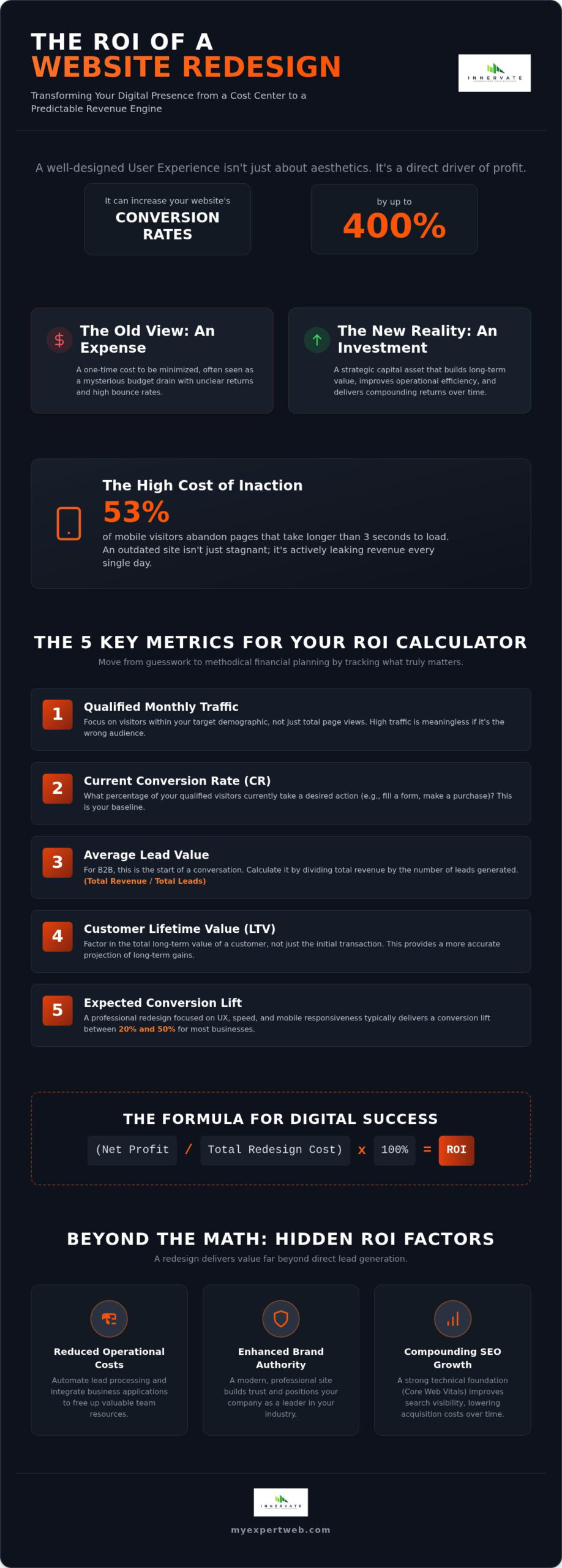
Did you know that a well-designed user experience can increase your website’s conversion rates by up to 400%? For many business owners, the digital presence often feels like a mysterious cost center where budgets disappear without a clear trail of revenue. It’s common to feel the weight of high bounce rates and low lead quality while struggling to justify significant digital spend to skeptical stakeholders. You want more than just a visual update; you need a strategic asset that pays for itself. This is where a website redesign ROI calculator becomes an essential tool for your planning process.
We understand that a redesign is a major commitment, and you deserve to see the math behind the investment. This article introduces a practical framework designed to help you accurately forecast financial returns and transform your site into a predictable revenue engine. By shifting the focus from aesthetics to performance, you can move forward with the quiet confidence of a seasoned expert who knows exactly where their capital is going.
We’ll walk you through a clear dollar-value projection model, provide a roadmap to boost your current conversion rates, and offer a professional framework to evaluate agency proposals based on their actual ability to drive growth. Let’s move from a state of identifying a need to a feeling of being supported by a comprehensive, data-driven solution.
Key Takeaways
- Understand how to reframe your digital presence as a strategic capital investment that builds long-term value for your organization.
- Learn to utilize a website redesign ROI calculator to provide stakeholders with clear, data-driven revenue projections and financial justifications.
- Identify the hidden benefits of a redesign, including reduced operational costs through automated lead processing and enhanced brand authority.
- Gain a methodical framework for auditing your sales funnel and prioritizing user experience updates that directly impact your most profitable conversion points.
Understanding the Financial Mechanics of a Website Redesign ROI
A website redesign is often viewed through the lens of aesthetics, yet its true value lies in its performance as a financial instrument. To accurately measure success, you must define your Return on Investment (ROI) as the net profit generated by the new site relative to its total cost of ownership. This perspective shifts the project from a simple marketing expense into a strategic capital investment. While an expense is a cost to be minimized, an investment is an asset designed to build long term value and operational efficiency.
Many organizations fail to account for the cost of inaction. If your current site suffers from a 53% abandonment rate due to slow mobile loading speeds, you’re losing measurable revenue every day. A redesign isn’t just about gaining new ground; it’s about stopping the “leaks” in your existing sales funnel. Unlike a one-off ad campaign, a high performing website offers compounding ROI. As your technical foundation improves, your search visibility and organic traffic typically grow over a two to three year period, lowering your average customer acquisition cost over time.
The Formula for Digital Success
Calculating the impact of your project requires a clear understanding of your data points. Stakeholders often confuse gross ROI with net ROI. Gross ROI looks at the total revenue increase, while net ROI accounts for the ongoing costs of maintenance and the initial development spend. Using a website redesign ROI calculator allows you to input variables like current conversion rates and average lead value to see a realistic projection of your gains. ROI is the ratio of net profit to the total cost of the redesign project. By establishing this baseline early, you move from guesswork to methodical financial planning.
Why 2026 Standards Demand a New Calculation
The digital environment in 2026 places a massive premium on technical excellence. Google’s emphasis on Core Web Vitals and mobile-first indexing means that performance is no longer optional. Research shows that a well-designed user experience can increase conversion rates by up to 400%. This direct correlation between UX and profit is why modern calculations must prioritize speed and accessibility. Additionally, integrating secure business application development protects your investment from the rising costs of data breaches and downtime. When your site is built to modern standards, it functions as a reliable, secure, and highly efficient member of your sales team.
The 5 Key Metrics That Power Your ROI Calculator
To build an accurate website redesign ROI calculator, you have to look beyond vanity metrics like total page views. You need to distinguish between total traffic and qualified traffic. High traffic numbers mean very little if the visitors aren’t within your target demographic. If your site attracts 10,000 visitors but only 100 are potential buyers, your redesign should prioritize attracting the right people through clearer user journeys. Setting a realistic “Expected CR” is also vital. This often aligns with an Enterprise Measurement Framework, which balances revenue growth with technical performance and operational efficiency.
Calculating Average Lead Value
For B2B service providers, a form fill isn’t an immediate sale. It’s the start of a conversation. You determine lead value by dividing total revenue by the total number of leads generated. Calculating the value of a form fill is distinct from the final sale value, as it accounts for the probability of conversion throughout your sales pipeline. It’s also vital to factor in Customer Lifetime Value (LTV) for accurate long-term projections. Custom business application development can significantly increase lead value by refining the data capture process, ensuring your sales team receives more qualified information from the start. If you’re looking to scale these technical improvements, an outsourcing development team can provide the dedicated focus needed to maintain high ROI over time.
Setting Realistic Conversion Lift Expectations
A professional redesign typically delivers a conversion lift between 20% and 50% for most businesses. This improvement depends heavily on mobile responsiveness and speed. Since 53% of mobile visitors abandon pages that take longer than three seconds to load, performance is a primary driver of ROI. Using integrated web development and SEO services ensures that the high-quality traffic you attract matches the excellence of your new user experience.
Finally, you must account for the lead-to-close ratio. This is the bridge between your website’s performance and your actual revenue. It’s the missing link that many generic calculators ignore. If your site generates 50 leads but your internal team only closes five, the financial outcome is very different than if you closed fifteen. A website can only do so much; your sales process must be ready to handle the volume. By analyzing these five metrics together, your website redesign ROI calculator moves from a theoretical exercise to a practical roadmap for business growth. This methodical approach ensures you aren’t just guessing but are making informed decisions based on hard data and proven benchmarks.
Beyond the Math: Hidden ROI Factors and Industry Benchmarks
While direct revenue is the most visible metric, a website redesign ROI calculator should also account for secondary benefits that stabilize a business over time. Operational efficiency is a prime example of a “hidden” gain. A legacy site often requires manual lead processing, which drains internal resources and slows down response times. By automating these workflows through a modern interface, you reduce the administrative burden on your team. This allows your staff to focus on high value activities rather than repetitive data entry, effectively lowering your internal costs.
Brand equity acts as another powerful factor in your financial return. When your digital presence reflects professional excellence, it builds immediate trust with visitors. Research from January 2026 shows that 94% of a user’s first impression of a brand is design-driven. This perceived authority often allows businesses to command premium prices and stand out in a crowded market. It also plays a vital role in recruitment. A polished, functional site attracts an offshore dedicated development team philippines and other top talent who want to work with organizations that value innovation.
Maintenance costs often hide in the shadows of a digital budget. Older sites built on legacy code typically require more frequent security patches and performance fixes. Moving to a scalable, modern framework can significantly lower your annual maintenance fees. Industry standards suggest businesses should budget 15% to 20% of the initial build cost for maintenance; a well-built site helps keep you at the lower end of that range. By reducing these recurring expenses, you improve your net profit margins for years to come.
ROI Benchmarks by Business Type
The goals of a redesign vary based on your specific business model. For B2B services, success is typically measured by lead volume and a significant reduction in the sales cycle. eCommerce brands focus on increasing the Average Order Value (AOV) and aggressively lowering cart abandonment rates. In contrast, SaaS and custom application providers prioritize user retention and the reduction of churn. Understanding these industry-specific benchmarks helps you set realistic targets within your website redesign ROI calculator.
The “Payback Period” Metric
To justify a project to financial stakeholders, you need to speak the language of the CFO. The “Payback Period” is a simple but effective metric calculated by dividing the total project cost by the expected monthly revenue increase. If a project pays for itself within 6 to 12 months, it’s considered an exceptional digital investment. This calculation follows the fundamental principles of marketing ROI by focusing on how quickly an asset generates enough cash flow to cover its initial outlay. Using this metric ensures your redesign is viewed as a strategic asset rather than a sunk cost.
How to Maximize Your Return: Turning Calculator Data into Strategy
Gathering data from a website redesign ROI calculator is only the first step; the real value emerges when you translate those numbers into a methodical strategy. You must move from a state of observation to one of action. Start by auditing your current sales funnel to identify where the biggest leaks occur. If your research shows that 53% of mobile visitors abandon pages that take longer than three seconds to load, you’ve identified a primary technical bottleneck. By prioritizing UX improvements that directly influence your most profitable conversion points, you ensure that every design choice serves a financial purpose. A well-designed user experience can increase conversion rates by up to 400%, making it the most effective lever for improving your return.
A successful redesign also requires a continuous maintenance plan to prevent ROI decay. Digital standards evolve quickly, and a site that performs well today may lag behind in two years. Implementing a schedule for performance monitoring and regular updates ensures your investment remains a high performing asset. If you want to transform your digital presence into a predictable revenue engine, you can partner with our expert team to build a site focused on measurable growth.
The Role of SEO in ROI Protection
A redesign without local seo services is a significant financial risk. If you ignore search visibility during the development phase, you risk losing the existing traffic value you’ve built over years. Protecting your investment requires a meticulous technical SEO plan, including 301 redirects and a clean site architecture, to preserve your rankings. Your content strategy then serves as the fuel for the ROI engine post launch. By aligning your design with the specific intent of your audience, you ensure that the traffic you attract is qualified and ready to convert.
Scaling with Custom Solutions
Sometimes a standard landing page isn’t enough to meet complex business goals. In these scenarios, moving toward custom business application development allows you to build deeper functionality that drives efficiency. Integrating your website with CRM and ERP systems enables you to track ROI from the initial click all the way to cash in the bank. This level of visibility is essential for enterprise level projects where stakeholders demand granular data. Leveraging dedicated teams for ongoing feature development ensures that your site stays ahead of competitors and continues to deliver a high return as your business scales.
Partnering for Profit: How MyExpertWeb Delivers Measurable Results
A website redesign is a significant undertaking that requires more than just technical skill; it demands a partner who understands your business objectives. At MyExpertWeb, we bring over 12 years of experience to every project, focusing on transforming your digital presence into a high performing asset. While many agencies operate on a transactional basis, focusing solely on the launch date, we prioritize a strategic partnership model. We view ourselves as an extension of your team, dedicated to the long term viability and growth of your organization across Australia and the US. Our approach ensures that every design choice is grounded in pragmatism and professional excellence.
One of our primary advantages is the specialized use of our outsourcing development team. This model allows you to scale your technical capabilities and maintain a high ROI without the overhead costs typically associated with enterprise level projects. We focus on creating clean, mobile-friendly, and secure designs that protect your investment from the start. By combining high level strategy with practical operational efficiency, we help you move beyond the initial projections of a website redesign ROI calculator and into a phase of consistent, measurable revenue generation.
A Methodical Guide to Your Redesign
Our process begins with a deep discovery phase. We listen first. Before a single wireframe is created, we work to understand your unique challenges, sales cycles, and lead generation goals. This methodical guide ensures that data, not just aesthetics, informs every decision we make. We analyze your current funnel to identify friction points and then build solutions that streamline the user journey. Our focus remains on operational ease, ensuring your new site reduces manual processing and integrates seamlessly with your existing business applications.
Ready to Calculate Your Potential?
If you’ve already used a website redesign ROI calculator to set your benchmarks, the next step is to verify those projections with a seasoned expert. We offer a professional consultation to help you refine your business case and identify the most profitable path forward. Whether you need a high converting landing page or complex secure web application development, our team has the expertise to handle the most intricate technical requirements. We remain unfazed by complexity and are committed to delivering a site that functions as a reliable engine for your business. Book a consultation with us today to turn your digital investment into a predictable source of profit.
Secure Your Digital Future with Data-Driven Design
Moving from a static digital presence to a high-performing revenue engine requires a fundamental shift in perspective. You’ve seen how reframing a redesign as a strategic capital investment allows you to stop revenue leaks and build long term brand equity. By focusing on qualified traffic and lead value, you move beyond vanity metrics and into the territory of predictable growth. A website redesign ROI calculator provides the baseline you need, but the real value comes from a methodical execution that integrates SEO and high performance user experience from the start.
You don’t have to navigate this transition alone. With 12+ years of digital agency experience, we specialize in building custom business applications and providing dedicated offshore development support to ensure your site remains a scalable asset. We’re here to help you translate complex data into a clear, actionable strategy that serves your unique business goals. Our team is ready to act as an extension of your own, providing the technical expertise needed to protect and grow your investment.
If you’re ready to move from guessing to knowing, book a free consultation with MyExpertWeb to build your ROI roadmap. Let’s work together to transform your digital presence into a secure and profitable foundation for the years ahead.
Frequently Asked Questions
How long does it take for a website redesign to pay for itself?
A professional website redesign typically pays for itself within 6 to 12 months. This payback period is calculated by dividing the total project cost by the expected monthly revenue increase. If your new site successfully stops revenue leaks from high mobile bounce rates, you’ll see a faster return. Using a website redesign ROI calculator helps you visualize this timeline based on your current lead volume and average sale value.
What is a good conversion rate increase to expect after a redesign?
Most businesses should target a conversion rate increase between 20% and 50% after a professional redesign. While a well-designed user experience can technically improve conversions by up to 400%, a more conservative estimate is safer for initial budgeting. The actual lift depends on your starting point; if your current site isn’t mobile-responsive or takes longer than three seconds to load, your potential for improvement is significantly higher.
Can a website redesign actually hurt my ROI if not done correctly?
Yes, a redesign can negatively impact your ROI if technical SEO and performance standards are ignored. Common mistakes include failing to implement 301 redirects, which causes a loss of existing search traffic, or creating heavy designs that slow down page speeds. Since 53% of mobile visitors abandon slow sites, a visually stunning but slow website will ultimately cost you more than it generates in new leads.
How do I calculate the ROI of a website if I don’t sell products online?
You calculate ROI for service-based businesses by determining your average lead value. Divide your total revenue by the number of leads generated to find what a single form fill is worth. Then, multiply your projected increase in leads by this value and subtract the project cost. This methodical approach ensures your website redesign ROI calculator reflects the reality of your sales pipeline rather than just direct online sales.
Is SEO included in the ROI calculation for a website redesign?
SEO is a critical component of the ROI calculation because it functions as the fuel for your new design. Without a steady stream of qualified traffic, even the most persuasive user experience cannot generate revenue. Including SEO in your initial plan protects your current rankings and ensures that your investment continues to deliver compounding returns as your organic visibility grows over a two to three year period.
Should I include internal staff time in my redesign investment cost?
You should include internal staff time in your calculation to determine your true net ROI. While the agency fee is the most visible cost, the time your team spends on discovery, content reviews, and testing represents a real operational expense. Accounting for these internal resources provides stakeholders with a comprehensive view of the total cost of ownership and helps justify the use of specialized outsourcing development teams to maintain efficiency.
What are the biggest factors that cause a redesign to fail to deliver ROI?
The primary factors that cause a redesign to fail include poor mobile performance, lack of search visibility, and a focus on aesthetics over user intent. If a site is difficult to navigate or fails to load quickly on mobile devices, users will abandon the journey before converting. Additionally, neglecting to integrate CRM systems makes it difficult to track lead quality, leaving you with data but no clear way to measure success.
How often should a business redesign their website to maintain high ROI?
Businesses should typically consider a redesign every 2 to 5 years to keep pace with technological advancements and shifting user expectations. Digital standards, such as Google’s Core Web Vitals, evolve rapidly, and a site that was high-performing three years ago may now be a bottleneck. Regular updates and a continuous maintenance plan help prevent ROI decay and ensure your digital presence remains a competitive asset in your market.