


MyExpertWeb Team
August 25, 2026
Scalable Web Architecture: 2026 Strategic Growth Guide
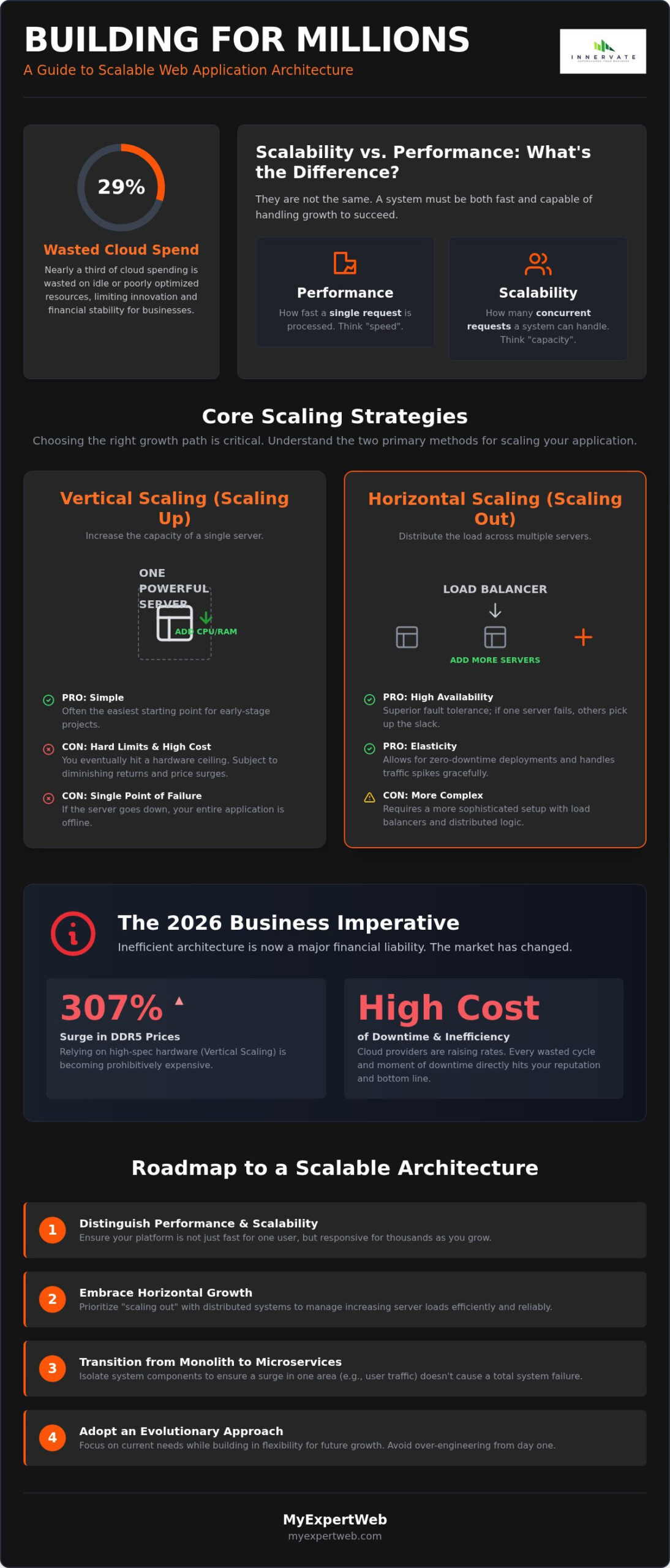
Did you know that nearly 29% of cloud spending is wasted on idle or poorly optimized resources? For many Australian businesses, this inefficiency isn’t just a technical oversight; it’s a financial burden that limits your ability to innovate. You’ve likely felt the stress of high latency during a traffic spike or watched your infrastructure costs climb faster than your actual revenue. It’s a common struggle to maintain a stable platform when your user base starts to expand rapidly.
This guide provides a clear path forward by exploring the core principles of a scalable web application architecture. We’ll show you how to design for millions of users without compromising on speed or your bottom line. By the end of this article, you’ll have a practical roadmap for building a flexible tech stack and the confidence to choose the right framework for your specific business goals. We’ll look at how modern strategies, from ARM-based processing to FinOps practices, can help you achieve long-term viability in the 2026 digital market.
Key Takeaways
- Distinguish between performance and scalability to ensure your platform remains responsive as your user base expands.
- Compare vertical and horizontal growth strategies to identify the most efficient way to manage increasing server loads.
- Master the principles of a scalable web application architecture by understanding when to transition from a monolith to microservices.
- Adopt an evolutionary approach to development that focuses on current needs while maintaining the flexibility for future growth.
- Learn why a consistent development partnership is vital for maintaining complex systems and managing long-term infrastructure costs.
What is Scalable Web Application Architecture?
At its core, a scalable web application architecture is a system design specifically engineered to handle an increasing workload by adding resources. It isn’t just about making a site look good; it’s about ensuring the underlying structure can grow without breaking. While many people confuse performance with scalability, they serve different purposes. Performance refers to how fast a single request is processed, while scalability refers to the total number of requests a system can handle simultaneously. A fast application that crashes when ten people use it is performant but not scalable.
When embarking on custom business application development, you must consider scalability from the very first line of code. This foresight addresses three critical dimensions: load (the number of concurrent users), data volume (the amount of information stored), and deployment complexity (the ease of updating the system). By utilizing a microservice architecture, developers can isolate these dimensions, ensuring that a surge in user traffic doesn’t lead to a total system failure.
Why Scalability is a 2026 Business Imperative
In 2026, the global cloud computing market has shifted. With DDR5 prices surging 307% since late 2025 and cloud providers raising rates to cover infrastructure costs, inefficient code is now a major financial liability. Downtime is no longer just an inconvenience; it’s a direct hit to your brand’s reputation in a crowded Australian market. Scalable design acts as a safeguard against technical debt, preventing the need for expensive, ground-up rewrites as you acquire more customers. Scalability is not a feature you add later; it is the foundation that allows your business to say yes to growth.
The ROI of Modern Architectural Design
A well-executed scalable web application architecture yields a measurable return. As your platform grows, an efficient system lowers the cost-per-user by optimizing how resources are consumed. With research from Flexera showing that 29% of IaaS and PaaS spending is wasted, architectural efficiency directly impacts your profitability. This flexibility allows your team to deploy new features faster, as they aren’t fighting against a rigid, outdated codebase. For Australian startups and SMEs, this agility is a significant competitive advantage. It allows you to respond to market shifts or seasonal traffic spikes with confidence, knowing your infrastructure will support your ambitions rather than hinder them.
Core Scaling Strategies: Vertical vs. Horizontal Growth
Choosing the right growth path is a critical decision for any Australian business aiming to reach a global audience. A robust scalable web application architecture relies on two primary methods: scaling up or scaling out. While they might seem similar at first glance, the long-term impact on your budget and reliability is vast. Understanding these differences allows you to make informed decisions that align with your specific business goals.
Vertical Scaling: When to Beef Up the Server
Vertical scaling, or “scaling up,” involves increasing the capacity of a single server by adding more RAM, CPU power, or faster SSD storage. It’s often the simplest starting point for early-stage prototypes or internal tools with predictable traffic. However, hardware has physical limits. You eventually hit a “ceiling” where even the most expensive server cannot handle more load. In 2026, with DDR5 prices having surged 307% since late 2025, relying solely on high-spec hardware can quickly become a financial liability. This approach also creates a single point of failure; if that one server goes down, your entire application goes with it.
Horizontal Scaling: The Power of Distributed Systems
Horizontal scaling, or “scaling out,” involves adding more machines to your resource pool rather than making one machine bigger. This strategy is the backbone of modern architectural patterns for scaling because it offers superior fault tolerance. By using a load balancer to distribute traffic across multiple nodes, you ensure that if one server fails, the others pick up the slack. This design also enables zero-downtime deployments, as you can update servers one by one without taking the whole system offline. It’s a more complex setup, but it provides the high availability that modern users expect.
The “Law of Diminishing Returns” often plagues vertical scaling, where doubling your hardware cost doesn’t necessarily double your performance. To combat this, many Australian firms now adopt diagonal scaling. This hybrid approach involves resizing existing instances to a cost-effective tier while simultaneously adding more nodes to handle traffic spikes. It’s a pragmatic way to balance performance and cost in a volatile cloud market. If you’re unsure which path fits your current growth stage, partnering with a methodical development team can provide the clarity needed to avoid costly infrastructure mistakes. By focusing on these strategies, you build a scalable web application architecture that doesn’t just survive growth but thrives on it.
Anatomy of a Scalable Stack: Microservices and APIs
Modern systems demand a modular mindset to remain functional under pressure. While a monolithic architecture places all your code in a single codebase, it often becomes a bottleneck as your team and user base grow. Adopting an “API-First” approach ensures your backend is ready for web, mobile, and third-party integrations from the start. This foundation allows you to offload static assets to Content Delivery Networks (CDNs), which reduces the load on your primary servers and improves speed for users across Australia. A well-structured scalable web application architecture thrives on this separation of concerns.
Breaking the Monolith: Moving to Microservices
Shifting to microservices allows individual parts of your application, such as the checkout process or search engine, to scale independently. If your search traffic spikes during a seasonal sale, you can allocate more resources to that specific service without scaling the entire application. These services typically communicate via REST, GraphQL, or gRPC. However, you must avoid the “distributed monolith” trap. This occurs when services are too tightly coupled, meaning a change in one requires a change in all others, which negates the benefits of the architecture.
Database Scaling: SQL vs. NoSQL
Data management is frequently the first component to struggle under heavy load. While traditional SQL databases are excellent for structured data, they are often harder to scale horizontally than NoSQL alternatives like MongoDB. You can manage this through replication or sharding. Database sharding is the process of splitting a large dataset across multiple database instances to improve performance. This prevents any single instance from becoming a point of congestion as your data volume expands.
Caching Strategies for Peak Performance
Speed depends heavily on your ability to serve data without hitting the database every time. By using tools like Redis or Memcached, you store frequently accessed data in-memory for near-instant retrieval. This can be implemented at the browser level or on the server. The main difficulty is cache invalidation, or the challenge of ensuring users don’t see outdated information. Balancing these performance gains with secure web application development is essential. In a distributed scalable web application architecture, every connection between services, databases, and caches must be protected to prevent data leaks and unauthorized access.
Practical Roadmap: Avoiding the Over-Engineering Trap
Building a scalable web application architecture is a balancing act between future-proofing and pragmatism. Many Australian startups and SMEs fall into the trap of premature optimization, where they spend months building complex systems for millions of users before they’ve even acquired their first thousand. This approach often leads to wasted capital and a rigid system that’s difficult to pivot. Instead, we advocate for an evolutionary architecture. This means building only what you need to solve today’s problems while ensuring your design doesn’t create “dead ends” that prevent future growth.
Knowing when to transition from a simple setup to a more complex one is vital. You should monitor your system for specific signals that indicate you’re reaching architectural limits. These include:
- Response times that increase consistently even when traffic remains stable.
- Database CPU usage that frequently exceeds 70% during standard business hours.
- Deployment cycles that become slow or error-prone due to manual intervention.
- Difficulty in adding new features without breaking existing functionality.
Automated testing and CI/CD (Continuous Integration and Continuous Deployment) pipelines are non-negotiable for maintaining a healthy codebase. They allow your team to move quickly and scale the application with the confidence that new changes won’t compromise stability. If you’re ready to build a system that grows with your business, our team specializes in custom software development that prioritizes long-term viability without the bloat.
Statefulness vs. Statelessness
For horizontal scaling to work effectively, your application should ideally be stateless. In a stateful system, a user’s session data is stored on a specific server, which means that user is “pinned” to that machine. If that server fails or becomes overloaded, the user experience suffers. By moving state to external stores like Redis, any server in your resource pool can handle any request. This makes it significantly easier to add or remove servers as traffic fluctuates throughout the day.
Asynchronous Processing and Message Queues
Not every task needs to happen in real-time. If a user requests a heavy report or signs up for a newsletter, the main application thread shouldn’t block while waiting for these tasks to finish. Using message brokers like RabbitMQ or Kafka allows you to handle these heavy operations in the background. This decoupled processing ensures that your user interface remains snappy and responsive. It also prevents a sudden surge in background tasks from crashing your primary web servers, as the message queue acts as a buffer that processes tasks at a sustainable rate.
Building for the Future with a Strategic Development Partner
A successful scalable web application architecture is not a static achievement; it is a living system that requires continuous oversight. As your business grows, the complexity of your stack increases, making a “set and forget” mindset a significant risk. Maintaining high availability and performance demands a dedicated, consistent team that understands the nuances of your specific codebase. Without this continuity, technical debt accumulates, and the very flexibility you built into your system can become a source of fragility.
For many Australian firms, the challenge lies in balancing the need for expert talent with the reality of rising operational costs. This is where an offshore dedicated development team in the Philippines provides a distinct advantage. By integrating skilled professionals into your workflow, you gain the ability to maintain complex architectures cost-effectively. MyExpertWeb bridges the gap between high-level architectural strategy and daily operational excellence, ensuring that your system remains robust as user demands evolve.
Visibility must also scale alongside your technical capacity. Our approach combines web development and SEO services to ensure that as your platform becomes more capable, it also remains visible to your target audience. A partner who understands both the server-side logic and the front-end search requirements helps you avoid the common pitfall of building a powerful application that no one can find.
The Dedicated Team Advantage
A remote team should act as a seamless extension of your internal staff, not as a separate entity. This model allows you to scale your workforce in lockstep with your technology, avoiding the overhead of rapid local hiring while maintaining high standards. With over 12 years of experience managing remote digital talent, we understand how to foster the collaboration and consistency required for long-term success. This stability is vital for managing the security protocols and performance tuning that a distributed scalable web application architecture requires.
Your Next Steps to a Scalable Future
The transition to a more flexible architecture begins with a clear understanding of your current position. We invite you to a strategic consultation to audit your existing architecture or plan a new build from the ground up. This discussion is not a high-pressure sales pitch; it is an opportunity to explore how a methodical partnership can support your specific business goals. Whether you are addressing current bottlenecks or preparing for future expansion, we are here to provide the guidance you need. Start building your scalable solution today and ensure your business is ready for the opportunities of 2026 and beyond.
Building a Resilient Foundation for 2026 and Beyond
Designing a scalable web application architecture is a strategic investment that pays dividends through operational efficiency and long-term stability. By understanding the balance between vertical and horizontal scaling, you can manage infrastructure costs while ensuring your platform remains responsive under pressure. We’ve explored how a modular approach and asynchronous processing prevent bottlenecks; this allows your business to grow without the constant burden of technical debt or performance lag. Success in 2026 requires moving beyond simple code to a methodical system design that evolves alongside your users.
At MyExpertWeb, we bring 12+ years of industry experience to every partnership. Our dedicated development teams provide a pragmatic, results-focused approach to help you manage complex transitions with quiet confidence. We prioritize your unique business challenges over generic solutions, acting as a steady ally in a volatile digital market. If you’re ready to audit an existing system or plan a new build, partner with MyExpertWeb for your next scalable project. We’re here to help you build a more resilient and visible digital presence that is ready for whatever comes next.
Frequently Asked Questions
What is the most important factor in a scalable web application architecture?
The most important factor is the decoupling of system components. A scalable web application architecture must be designed so that different parts of the system can grow independently without affecting the rest. This separation prevents single points of failure and allows you to allocate resources specifically where they are needed most, such as scaling your payment processing separately from your content delivery.
Is it better to start with a monolith or microservices?
For most Australian startups, starting with a modular monolith is the pragmatic choice. Microservices offer great flexibility but introduce significant operational complexity and higher initial costs. By building a well-structured monolith first, you can focus on product-market fit. You only need to transition to microservices when your user base grows large enough that specific components require independent scaling to maintain performance.
How do I know if my current web application needs to be re-architected?
You’ll notice specific signals like consistently slow response times or high server costs that don’t align with your revenue growth. If your team finds it difficult to add new features without causing regressions, or if the system crashes during minor traffic spikes, you’ve likely hit an architectural ceiling. These bottlenecks indicate that your current structure can no longer support your business goals efficiently.
Does horizontal scaling always increase the cost of my hosting?
It doesn’t always lead to higher costs because it allows for better resource optimization. Instead of paying for one massive, underutilized server, you can use several smaller, cost-effective instances. Many businesses now use ARM-based instances to see a 20-40% price-performance improvement. Horizontal scaling also lets you scale down during quiet periods, which can actually reduce your total monthly hosting expenditure.
Can any web application be made scalable after it is built?
While any application can technically be modified, it often requires a substantial rewrite of the core codebase. If your app was built with a tightly coupled, stateful design, making it scalable involves extracting services and moving session data to external stores. It’s always more cost-effective to plan for growth from day one rather than trying to fix a rigid system after it has already failed.
What role does a Load Balancer play in a scalable architecture?
A load balancer acts as a traffic manager that distributes incoming requests across your pool of servers. In a scalable web application architecture, this ensures that no single server is overwhelmed by too much traffic. It also provides a safety net; if one server fails, the load balancer automatically redirects users to healthy servers, which prevents downtime and keeps your application available 24/7.
How does database sharding help with scaling?
Database sharding involves splitting your large dataset into smaller, more manageable pieces and spreading them across multiple servers. This prevents your database from becoming a bottleneck as your data volume grows. By distributing the workload, you can process more queries simultaneously. This technique is essential for applications that handle massive amounts of user data and require fast retrieval times without lag.
Why is statelessness important for scaling web apps?
Statelessness means that your servers don’t store user session data locally, which allows any server in your network to handle any request. This is vital for horizontal scaling because it lets you add or remove servers instantly based on real-time traffic. Without statelessness, users would be “pinned” to a specific server, making it much harder to balance the load and maintain a stable experience during spikes.