


MyExpertWeb Team
August 29, 2026
Digital Marketing ROI for Small Business: 2026 Guide
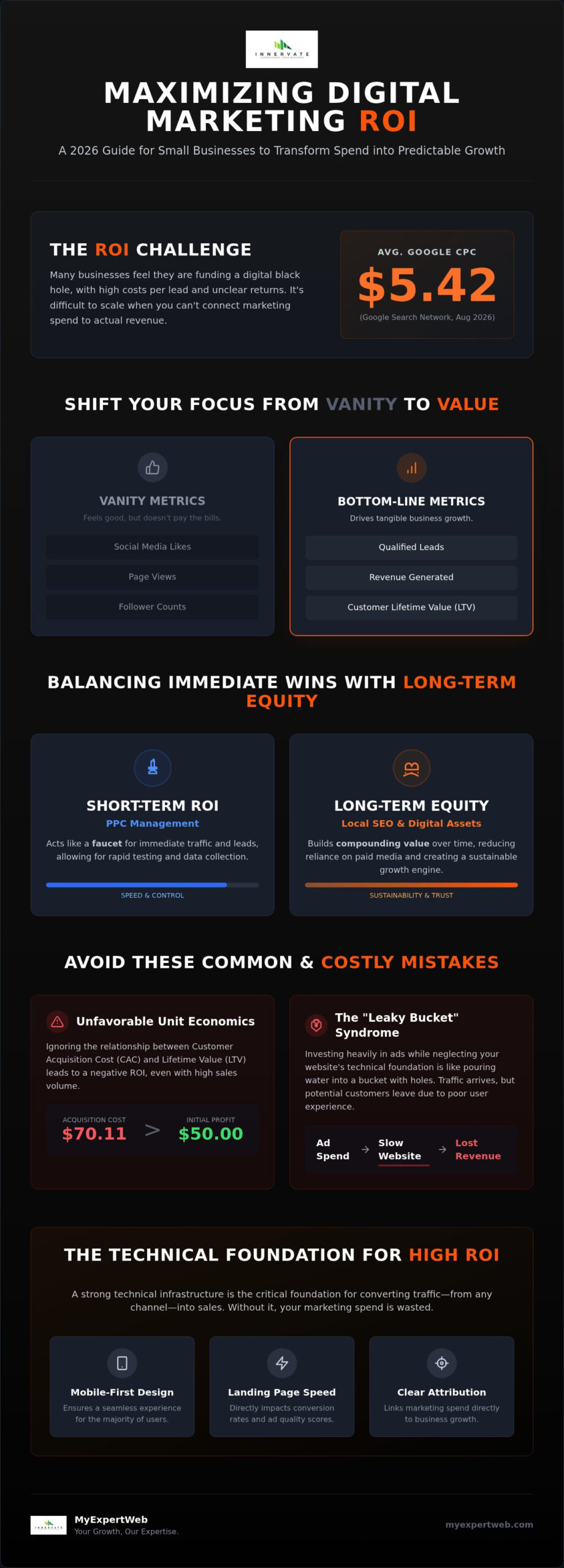
With the average cost per click on the Google Search Network reaching $5.42 in August 2026, many entrepreneurs feel as though they are funding a digital black hole. You likely recognize the frustration of seeing a high cost per lead while your actual digital marketing ROI for small business remains unclear. It is difficult to scale when you cannot track which channel is driving revenue or why a slow website is driving potential customers away. We understand that you need more than just traffic; you need a partnership that prioritizes your unique business goals over generic metrics.
You deserve a predictable lead generation engine that links every dollar spent to tangible revenue. This 2026 guide is designed to help you calculate, track, and maximize your returns through a blend of strategic visibility and technical excellence. We will examine the latest benchmarks for 2026, identify the technical fixes that improve performance, and outline a methodical approach to building a scalable digital presence. By the end of this article, you’ll have a clear roadmap to transform your marketing from a confusing expense into a reliable growth asset.
Key Takeaways
- Learn why shifting from vanity metrics to bottom-line revenue is essential for accurately calculating digital marketing ROI for small business in 2026.
- Identify how to balance the compounding growth of Local SEO with the immediate lead generation potential of professionally managed PPC campaigns.
- Understand why technical infrastructure, such as mobile-first design and landing page speed, serves as the critical foundation for converting traffic into sales.
- Discover a methodical framework for tracking sanity metrics that link your marketing spend directly to long-term business growth.
- Explore how partnering with a strategic outsourcing development team can reduce operational costs while providing access to the technical expertise needed to scale.
Defining Digital Marketing ROI for Small Business in 2026
Digital marketing ROI is the ratio of net profit to total marketing investment, including both spend and labor. In 2026, achieving a healthy digital marketing ROI for small business requires a shift from tracking vanity metrics, such as social media likes or shares, to prioritizing bottom-line metrics like qualified leads and actual revenue. While high engagement numbers feel positive, they don’t always pay the bills. A pragmatic strategy focuses on how every digital touchpoint contributes to the financial health of the company.
We distinguish between short-term returns and long-term equity. Short-term ROI is often driven by PPC Management, which acts like a faucet to generate immediate traffic and testing data. Conversely, long-term equity is built through Local SEO and custom digital assets. These investments provide compounding value, reducing your reliance on paid media over time. Balancing these two timelines is the key to a sustainable and predictable growth engine.
The ROI Equation: Beyond Simple Math
Calculating your Return on Marketing Investment (ROMI) involves more than just looking at your ad dashboard. You must account for the true cost of your campaigns, which includes agency fees, direct ad spend, and the internal time your team spends on management. Many owners overlook the “Lag Effect,” where certain strategies take months to show a positive ratio. It’s also vital to implement clear attribution models. Knowing exactly which channel or technical fix closed a sale allows you to stop wasting budget on underperforming areas and double down on what works.
Why Small Businesses Often Miscalculate Returns
Miscalculations frequently occur when a business ignores the relationship between Customer Acquisition Cost (CAC) and Customer Lifetime Value (LTV). If your average cost per lead on Google Ads is $70.11, but the profit from a single transaction is only $50, your ROI is negative unless you have a high retention rate. Another common mistake is the “Leaky Bucket” syndrome. Many businesses over-invest in trendy platforms while neglecting their technical infrastructure. A slow or confusing website can ruin the conversion rate of even the most expensive ad campaign. Without a high-performance landing page, your digital marketing ROI for small business will remain stagnant despite increased visibility.
High-Impact Channels: Where Small Businesses See the Best Returns
Selecting the right mix of channels is the first step toward a positive digital marketing ROI for small business. Each platform serves a distinct purpose, from the immediate results of paid ads to the long-term equity of organic search. Understanding these Digital Marketing Basics for Small Business helps you allocate your budget where it will have the most significant impact on your bottom line. While social media marketing builds authority and content marketing educates your audience, SEO and PPC remain the primary drivers of revenue for most service-based companies.
Search Engine Optimization requires an upfront investment, typically ranging from $500 to over $3,500 per month for small businesses in 2026. While this may seem high, the cost per acquisition usually drops significantly after the first six months as your organic rankings stabilize. This long-term equity is a major differentiator for businesses that want to move away from the high-pressure cycle of constant ad spend. Content marketing supports this by educating the buyer and reducing friction in the sales cycle, ensuring that once a lead arrives, they are ready to convert.
Local SEO: The Engine for National Visibility
Local SEO acts as the compounding interest of your digital presence. Appearing in the ‘Map Pack’ and organic search results provides a steady stream of high-intent traffic without the recurring cost of a click. Our local seo services focus on building this sustainable foundation, which often serves as the first step toward broader national visibility. By establishing local authority first, you create a scalable model that grows with your business. This organic visibility builds a level of trust with your community that paid ads alone cannot replicate.
PPC and Lead Generation: Managing the Cost Per Acquisition
PPC is the ‘faucet’ you can turn on for immediate lead generation and testing. However, with the average cost per click on the Google Search Network rising to $5.42 in 2026, professional management is essential to prevent budget bleed. The average cost per lead now sits at approximately $70.11, making every conversion critical. Effective PPC Management ensures you aren’t overpaying for low-intent traffic while balancing your ad spend with organic efforts to maintain a diversified ROI profile. This approach captures high-intent searchers at the exact moment they are looking for your services, providing the cash flow needed to fund your long-term growth strategies.
Beyond Ad Spend: Why Technical Infrastructure Dictates Your ROI
Great marketing cannot fix a broken user experience. Many entrepreneurs fall into the “Leaky Bucket” trap, where they invest heavily in traffic only to watch potential customers abandon a slow or confusing website. Protecting your digital marketing ROI for small business starts with a high-performance foundation. In 2026, mobile-first design is a non-negotiable requirement for conversion. If your site doesn’t function flawlessly on a smartphone, you’re essentially subsidizing your competitors’ growth. True success comes from the synergy between integrated web development and SEO services, ensuring that your technical setup supports your visibility goals.
Technical excellence isn’t just about aesthetics; it’s about business utility. When your backend infrastructure is optimized, your cost per acquisition drops because your conversion rate rises. This shift allows your marketing budget to go further, creating a more resilient and profitable digital presence. High-performing sites also enjoy better organic rankings, which provides the long-term equity discussed in previous sections.
Custom Business Applications and ROI
Standard off-the-shelf tools often create friction in the lead-to-sale journey. Investing in custom business application development allows you to build workflows that match your specific operational needs. By automating follow-ups, you ensure that no marketing lead goes to waste. These applications reduce manual data entry and human error, which improves your overall business margins. When your internal systems work efficiently, the indirect boost to your marketing ROI is substantial because you’re converting a higher percentage of leads with less manual effort.
The ROI of Site Speed and Security
There is a direct, measurable correlation between load times and bounce rates. Even a one-second delay can lead to a significant drop in revenue. Security is equally critical; a single data breach can destroy years of brand equity and community trust. This is why secure web application development is essential for maintaining a healthy ROI. According to academic research on effective digital marketing strategies, technical reliability is a cornerstone of small business sustainability. Technical SEO serves as the bridge here, linking your development standards to your marketing success. A fast, secure site doesn’t just please search engines; it provides the professional experience your customers expect.
Measuring What Matters: A Small Business Framework for ROI Tracking
Establishing a clear baseline is the first requirement for a healthy digital marketing ROI for small business. You cannot verify if your strategy is working if you don’t know your starting numbers. We recommend beginning with a pragmatic audit of your current cost per acquisition, lead volume, and website conversion rates. This data serves as the foundation for all future growth, allowing you to see exactly how new campaigns or technical improvements impact your bottom line over time.
We categorize metrics into a hierarchy of “vanity” versus “sanity.” Vanity metrics, such as reach, impressions, or social media likes, indicate visibility but don’t always pay the bills. Sanity metrics focus on conversion rates, cost per lead, and actual revenue. Your “North Star” should be a single, high-level metric—often the net profit generated per marketing dollar—that guides your long-term scaling decisions. By focusing on this number, you avoid the distraction of surface-level engagement and keep your eyes on business viability.
Step-by-Step ROI Tracking Implementation
Reliable data requires a solid technical setup. Integrating your website with a CRM allows you to track exactly where each lead originated, whether it was a local search or a paid ad. By setting up Google Analytics 4 (GA4) for event-based conversion tracking, you can see specific actions like form submissions, phone calls, or button clicks. A critical part of this process is calculating Customer Lifetime Value (LTV). Many owners make the mistake of looking only at the first transaction. If a new client typically stays with your business for several years, you can justify a higher initial acquisition cost, turning a seemingly expensive lead into a highly profitable long-term investment. This perspective is vital for maintaining a positive digital marketing ROI for small business in competitive markets.
Monthly Reporting and Iteration
Data is only useful if it leads to action. A monthly marketing retainer should provide more than a simple summary of clicks; it should include a deep-dive analysis of what those clicks mean for your revenue. This methodical review allows you to identify underperforming channels and reallocate your budget toward the areas with the highest returns in real-time. Building a consistent feedback loop between your sales and marketing teams ensures that lead quality remains high. When sales teams report on which leads actually close, the marketing team can refine their targeting to attract more of those high-value prospects. If you’re ready to move beyond basic reporting, our PPC management and lead tracking services can help you link every marketing dollar directly to your revenue.
Strategic Partnerships: Scaling ROI with Dedicated Digital Expertise
Many entrepreneurs fall into the “DIY Trap,” attempting to manage complex ad campaigns and technical site updates while simultaneously running their daily operations. This approach often results in a lower digital marketing ROI for small business because the owner’s time has a high opportunity cost. When you spend hours troubleshooting a plugin or adjusting keyword bids, you aren’t focusing on the high-level strategy that drives growth. Scaling your returns requires a shift from doing everything yourself to managing a reliable strategic partnership.
Outsourcing provides a pragmatic path to accessing expert talent at a fraction of the cost of a full-time local hire. Utilizing a cost-effective dedicated development team in the Philippines allows you to scale your technical capacity without the financial strain of local recruitment. This model accelerates marketing execution because you have specialists dedicated to the technical infrastructure and data tracking discussed earlier. The best partners understand that digital marketing ROI for small business is the result of code and content working in unison, ensuring your technical foundation supports your visibility goals.
Why a Digital Agency is a Growth Extension
Moving from a “vendor” mindset to a “strategic partner” relationship changes the trajectory of your business. Instead of purchasing isolated services, you gain access to a multi-disciplinary team of SEO experts, developers, and designers under one roof. This collaborative approach ensures that every project is viewed through the lens of your specific business goals. It allows you to focus on your core competencies while experts handle the complexities of technical growth, security, and lead generation. This partnership functions as an extension of your own team, providing the consistency needed for long-term success.
The Long-Term Value of Methodical Guidance
Methodical guidance helps you avoid “shiny object syndrome,” where businesses jump from one trendy platform to another without a clear conversion strategy. A structured marketing roadmap keeps your efforts focused on the channels that provide the best returns for your specific industry. Over time, this consistency builds digital assets, such as high-ranking organic content and custom software, that increase the overall valuation of your business. It is helpful to remember that ROI is not a single event or a one-time fix. It’s a consistent, data-driven process that requires patience, technical excellence, and a commitment to continuous improvement.
Building a Sustainable Growth Engine for 2026
Achieving a strong digital marketing ROI for small business in 2026 requires a shift from surface-level engagement to a focus on technical excellence and data-driven strategy. By prioritizing bottom-line metrics over vanity numbers and ensuring your website is a high-performance conversion tool, you transform your digital presence from a cost center into a predictable revenue generator. We’ve explored how the synergy between Local SEO, professionally managed PPC, and custom software development creates a scalable foundation that grows alongside your company.
MyExpertWeb brings over 12 years of industry experience to help you navigate these complexities. With a proven track record across Australia and international markets, our team provides full-service capabilities ranging from Local SEO to custom software development. We act as a methodical guide and a reliable strategic partner, allowing you to focus on your core business while we handle the technical growth. If you’re ready to stop guessing and start growing, book a free consultation with MyExpertWeb to audit your digital marketing ROI. Your path to a more efficient and profitable digital future starts with a single, data-driven step.
Frequently Asked Questions
What is a good digital marketing ROI for a small business?
A 5:1 ratio is often considered a strong benchmark, though it varies significantly by industry. In competitive sectors like legal services, where the average cost per lead reached $131.63 in 2026, the ratio might be lower during the initial acquisition phase. The goal is to ensure your customer lifetime value exceeds your total acquisition costs. Consistent monitoring helps you maintain a healthy digital marketing ROI for small business as market conditions and advertising costs shift.
How long does it take to see a return on SEO investment?
Most small businesses begin to see measurable returns from SEO within six to twelve months. This timeline accounts for the compounding nature of organic growth and the technical foundation required for high rankings. Unlike paid ads, which stop the moment you stop paying, organic search builds long-term equity for your brand. It requires patience and a methodical approach to technical infrastructure, but the eventual reduction in cost per lead makes it a highly sustainable growth strategy.
Is PPC or SEO better for immediate ROI?
PPC is the superior choice for immediate ROI because it functions like a faucet you can turn on instantly. With the average cost per click on the Google Search Network reaching $5.42 in August 2026, paid ads allow you to capture high-intent searchers immediately. SEO is a long-term play focused on building authority and trust. We recommend a balanced approach where PPC generates quick cash flow while SEO works to lower your overall acquisition costs over time.
How much should a small business spend on digital marketing?
A common benchmark is allocating 5% to 10% of your total revenue to marketing. For those using Google Ads, the average starting budget typically ranges from $1,000 to $2,500 per month. Your specific spend depends on your growth targets and industry competition. It is vital to start with a budget that allows for consistent testing across channels like Local SEO and PPC management to find the most profitable and scalable path for your specific business goals.
Can I track ROI without a complex CRM system?
You can track basic ROI using tools like Google Analytics 4 and simple spreadsheets, though it requires more manual effort. By setting up event-based conversion tracking, you can monitor form submissions and phone calls directly from your website. However, as your digital marketing ROI for small business grows, integrating a CRM becomes essential for linking specific leads to final sales. This technical setup ensures your reporting remains accurate and actionable as your presence and spend increase.
What are the most important metrics for digital marketing success?
Focus on sanity metrics like Cost Per Lead, Conversion Rate, and Customer Lifetime Value. While impressions and likes offer visibility, they don’t always correlate with revenue. In 2026, tracking the lead-to-sale ratio is critical to understanding your true return. By identifying which channels drive the highest quality prospects, you can refine your strategy and ensure every marketing dollar contributes to your long-term business viability and operational ease. Avoid vanity metrics that don’t impact your bottom line.
How does website speed affect my marketing ROI?
Website speed has a direct impact on your conversion rates and overall marketing returns. A slow site increases bounce rates, meaning you are effectively paying for clicks that never have a chance to convert. Technical SEO and custom web development ensure your pages load fast enough to keep high-intent visitors engaged. In a mobile-first world, even a one-second delay can significantly reduce the effectiveness of your ad spend and lower your organic search rankings over time.
Is outsourcing digital marketing more cost-effective than hiring in-house?
Outsourcing is often more cost-effective because it provides access to a full team of specialists at a fraction of the cost of one local hire. A dedicated development team can handle everything from cyber security to landing page design without the overhead of local recruitment. This strategic partnership allows you to tap into 12 years of experience and global perspectives, ensuring your digital presence remains modern and secure while your internal team focuses on core business operations.