


MyExpertWeb Team
August 31, 2026
10 Game-Changing Benefits of Custom ERP for Small Business in 2026
Why should your small business pay a perpetual “subscription tax” for rigid software that forces you to change your proven workflows? It’s a common frustration to juggle multiple tools that refuse to talk to each other, which often leads to manual data entry errors and a fragmented view of your actual performance. When you analyze the benefits of custom ERP for small business, you’ll see that software costs shouldn’t punish your success with aggressive per-user fee hikes or locked features. We believe that your technology should adapt to your unique processes, providing a stable foundation for long-term growth.
This article explores how a tailored system eliminates operational silos, reduces long-term costs, and provides the scalable foundation you need to outpace competitors in 2026. By treating software as a strategic asset rather than a monthly expense, you gain a unified view of your operations and automated workflows that free up your staff for high-value tasks. We will examine ten specific ways a custom-built solution transforms your daily operations into a streamlined, efficient engine for growth.
Key Takeaways
- Learn why the initial investment in custom software often yields a higher ROI than perpetual SaaS fees when calculating the total cost of ownership over a five-year period.
- Explore the core benefits of custom ERP for small business, specifically how tailored workflows allow the software to adapt to your proven processes rather than forcing you to change them.
- Discover a methodical approach to implementation by starting with a Minimum Viable Product (MVP) that addresses your most critical operational bottlenecks first.
- Find out how a dedicated development team model makes bespoke software accessible by bridging the gap between high domestic costs and the need for high-quality, long-term support.
- Understand how owning your intellectual property ensures you can scale departments or features without facing premium tier price hikes or per-user license fees.
What is a Custom ERP and Why Does Your Small Business Need One?
A custom ERP isn’t just a piece of software; it’s a digital architecture designed around your specific business logic. Most small businesses start by using “point solutions”—individual tools like Slack for communication, Xero for accounting, or Shopify for sales. While these are excellent for startups, they eventually create a disjointed environment where data lives in separate, disconnected buckets. Moving toward a unified business engine means integrating these functions into a singular platform. This shift allows you to move beyond basic Enterprise Resource Planning (ERP) concepts and into a space where your software actually mirrors your operational reality.
In 2026, the market is shifting away from rigid, one-size-fits-all platforms because small businesses require greater agility to stay competitive. Off-the-shelf software often dictates how you should work, which limits your ability to innovate or pivot. A custom system provides a “Single Source of Truth.” This means every department looks at the same data in real-time. High data visibility becomes your ultimate competitive advantage because you can make decisions based on facts rather than guesses. One of the primary benefits of custom ERP for small business is this ability to see the entire landscape of your company through a single, clear lens.
The Core Components of a Small Business ERP
A custom system focuses on the parts of your business that drive the most value. Instead of paying for a thousand features you’ll never use, you build only what’s necessary for your operations. This usually includes:
- Inventory and Supply Chain Management: Tailored to your specific niche, whether you’re managing perishable goods or complex manufacturing components.
- Customer Relationship Management (CRM): A system that follows your actual sales process rather than a generic template.
- Financial Reporting: Automated invoicing and reporting that syncs perfectly with your unique workflow.
These components work together to ensure that one action, such as a sales order, triggers the correct response across the entire company without manual intervention.
Signs You Have Outgrown Your Current Software Stack
Many businesses hit what we call the “Spreadsheet Ceiling.” This happens when manual data entry becomes so frequent that it leads to costly human errors and slows down your growth. You might notice that your sales team doesn’t know what is currently in the warehouse, or your finance team is waiting days for reports that should be instant. These are classic symptoms of information silos. The Silo Effect occurs when departments operate in isolation, creating fragmented data pools that prevent the business from acting as a cohesive, agile unit. Recognizing the benefits of custom ERP for small business early can prevent this operational paralysis and keep your team focused on growth.
The Strategic Benefits of Custom ERP for Small Business
Standard software often forces you to bend your operations to fit a rigid template. This approach is counterproductive for companies with specialized workflows that don’t fit into a generic box. One of the primary benefits of custom ERP for small business is that the software adapts to your logic, not the other way around. This flexibility ensures that your unique competitive advantages are preserved and even enhanced by technology. The strategic benefits of ERP systems are most impactful when they allow for unrivaled scalability. Unlike SaaS models that charge more as you grow, a custom system allows you to add features or departments without facing “Premium” tier price hikes. You aren’t just buying a tool; you’re building a scalable foundation for your company’s future.
Owning your software asset also means owning your data. Instead of trusting a third-party provider’s shared cloud, you can host your information in a secure, private environment. This level of control is essential for modern cyber security and long-term data integrity. Real-time business intelligence allows you to make decisions based on live data. You aren’t looking at last month’s reports to solve today’s problems. You’re seeing current stock levels, pending orders, and cash flow in a single, unified view. This immediate visibility transforms how you respond to market shifts and internal challenges.
Operational Efficiency Through Intelligent Automation
Automation is about more than just speed; it’s about accuracy. By eliminating repetitive tasks, you reduce the risk of human error in critical areas like payroll or inventory tracking. Practical applications include:
- Automated order processing that triggers warehouse alerts instantly.
- Data syncing between sales and finance to eliminate double entry.
- Scheduled reporting that arrives in your inbox without manual intervention.
These improvements free up your core team to focus on high-value strategic growth. Working with a reliable partner for custom software development ensures these automations are built to last and evolve with your needs.
Superior Customer Experience and Retention
Your customers expect fast, personalized service. An integrated ERP provides your staff with a complete history of every customer interaction. This means faster response times and service delivery based on actual data-driven insights. Building a custom solution allows you to capture the full benefits of custom ERP for small business by targeting the specific friction points in your customer journey. When a client calls, your team already knows their project status, previous issues, and preferences. This transparency builds trust and improves retention by making the customer feel understood. Accurate project tracking ensures you meet deadlines consistently, which is the most effective way to secure long-term loyalty in a competitive market.
Custom ERP vs. Off-the-Shelf: The Financial Reality
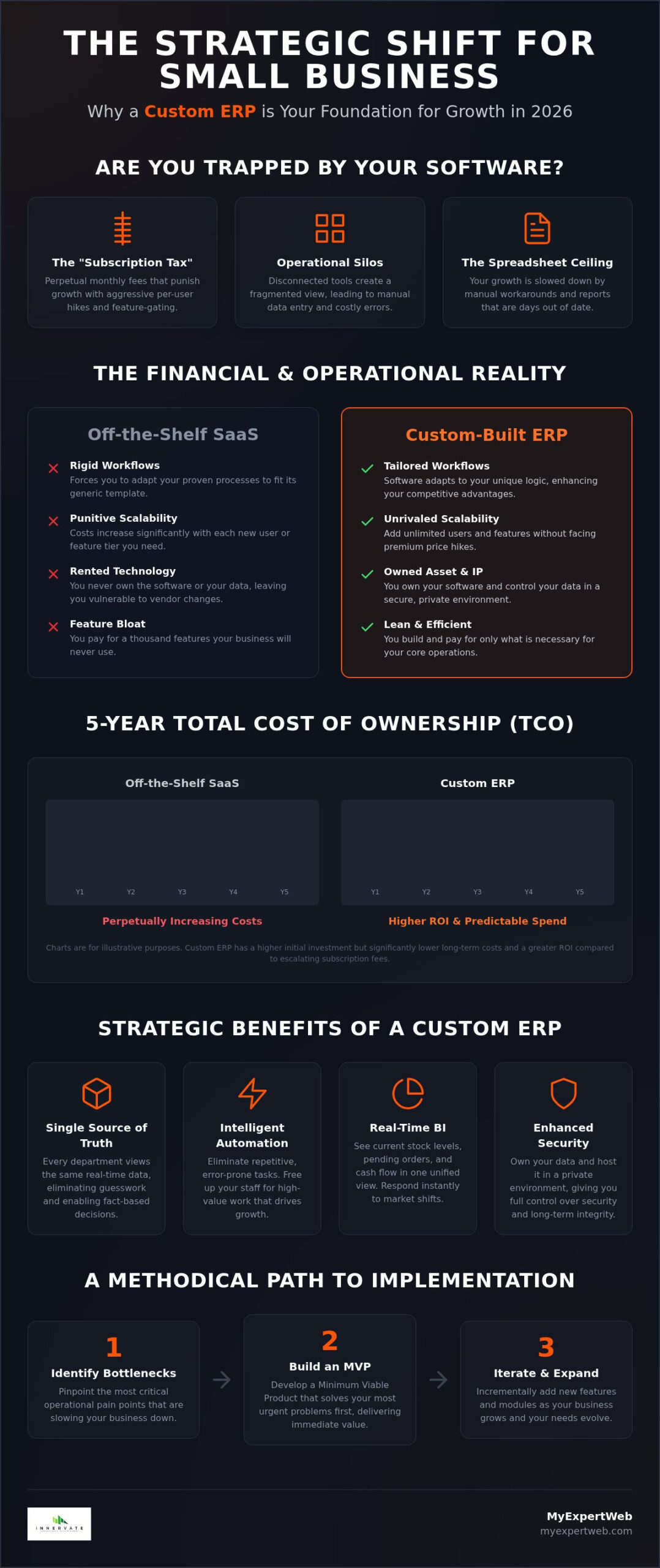
Choosing between a subscription and a custom build is often framed as a simple “cheap vs. expensive” debate. However, the upfront investment fallacy leads many owners to ignore the compounding costs of what we call the “subscription tax.” When you calculate the total cost of ownership (TCO) over a five-year period, the financial benefits of custom ERP for small business become strikingly clear. A custom build is a capital expenditure that creates a tangible asset on your balance sheet. In contrast, monthly subscriptions are operational expenses that never end. Owning your intellectual property increases your business valuation, making your company more attractive to future buyers who value proprietary, efficient systems.
The Hidden Costs of Subscription Software
Subscription models are designed to grow with your revenue, but they often grow faster than your team’s productivity. Per-user licensing fees effectively penalize you for hiring more staff, turning every new employee into a recurring monthly bill. You also have to consider the “integration glue” costs. These are the fees paid for third-party middleware just to make your different apps talk to each other. By 2026, many SMEs are finding that subscription fatigue drains margins as they manage dozens of separate payments for tools that only partially meet their needs. This constant financial leakage makes it harder to reinvest in your core services.
Long-Term ROI of a Custom Solution
The primary financial advantage of a bespoke system is the elimination of licensing fees after the initial development phase. Once the platform is built, you own it. This stability allows for more predictable long-term budgeting. A tailored system also provides customized reporting that identifies specific areas of waste in your current operations, such as inventory spoilage or inefficient labor allocation. By focusing on your exact needs, you avoid the “feature bloat” of off-the-shelf software where you pay for hundreds of tools you’ll never touch. If you’re ready to explore this path, understanding the process of custom business application development is the first step toward reclaiming your software budget. One of the most significant benefits of custom ERP for small business is this transition from a renter to an owner, securing your financial future while building a more agile organization.
How to Plan Your Custom ERP Implementation
Moving from fragmented tools to a unified system is a significant transition that requires a methodical approach. Planning is the bridge between identifying a need and deploying a functional business asset. The journey begins with a thorough audit of your current processes to identify the biggest bottlenecks in your daily operations. You can’t automate a process that isn’t clearly defined, so we start by documenting exactly how work moves through your company. This clarity ensures that the development team builds solutions for real world problems rather than theoretical ones.
One of the long-term benefits of custom ERP for small business is the ability to scale at your own pace. We recommend defining a Minimum Viable Product (MVP) that focuses on your most critical modules first. This approach allows you to see a return on investment sooner while gathering user feedback that informs future updates. Choosing the right tech stack is equally vital; your ERP should be built for 2026 and beyond, using modern frameworks that prioritize speed, security, and integration capabilities.
Phase 1: Discovery and Workflow Mapping
During the discovery phase, we interview department heads to find “hidden” inefficiencies that standard reports often miss. These conversations reveal the manual workarounds and “spreadsheet graveyards” that slow down your team. We then map the entire data journey from lead generation to final delivery, ensuring no information is lost between departments. A key part of this stage is integrating secure web application development principles to protect your proprietary data from the ground up.
Phase 2: Agile Development and Testing
The build phase relies on iterative feedback loops. Rather than waiting months for a finished product, you’ll see regular updates and provide input through agile development. This ensures the final system aligns perfectly with your expectations. We conduct rigorous testing for security and mobile responsiveness, as your team needs access to the ERP from the warehouse, the office, or the field. We also plan for seamless data migration from legacy systems to ensure that your historical records are preserved and accessible in the new environment.
A successful implementation also requires a clear user adoption strategy. Getting your team on board is easier when the software is intuitive and directly solves their daily frustrations. When the system is built around their actual workflows, the learning curve flattens significantly. If you’re ready to move away from rigid platforms, you can connect with our dedicated team to start your workflow audit and build a roadmap for your custom solution.
Making Custom ERP Affordable: The Dedicated Team Model
The primary barrier to bespoke software is often the perceived entry cost. For many owners, the idea of building a system from scratch feels like an enterprise-level luxury. However, the dedicated team model bridges the gap between these financial concerns and the need for high-performance software. By utilizing a managed extension of your company, you can access specialized talent that focuses exclusively on your business logic. This approach moves away from the transactional nature of one-time vendors and toward a long-term partnership that values the stability and growth of your digital assets.
The Philippines has emerged as the leading destination for custom ERP development in 2026. This isn’t just about labor costs; it’s about a deep pool of technical talent that understands the nuances of Western business processes. Cultural and linguistic alignment ensures that project management remains smooth and requirements aren’t lost in translation. When you choose this path, you secure the core benefits of custom ERP for small business: ownership of your intellectual property and a platform that scales without per-user penalties.
Leveraging Offshore Talent for High-Value Projects
Building a custom solution locally often carries a price tag that forces SMEs back into the cycle of rigid SaaS subscriptions. A dedicated offshore team can reduce development costs by up to 60% while maintaining high technical standards. This financial flexibility allows you to reinvest those savings into other areas of your business, such as marketing or product development. Understanding the cost of hiring developers in philippines is essential for any leader looking to modernize their tech stack responsibly. You don’t have to sacrifice technical excellence for affordability; you simply need a model that optimizes your budget.
Partnering with MyExpertWeb for Your ERP Journey
We’ve spent over 12 years helping businesses navigate the complexities of digital transformation. Our approach isn’t just about writing code; it’s about acting as a strategic guide that understands your operational goals. We focus on building secure, scalable business applications that serve as the engine for your company’s growth. By providing a dedicated team, we ensure that your software remains a living asset that we update and refine as your needs evolve. This partnership provides the peace of mind that comes from having an expert ally in your corner. If you’re ready to eliminate silos and take control of your data, Contact MyExpertWeb for a free consultation on your custom ERP needs and discover how a tailored system can redefine your efficiency.
Secure Your Operational Future with a Tailored System
Transitioning from fragmented tools to a unified engine is no longer just an option for growth; it’s a necessity for maintaining a competitive edge. By owning your intellectual property and eliminating the perpetual “subscription tax,” you transform your software from a monthly expense into a valuable business asset. The primary benefits of custom ERP for small business lie in this long-term stability and the ability to automate workflows that are unique to your specific niche. We’ve seen how a methodical approach to implementation, starting with a clear audit and an MVP, ensures that your technology remains a supportive partner rather than a rigid constraint.
With 12+ years of software excellence, MyExpertWeb provides the scalable and secure architecture your company needs to thrive. Our dedicated support teams act as an extension of your own staff, guiding you through every phase of development and deployment. Ready to own your software? Book a free consultation with MyExpertWeb today. Taking control of your data today builds the foundation for a more efficient and profitable tomorrow.
Frequently Asked Questions
Is a custom ERP too expensive for a business with fewer than 50 employees?
No, custom ERP isn’t just for large corporations. By leveraging dedicated offshore teams, small businesses can build tailored systems at a fraction of local development costs. One of the main benefits of custom ERP for small business is that it replaces multiple monthly SaaS subscriptions with a single, owned asset. This eliminates the subscription tax that often penalizes growth, making it a viable financial strategy for companies with fewer than 50 employees.
How long does it typically take to build a custom ERP for a small business?
Most custom ERP projects for small businesses reach the Minimum Viable Product (MVP) stage within three to six months. This timeline depends on the number of modules required, such as inventory or CRM. Using an agile development process allows you to start using critical features early while the rest of the system is built in iterations. This methodical approach ensures the software remains aligned with your operational needs as the project progresses.
Can a custom ERP integrate with my existing accounting software like Xero?
Yes, seamless integration with existing tools like Xero or Shopify is one of the biggest advantages of bespoke software. We design the system to communicate directly with your current accounting or e-commerce platforms through secure APIs. This eliminates the need for manual data entry and ensures that your financial reports are always accurate. A custom solution acts as the central engine that pulls data from all your essential business tools.
What happens to my data if I decide to switch systems in the future?
You maintain full ownership of your data and the software’s intellectual property. Unlike many SaaS platforms that make it difficult to export your information, a custom system gives you direct access to your database architecture. If you decide to switch systems in the future, your data is stored in a clean, structured format that simplifies migration. This level of control is a critical part of building a secure, long-term business asset.
Do I need a full-time IT person to manage a custom ERP system?
You don’t need to hire a dedicated internal IT person to manage the system. When you partner with a strategic guide like MyExpertWeb, our dedicated development teams act as an extension of your company. We handle the technical maintenance, security updates, and feature enhancements on your behalf. This managed model allows you to focus on high-value strategic growth while we ensure your software continues to perform at its peak.
Is custom software more secure than popular off-the-shelf SaaS platforms?
Custom software provides a private, secure environment that isn’t shared with thousands of other companies. Popular SaaS platforms are multi-tenant environments, which can sometimes be targets for large-scale attacks. By building a custom system, you can implement specific cyber security protocols that match your unique risk profile. Owning the environment means you control the access levels and encryption standards, providing a level of protection that generic platforms often can’t match.
Can I build my custom ERP in stages to manage the initial investment?
Yes, building in stages is the most pragmatic way to manage your investment. We recommend starting with a Minimum Viable Product that addresses your most painful operational bottlenecks first. Once those core modules are functional and delivering ROI, you can reinvest those gains into secondary features. This modular approach ensures that your team isn’t overwhelmed by too many changes at once while keeping the initial development costs more manageable.
How does a custom ERP help with business scalability?
Custom software scales by adapting to your increasing complexity without increasing your per-user costs. One of the major benefits of custom ERP for small business is the ability to add new departments or features without being forced into a premium subscription tier. As your transaction volume grows, the system’s architecture remains stable and efficient. You own a tool that expands alongside your company, providing a reliable foundation for national or international growth.