


MyExpertWeb Team
September 4, 2026
Custom Business Application Development: The 2026 Strategic Growth Guide
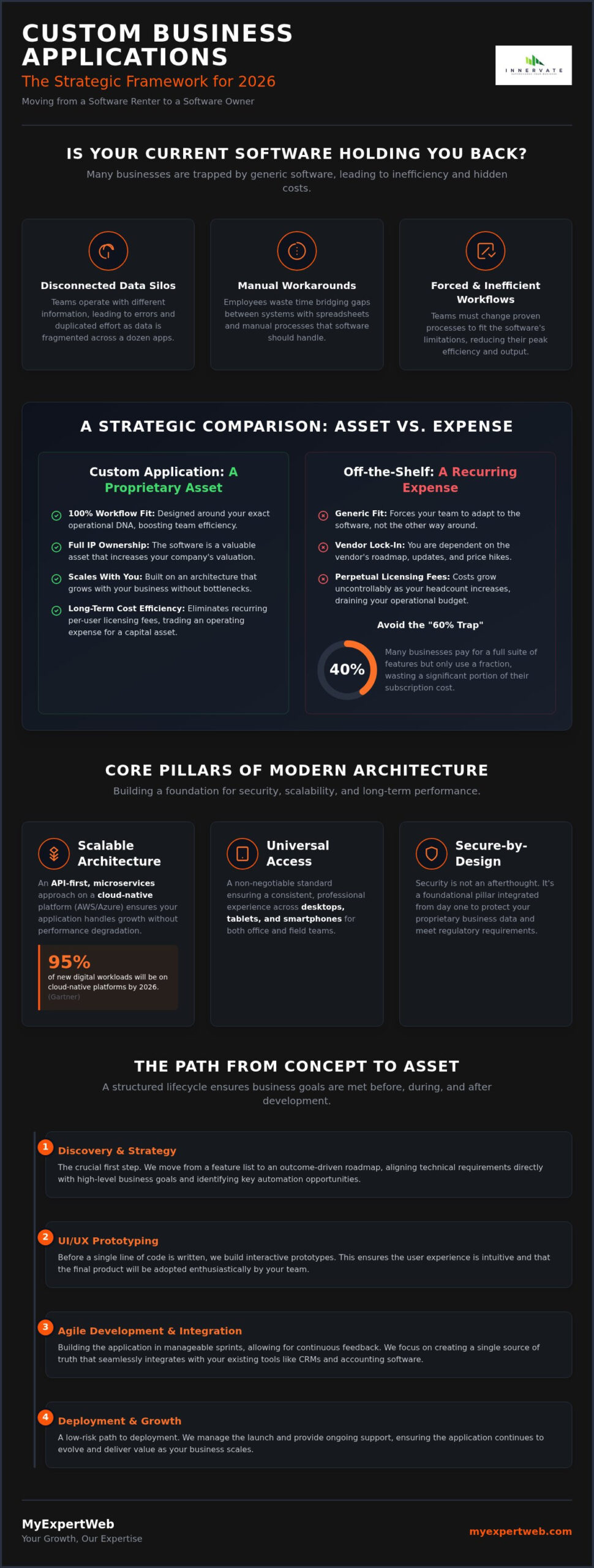
What if the enterprise software you’re paying for is actually the very thing slowing your Australian business down? Many leaders find themselves trapped in a cycle of manual workarounds and disconnected data silos because their “off-the-shelf” solutions don’t reflect their unique operational logic. You likely feel the frustration of paying for a suite of features your team never touches while still needing spreadsheets to bridge the gaps. Investing in custom business application development isn’t just about writing code; it’s about building a proprietary asset that fits your workflows like a glove. It’s a shift from being a software renter to a software owner.
This guide explores how to transform your specific business challenges into scalable, secure software that grows with you. We’ll show you how to eliminate per-user licensing fees and reclaim full ownership of your intellectual property. You’ll learn the strategic framework for 2026 that ensures your new system integrates seamlessly with your existing tools while providing the robust security your clients expect. From identifying high-impact automation opportunities to choosing a hybrid development model that balances local oversight with global efficiency, we’re laying out the roadmap for long-term ROI and operational freedom.
Key Takeaways
- Understand the shift from feature-based lists to outcome-driven custom business application development that aligns software directly with your unique operational logic.
- Learn how cloud-native architectures and microservices provide a secure, scalable foundation that adapts to your growth without performance bottlenecks.
- Avoid the “60% Trap” by comparing the long-term Total Cost of Ownership (TCO) between generic subscriptions and proprietary software assets.
- Discover why a robust discovery phase and UI/UX prototyping are essential for ensuring technical builds meet high-level business goals before development begins.
- Identify how a hybrid partnership model combines Australian strategic oversight with global execution to provide a cost-effective, low-risk path to deployment.
What is Custom Business Application Development in 2026?
Custom business application development is the process of designing and building software specifically around your company’s unique operational DNA. It moves beyond generic solutions to create a digital engine that mirrors your exact workflows. In the current market, we’ve seen a decisive shift from “feature-focused” development to “outcome-driven” results. This means instead of checking off a list of standard tools, the focus is on solving specific bottlenecks that hinder your growth. For Australian SMEs, these applications aren’t just tools; they’re high-value intellectual property (IP) that directly increases the valuation of the business.
Consolidating fragmented systems is a primary driver for these projects. Most companies struggle with “software sprawl,” where teams use a dozen disconnected apps to manage a single process. This fragmentation leads to data silos and manual workarounds that drain productivity. By building a single source of truth, you eliminate the need for double-handling data and ensure that every department operates from the same real-time information. It’s a pragmatic approach to digital transformation that prioritises operational clarity over technical complexity.
Custom vs. Bespoke: Understanding the Modern Terminology
The industry is moving away from generic terms like “custom software” in favour of “business application development” to emphasise utility and business logic. While low-code solutions have gained popularity for simple tasks, they often hit a functional ceiling that prevents long-term scaling. Custom builds provide the flexibility to evolve as your market changes. By following a modern development lifecycle, you ensure your system is built on a robust, professional foundation. For Australian business owners, the most critical distinction is source code ownership. Unlike subscription models, owning your code means you aren’t beholden to a vendor’s roadmap or price hikes.
The Strategic Value of Tailored Software
Generic SaaS platforms often force your team to change their proven processes to fit the software’s limitations. Tailored software achieves a 100% fit for your workflows, allowing your team to work at peak efficiency without fighting the interface. This alignment drives long-term cost efficiency by removing the recurring burden of per-user monthly licensing fees, which can become astronomical as your headcount grows. You’re essentially trading a perpetual operating expense for a capital asset. Custom business application development is a strategic asset that allows businesses to scale operations without increasing overhead proportionally.
Core Pillars of Scalable and Secure Application Architecture
Building for 2026 requires more than just functional code; it demands an architecture that handles growth without performance degradation. Gartner predicts that by 2026, 95% of new digital workloads will be deployed on cloud-native platforms. Leveraging AWS or Azure isn’t just about hosting. It’s about using serverless functions and auto-scaling groups to ensure your application remains responsive during peak Australian business hours. This cloud-native approach allows your infrastructure to expand automatically as your user base grows.
The choice between microservices and monolithic architecture is a foundational decision for future growth. While a monolithic setup might suit simpler projects, microservices allow you to scale individual components independently. This modularity is vital for custom business application development that needs to integrate with a global tech ecosystem. An API-first development strategy ensures your system communicates seamlessly with external tools, from accounting software to CRM platforms, creating a unified digital environment.
Mobile-friendly and responsive design is now a non-negotiable standard, especially for field operations. Australian businesses often require staff to access data from remote job sites or warehouses where connectivity varies. A responsive interface ensures that your application provides a consistent, professional experience across desktops, tablets, and smartphones, keeping your team productive regardless of their location.
Secure-by-Design: Protecting Proprietary Business Data
Security isn’t a layer you add at the end of a project. It’s a foundational pillar that must be integrated from day one. In 2026, regulatory frameworks like ISO 42001 mandate a “shift-left” approach where security starts at the first line of code. Protecting your data requires a multi-layered strategy:
- Multi-factor authentication (MFA): Prevents unauthorised access even if credentials are compromised.
- Role-based access control (RBAC): Ensures employees only access the specific data needed for their roles.
- Advanced Encryption: Using AES-256 for data at rest and TLS 1.3 for data in transit to keep proprietary information private.
For a deeper look at protecting your digital assets, you can explore our Secure Web App Development: Strategic Guide for 2026.
Future-Proofing with Modern Tech Stacks
Selecting the right technology stack prevents expensive technical debt. Laravel and React remain the gold standard for robust business apps because they offer extensive support and maintainability. These frameworks allow for rapid prototyping while ensuring the final product is stable. We’re also seeing AI and machine learning play a larger role in automating routine data entry and generating predictive reports, which saves your team hours of manual work. Ensuring code maintainability is vital so your software remains an asset rather than a legacy burden. If you’re ready to build a system that scales, our custom software development experts can help you architect a solution that balances current operational needs with long-term viability.
Custom vs. Off-the-Shelf: A Strategic Comparison Framework
Many Australian business owners begin their digital journey with off-the-shelf SaaS products because they offer a low barrier to entry. However, most eventually encounter the “60% Trap.” This occurs when a generic platform solves the majority of your needs, but the remaining 40% requires inefficient manual workarounds, spreadsheets, and double-handling of data. Over a 3-to-5-year operational horizon, the Total Cost of Ownership (TCO) for these “affordable” subscriptions often balloons. When you factor in per-user licensing fees and the hidden labor costs of managing fragmented workflows, the initial savings quickly evaporate.
Integration friction is another silent killer of productivity. Relying on “glue code” or third-party automation tools to link disconnected SaaS apps creates a fragile digital ecosystem. If one platform changes its API or updates its terms, your entire operational flow can grind to a halt. Choosing custom business application development allows you to build a unified system where every module is designed to work in harmony. This eliminates the need for fragile intermediaries and ensures your data remains consistent across every department.
When Off-the-Shelf Software is the Right Choice
Generic software isn’t always the enemy. For low-complexity tasks like standard accounting, email marketing, or basic document storage, a standard SaaS product is often the most logical choice. These platforms serve as an excellent “Minimum Viable Product” (MVP) for testing new business ideas without a significant upfront investment. If your operational process is a commodity that doesn’t provide a competitive edge, buying a subscription is a pragmatic way to get started. It’s only when your unique business logic starts to clash with the software’s rigid structure that you need to reconsider your approach.
The Tipping Point: Identifying When to Go Custom
You’ve reached the tipping point when your software begins to dictate your business processes rather than supporting them. Signs of this liability include staff spending more time “fixing” data than using it, or hitting scalability bottlenecks where your SaaS provider’s limits on data storage or API calls hinder your growth. Transitioning to a proprietary build allows you to turn your operational efficiency into a unique competitive advantage that your rivals simply cannot buy off a shelf. For a deeper look at how this fits into your long-term roadmap, see The Strategic Guide to Custom Business Application Development in 2026. Investing in a tailored asset ensures your technology remains a driver of growth rather than a ceiling on your potential.
The Modern Development Lifecycle: Discovery to Deployment
The lifecycle of building professional software is often misunderstood as a purely technical exercise. In reality, successful custom business application development is a strategic journey that begins long before the first line of code is written. While some firms prioritise rapid deployment at all costs, a methodical approach ensures the final product actually solves the operational challenges we’ve discussed. This process relies heavily on UI/UX prototyping to visualise the user journey. By creating interactive mockups, stakeholders can refine the interface and functionality before expensive development begins. Agile development sprints then maintain transparency, using iterative feedback loops to ensure the project stays aligned with your evolving business needs and market conditions.
The Discovery Phase: The Foundation of Project Success
Mapping complex workflows is the first step in building a reliable system. During this phase, we identify key user personas within your company, from field technicians to executive leadership, to ensure the software serves every level of the organisation. We focus on understanding the specific friction points of each persona to ensure the final build provides genuine utility. Defining measurable KPIs, such as a reduction in data entry time or improved reporting accuracy, allows you to track the application’s real-world impact on your bottom line. A thorough discovery phase creates a clear technical roadmap that prevents costly mid-project scope changes and timeline delays.
Post-Launch Maintenance and Continuous Improvement
Deployment is the beginning of a new phase, not the end of the partnership. The first 90 days post-launch are critical for user adoption and refinement, as real-world usage often reveals opportunities for further optimisation. We monitor how your team interacts with the system to identify any friction points that weren’t apparent during testing. Modern DevOps practices ensure that software updates and security patches occur with zero downtime, keeping your operations running smoothly without interruption. If your project includes a field component, you can find cross-platform deployment tips in our Choosing a Mobile App Development Company: 2026 Guide. Rigorous Quality Assurance (QA) and User Acceptance Testing (UAT) protocols are the final safeguards that ensure your application is production-ready and secure. If you’re ready to start your journey, our outsourcing development team can guide you through every stage of this lifecycle.
Selecting a Strategic Partner for Long-Term Viability
Choosing a partner for custom business application development is one of the most significant decisions a leader can make. It’s not merely about finding a vendor who can write code; it’s about securing a strategic ally who understands your industry’s nuances and can provide long-term stability. In the current Australian market, many firms offer either expensive local-only consulting or pure offshore execution. Neither extreme is ideal for most SMEs. The most effective strategy for 2026 is the hybrid model. This approach combines Australian-standard strategic oversight and high-level project management with the technical execution and cost-efficiency of global development talent.
Transparency and communication are the primary predictors of project success. Without a clear feedback loop, even the most talented developers can lose sight of high-level business goals. This is why we advocate for dedicated teams over project-based freelancers. While freelancers might be suitable for minor tasks, they often lack the deep system knowledge required for ongoing support. A dedicated team stays with you, retaining the institutional knowledge of your unique business logic and ensuring that future updates are handled by experts who already understand your architecture’s core pillars.
Evaluating Technical Expertise and Cultural Alignment
Assessing a development portfolio requires looking beyond aesthetics to find depth in complex business logic. You need to see evidence of systems that handle intricate workflows and secure data management. Technical expertise is the baseline, but cultural alignment and operational compatibility are what make the partnership work. Time-zone alignment and high English proficiency are essential for maintaining the transparency needed to prevent project drift. For companies looking to scale their capacity without the overhead of local hiring, we’ve developed a framework in our Cost of Hiring Developers in the Philippines: The 2026 Strategic Guide. Vetting for business acumen ensures your developers understand your industry, not just the code they’re writing.
The MyExpertWeb Advantage: Your Methodical Guide
With over 12 years of industry experience, we’ve built our reputation on bridging the gap between business needs and technical reality. We don’t just build features; we architect secure, mobile-friendly, and scalable systems that act as a foundation for your company’s growth. Our methodical approach ensures that every project is built with a “secure-by-design” philosophy, protecting your proprietary IP from the very first sprint. By positioning our outsourcing development team as a seamless extension of your own operations, we provide the quiet confidence you need to lead your digital transformation. We’re a steady, results-focused ally dedicated to your long-term viability and operational excellence.
Building Your Digital Competitive Advantage for 2026
The transition from being a software renter to a software owner is a pivotal moment for any growing Australian business. By moving beyond the “60% trap” of generic SaaS and investing in custom business application development, you’re creating a proprietary asset that mirrors your unique operational logic. We’ve explored how a secure, cloud-native architecture and a methodical discovery phase ensure your system remains scalable and resilient. This strategic shift doesn’t just eliminate manual workarounds; it builds a foundation for long-term ROI and operational freedom.
Success in this space requires a partner who balances global execution with local strategic oversight. With over 12 years of industry experience, MyExpertWeb provides the end-to-end service needed to turn technical requirements into business growth. Our dedicated teams act as an extension of your company, ensuring your software remains a high-value asset rather than a legacy burden. If you’re ready to reclaim ownership of your workflows, book a free consultation with MyExpertWeb to discuss your custom application strategy. We’re here to help you navigate the complexities of 2026 and beyond with quiet confidence.
Frequently Asked Questions
How much does custom business application development typically cost in 2026?
Costs are determined by the complexity of the business logic and the depth of integration required. A production-ready Minimum Viable Product (MVP) typically requires a different investment level than a multi-module enterprise system. We focus on transforming your software from a recurring subscription expense into a proprietary capital asset. This approach prioritises long-term ROI by eliminating per-user licensing fees while building a system that scales alongside your Australian business operations.
How long does it take to move from discovery to a launched custom application?
Launching a production-ready application generally takes between three to nine months depending on the project’s scope. The discovery and strategy phase usually occupies the first four weeks to ensure technical requirements align with your business goals. Following this, agile development sprints allow for iterative feedback and testing. This methodical pace ensures that the final product is stable, secure, and ready for your team to use without significant post-launch disruptions.
Will my business own the full source code and intellectual property?
Yes, you retain full ownership of the source code and all intellectual property upon project completion. Full IP ownership is a primary advantage of custom business application development as it directly increases your company’s valuation. Unlike SaaS platforms where you essentially rent access, owning your software means you have total control over your digital roadmap. This autonomy allows you to modify the system or scale it without ongoing vendor permission or additional fees.
Can a custom application integrate with my existing CRM or accounting software?
Custom builds are designed with an API-first architecture to ensure seamless integration with your existing CRM or accounting tools. Whether you use Xero, Salesforce, or proprietary industry software, we build bridges that allow data to flow without manual entry. This connectivity eliminates the data silos that often hinder operational efficiency. By creating a unified ecosystem, your custom application becomes the central source of truth for all your business-critical information.
What is the difference between a dedicated development team and a fixed-price project?
A dedicated development team acts as a permanent extension of your internal staff, while a fixed-price project is limited to a specific, one-time scope. Dedicated teams are ideal for long-term viability because they retain deep institutional knowledge of your system. This model allows for continuous improvement and rapid responses to market changes. Fixed-price projects are better suited for simple, well-defined tasks that don’t require ongoing evolution or strategic scaling.
How do you ensure the security of sensitive business data in a custom build?
Security is integrated into the foundation of every build through a secure-by-design philosophy. We implement multi-factor authentication (MFA), role-based access control (RBAC), and advanced encryption for data both at rest and in transit. Our process aligns with modern standards like ISO 42001 to protect your proprietary business data from evolving threats. Regular security audits and automated compliance checks ensure your application remains a safe environment for sensitive customer and financial information.
Do I need to have a technical background to manage a custom development project?
You don’t need a technical background to successfully lead a development project. Our role as your strategic partner is to translate your business needs into technical reality through a methodical discovery process. We handle the architectural complexity while you focus on the operational logic and user requirements. Clear communication and regular feedback loops ensure you remain in control of the project’s direction without needing to understand the underlying code.
What kind of ongoing maintenance does a custom business application require?
Ongoing maintenance involves performance monitoring, security patches, and periodic updates to ensure compatibility with new operating systems. A healthy application requires regular DevOps oversight to maintain zero downtime during updates. We also focus on refining the user experience based on real-world feedback during the first 90 days post-launch. This proactive approach prevents technical debt from accumulating and ensures your software continues to deliver high-level performance as your business grows.