


MyExpertWeb Team
September 6, 2026
Streamlining Business Processes with Technology: The 2026 Strategic Guide
The global ERP software market is projected to reach $81 billion in 2026, according to Technova Partners, yet many organizations still find themselves trapped in a cycle of manual data entry and disconnected tools. It’s a frustrating reality where software meant to help actually creates more work. If you’ve noticed your overhead costs climbing while your team’s output remains stagnant, you aren’t alone. Achieving true operational excellence requires a shift in focus toward streamlining business processes with technology in a way that prioritizes harmony over just adding more subscriptions.
We understand that the path to digital transformation can feel overwhelming when your current systems don’t talk to each other and visibility into performance is clouded. You deserve a clear, manageable approach to modernization that respects your unique business needs. In this guide, we’ll show you how to identify specific points of friction within your workflows and implement custom solutions that deliver measurable efficiency. We’ll explore a strategic roadmap for tech adoption, from hyperautomation to dedicated development teams, designed to reduce your costs and provide the clarity you need to lead with confidence.
Key Takeaways
- Understand how the shift toward proactive, AI-driven automation in 2026 is replacing reactive fixes to fundamentally redefine operational efficiency.
- Discover the most effective methods for streamlining business processes with technology by focusing on the convergence of cloud, mobile, and secure data handling.
- Compare the long-term value of custom software against the hidden integration costs and per-user pricing models often found in standard SaaS platforms.
- Learn a methodical 4-step framework to audit your current workflows and identify the specific friction points where manual errors and data silos occur.
- Explore how strategic partnerships and dedicated offshore development teams provide the technical expertise needed to scale your business capabilities.
Understanding Business Process Streamlining in the AI Era
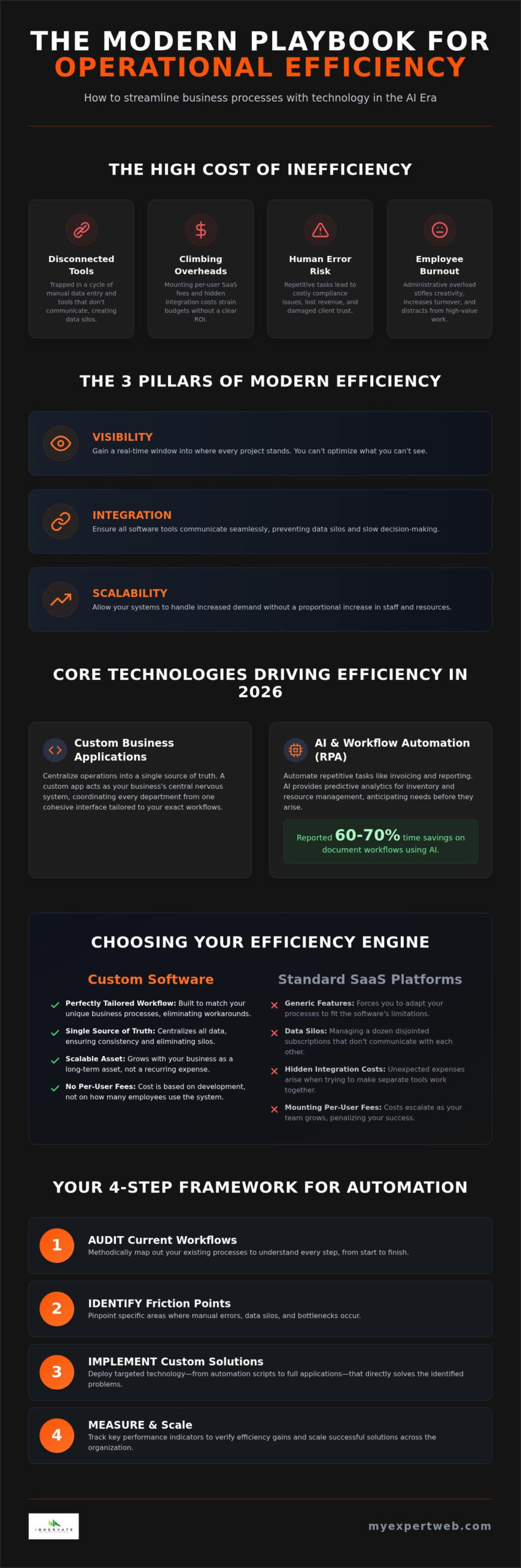
Streamlining is more than a corporate buzzword; it’s the methodical removal of friction from your daily operations. In previous years, businesses focused on simply digitizing paper records, but the landscape has changed. Today, streamlining business processes with technology means creating a unified ecosystem where data drives immediate action. By 2026, we’ve seen a definitive shift from reactive fixes to proactive, AI-enabled automation. This evolution allows leaders to move beyond basic task completion toward sophisticated Business Process Management strategies that predict bottlenecks before they occur. The primary objective is to reclaim human time, allowing your team to focus on high-value strategic work rather than administrative maintenance.
The Core Pillars of Modern Operational Efficiency
True efficiency rests on three foundational elements that ensure your technology works for you. First, visibility provides a real-time window into exactly where every project or transaction stands. You can’t optimize what you can’t see. Second, integration ensures that your software tools communicate without manual intervention, preventing data silos that slow down decision-making. Finally, scalability allows your systems to handle increased demand without requiring a proportional increase in your staff numbers. When these pillars are strong, your business moves with a level of precision that manual systems simply can’t replicate.
Why Manual Processes are Failing Businesses in 2026
Relying on manual entry and disconnected spreadsheets is no longer just inconvenient; it’s a significant financial risk. Human error in data-sensitive industries can lead to costly compliance issues and lost revenue. Beyond the bottom line, repetitive administrative tasks are a primary driver of employee burnout. This exhaustion stifles creativity and increases turnover at a time when talent is harder to retain. As we move through 2026, agile competitors are using custom applications to outpace traditional models. If your team is stuck updating rows of data, they aren’t spending time innovating or building client relationships. Modern streamlining business processes with technology isn’t just about speed; it’s about survival in an increasingly automated marketplace.
5 Core Technologies Driving Efficiency in 2026
By 2026, the gap between market leaders and those struggling to keep up is defined by how well they integrate cloud, mobile, and secure data handling. It’s no longer enough to have a collection of separate tools; these technologies must converge into a unified ecosystem. For small and medium enterprises, this convergence is the key to streamlining business processes with technology, ensuring that information moves instantly from a field technician’s mobile device to the central database and finally into an executive dashboard. This interconnectedness provides the visibility needed to make fast, data-driven decisions.
Custom Business Application Development
A tailored application provides a significant advantage over managing a dozen disjointed SaaS subscriptions that don’t communicate with each other. Instead of paying mounting per-user fees for generic features you don’t use, businesses are increasingly centralizing their operations into a single source of truth. A custom application acts as the central nervous system of a modern business, coordinating every department from a single, cohesive interface. This approach eliminates the friction of switching between platforms and ensures that your data remains consistent across the entire organization. If you’re looking to build a foundation for growth, custom business application development offers a path to a system that fits your specific workflow perfectly.
AI and Workflow Automation (RPA)
Artificial intelligence has moved from a novelty to a practical necessity for daily resource management. Robotic Process Automation (RPA) now handles the repetitive, “boring” administrative tasks like invoicing, scheduling, and reporting that often lead to human error. Organizations are currently reporting 60-70% time savings on document workflows by using Intelligent Document Processing with AI. Beyond simple automation, these systems provide predictive analytics for inventory and resource management, allowing you to anticipate client needs rather than reacting to shortages. This reduces the need for constant manual oversight, freeing your management team to focus on high-level strategy.
Mobile-First Design and Cyber Security
With remote and field operations becoming the standard, mobile-first design is essential for maintaining a competitive edge. Systems must be accessible and fully functional on any device to ensure that your team stays productive regardless of their location. However, as your systems become more connected and accessible, the role of robust cyber security becomes paramount. Streamlining business processes with technology only delivers long-term value if those processes are protected from external threats. A secure infrastructure ensures that your efficiency gains aren’t compromised by data breaches, providing the reliable stability your team and clients expect.
Custom Software vs. SaaS: Choosing Your Efficiency Engine
Deciding how to power your operations often comes down to a choice between renting a generic platform or building a proprietary system. Software as a Service (SaaS) offers a “rent” model that is attractive for its low initial barrier to entry. However, as your organization grows, the per-user pricing models can become a significant burden. For example, Salesforce Sales Cloud Unlimited tiers reached $350 per user monthly in 2026, while Oracle NetSuite starts at $999 per month plus additional per-user fees. When you factor in the integration fees required to make these tools talk to each other, the “affordable” rental often becomes more expensive than a dedicated build over a three to five-year period.
Owning your infrastructure provides a level of long-term ROI that rental models can’t match. When you invest in custom software, you’re building a business asset that you own entirely, free from sudden price hikes or forced feature changes. This ownership is central to streamlining business processes with technology because it allows you to dictate exactly how your data flows. Instead of bending your workflows to fit a software’s limitations, the software is engineered to support your specific operational goals. This alignment is what transforms a simple tool into a true efficiency engine.
When to Stick with Off-the-Shelf Solutions
Generic SaaS tools still have a place in a modern ecosystem, particularly for non-core functions. Basic accounting, email, and internal communication are areas where off-the-shelf solutions excel. For instance, Microsoft Teams Essentials remains a cost-effective choice at $4 per user per month for standard collaboration. Startups often benefit from the speed-to-market these tools provide, allowing them to launch without waiting for a full development cycle. The limitation arises when these “fixed” features stop supporting your growth or create manual workarounds because the software lacks a specific, industry-required function.
The Strategic Case for Custom Business Applications
Custom builds are reserved for the processes that define your competitive advantage. If your workflow involves unique industry pain points that standard software ignores, a tailored solution is the only way to achieve peak efficiency. By developing proprietary technology, you create a barrier to entry for competitors who are still struggling with the same manual friction points you’ve eliminated. This approach ensures your system evolves alongside your business needs without the friction of third-party updates. To explore this further, read The Strategic Guide to Custom Business Application Development in 2026. Building your own platform is a commitment to professional excellence and long-term viability in a crowded market.
A 4-Step Framework for Auditing and Automating Workflows
Transitioning from manual workflows to automated systems requires more than just buying a license; it demands a structured approach. Streamlining business processes with technology is most successful when you treat it as a partnership between your operational needs and your technical capabilities. Without a clear audit, you risk automating an inefficient process, which only leads to faster mistakes. A methodical framework ensures that every dollar spent on tech adoption directly addresses a verified business bottleneck rather than just adding another layer of complexity.
Step 1 & 2: Process Mapping and Pain Point Identification
The first stage involves uncovering the “shadow workflows” that exist in almost every office. These are the unofficial spreadsheets and manual workarounds your team uses because your current tools don’t meet their needs. By interviewing staff across different departments, you can identify exactly where data gets stuck or requires manual re-entry. It’s vital to measure the actual time and dollar cost of these manual tasks. For example, if a senior manager spends four hours a week manually reconciling reports, that’s a clear friction point with a high cost of ownership. Visualizing the flow of data from the first lead to the final delivery reveals the handoff points where errors are most likely to occur. This deep dive ensures that your future tech implementation is grounded in user-centric design rather than just executive assumptions.
Step 3 & 4: Prioritization and Pilot Implementation
After identifying your pain points, you must rank them by their potential for impact and ease of implementation. We recommend using a “Quick Win” vs. “High Impact” matrix to guide your tech adoption roadmap. Focus on processes that offer the highest scalability potential, where automation allows you to triple your output without increasing your headcount. Instead of attempting a total overhaul, start with a Minimum Viable Product (MVP). This pilot program allows you to test the automation in a real-world setting with a small group of users. Their feedback is essential for iterating the system before a company-wide launch. This agile approach reduces risk and builds internal trust in the new technology. If you’re ready to move away from manual friction, our custom software development services provide the methodical guidance needed to build a system that grows with you.
Strategic Partnerships: Scaling with Tech and Talent
Technology provides the framework, but human expertise brings that framework to life. Many businesses make the mistake of assuming a new software tool’s implementation will solve all their problems without ongoing guidance. True efficiency comes from a strategic partnership where tech and talent work in tandem. By 2026, successful organizations have moved away from simple vendor-client transactions in favor of collaborative relationships that prioritize long-term growth over quick fixes. This approach ensures that streamlining business processes with technology remains a sustainable strategy rather than a temporary patch. At MyExpertWeb, we view ourselves as an extension of your team, grounded in the belief that your unique challenges deserve more than a generic solution.
The Role of Dedicated Development Teams
Hiring an offshore dedicated development team philippines is a practical way to scale your technical capabilities without the high overhead of local recruitment. These teams act as a reliable resource, providing the consistent maintenance and iterative updates that custom applications require to stay competitive. This model is particularly effective for businesses requiring 24/7 operational support or those looking to expand their digital presence rapidly. Bridging the gap between a one-off project and continuous business improvement requires this kind of dedicated focus. It allows your core team to stay focused on high-value client interactions while technical experts manage the underlying infrastructure that keeps your business moving.
Securing Your Streamlined Future
As you consolidate your data and automate your workflows, your digital footprint inevitably expands. This makes secure web application development a non-negotiable requirement for any modern business. Efficiency gains are quickly lost if a security breach compromises your client data or halts your operations entirely. Regular maintenance and proactive security audits are essential components of any streamlined system. We believe that a true partner stays to ensure that every tool remains a safe, reliable asset for your organization. When custom development is paired with strategic SEO and professional web content services, your business doesn’t just run faster; it becomes more visible to the right audience. This synergy creates a virtuous cycle of growth and operational ease that manual processes can’t hope to replicate.
Securing Your Competitive Edge Through Operational Clarity
Achieving peak efficiency in 2026 isn’t about collecting the most tools; it’s about building a unified ecosystem where data moves without friction. We’ve explored how a methodical audit and the transition from generic SaaS to custom builds can transform your daily operations from a source of frustration into a driver of growth. By focusing on streamlining business processes with technology, you’re not just saving time today; you’re building a scalable foundation that adapts to the shifting demands of your industry.
With over 12 years of experience in custom development and a proven track record supporting national and global clients, MyExpertWeb is here to act as your reliable strategic partner. We’re committed to providing the dedicated support you need for long-term, sustainable expansion. If you’re ready to eliminate manual errors and reclaim your team’s high-value strategic time, we’re ready to listen. Book a Free Consultation with MyExpertWeb to Audit Your Business Processes and start your journey toward a more visible, efficient, and profitable future. Your path to operational excellence starts with a single, methodical step.
Frequently Asked Questions
What does it mean to streamline a business process with technology?
To streamline a business process with technology means identifying and removing redundant steps in a workflow by replacing manual labor with digital solutions. Instead of just digitizing a paper form, you’re re-engineering the path data takes to reach its destination faster. This involves streamlining business processes with technology so information flows without human intervention. The goal is to create a frictionless environment where your team focuses on high-value strategy rather than administration.
How do I know if my business needs custom software or just a better SaaS tool?
You likely need custom software if your core operations involve unique steps that off-the-shelf tools can’t support without awkward workarounds. SaaS tools are excellent for non-core functions like email or basic payroll. However, if you’re paying for dozens of per-user licenses and still manually moving data between them, a custom build is usually more cost-effective. Owning your infrastructure ensures the technology fits your business, rather than you fitting the software.
What are the most common business processes to automate first?
High-volume, repetitive tasks offer the quickest return on investment. Most businesses find success starting with:
- Lead intake and CRM data entry
- Invoicing and payment reminders
- Inventory tracking and resource allocation
- Staff scheduling and project reporting
Focusing on these areas reduces manual errors immediately. It allows your management team to reclaim hours of administrative time every week.
Can streamlining business processes really reduce my overhead costs?
Yes, streamlining business processes with technology reduces overhead by minimizing the labor hours required for routine maintenance. When a custom application automates data entry and reporting, you can scale your operations without a proportional increase in headcount. Organizations often see lower costs through reduced error rates and faster billing cycles. It also helps prevent SaaS creep where multiple subscriptions for disjointed tools inflate your monthly technology budget.
How long does it typically take to see ROI from a custom business application?
Most businesses begin seeing operational improvements immediately after implementation, while full financial ROI typically manifests within 12 to 24 months. The exact timeline depends on the complexity of the build and the cost of the manual friction it replaces. Because you own the software, you eliminate recurring per-user fees, which accelerates long-term savings. We focus on building scalable systems that provide measurable value through increased team productivity and better data visibility.
What role does AI play in streamlining workflows in 2026?
In 2026, AI has shifted from a simple chatbot to a proactive decision-intelligence tool. It’s now used for hyperautomation, where machine learning predicts bottlenecks and reallocates resources before a delay occurs. For example, intelligent document processing can now extract and verify data from complex contracts with 99% accuracy. This reduces the need for human oversight in standard workflows, ensuring that your automated systems are smarter and more adaptable than traditional logic-based software.
Is it better to hire an internal developer or an offshore dedicated team?
Hiring an offshore dedicated development team is often the more pragmatic choice for scaling businesses. It provides access to a full suite of expertise, from design to cyber security, without the overhead of local recruitment. This model allows for 24/7 support and faster iteration on your custom applications. While an internal developer offers physical proximity, a dedicated offshore partner acts as a scalable extension of your team, providing professional consistency and technical depth.
How can I ensure my team actually adopts the new technology we implement?
Successful adoption depends on user-centric design and involving your staff early in the process. When a tool actually solves a daily frustration, resistance naturally fades. Start with a pilot program or a Minimum Viable Product to gather real-world feedback and make necessary adjustments. Providing clear training and demonstrating how the technology reclaims their time for more interesting work builds trust. A supportive, phased rollout ensures the transition feels like an improvement rather than an imposition.