


MyExpertWeb Team
September 8, 2026
Software Outsourcing: 2026 Guide for Growing Businesses
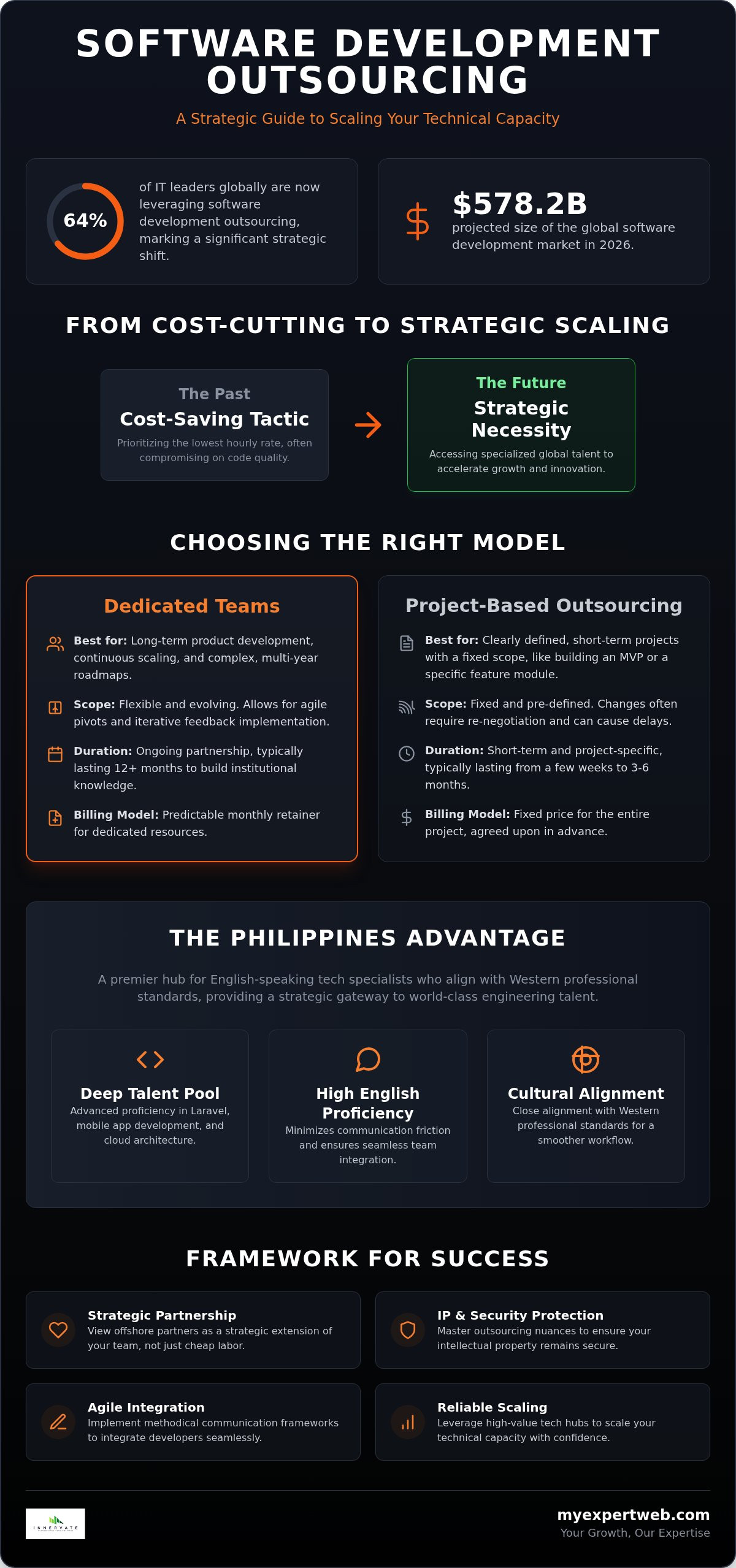
With 64% of IT leaders globally now leveraging software development outsourcing, the shift from a cost-saving tactic to a strategic necessity is complete. You’ve likely felt the pressure of rising local hiring costs in Australia or the persistent difficulty of finding niche talent for Laravel or mobile projects. It’s also understandable if you’re cautious after a past experience with a “budget” offshore vendor that prioritized speed over code quality. We believe you shouldn’t have to compromise your standards to maintain your margins.
This guide provides a pragmatic framework to help you master these complexities while strictly protecting your intellectual property and scaling your technical capacity. We’ll show you how to transition from a simple vendor relationship to a seamless team extension that delivers high-quality, secure results. By following a methodical approach, you’ll learn how to access top-tier talent in high-value hubs like the Philippines at a sustainable cost. We’ll explore the essential steps to ensure your custom software solutions remain scalable, secure, and aligned with your long-term business goals.
Key Takeaways
- Shift your perspective from viewing offshore partners as cheap labor to seeing them as a strategic source of specialized global talent.
- Select the model that’s best for your business by comparing the long-term scalability of dedicated teams against the fixed scope of project-based development.
- Master the nuances of software development outsourcing to ensure your intellectual property remains secure while reducing operational overhead.
- Implement a methodical communication framework and Agile practices to integrate external developers into your internal workflow seamlessly.
- Discover how a methodical guide helps you scale technical capacity reliably by leveraging high-value tech hubs like the Philippines.
The Evolution of Software Development Outsourcing in 2026
The global software development market is projected to reach USD 578.20 billion in 2026. This expansion reflects more than just a growing reliance on digital tools; it marks a transformation in how companies build their engineering capacity. The business practice of outsourcing has matured from a quest for the lowest hourly rate into a strategic pursuit of high-tier talent. Today, software development outsourcing allows growing businesses to bridge the gap between their ambitious roadmaps and the reality of local talent shortages.
Current market dynamics favor organizations that maintain flexible, remote-ready engineering teams. In Australia, the difficulty of finding niche specialists in areas like Laravel or mobile development often stalls growth. By looking beyond national borders, businesses can bypass these local bottlenecks and secure the skills they need to remain competitive. This isn’t about replacing internal staff; it’s about augmenting them with specialized expertise that might otherwise be out of reach.
From Cost-Cutting to Strategic Scaling
Small and medium enterprises (SMEs) are increasingly moving away from hiring one-off freelancers in favor of dedicated agency partners. While a freelancer might solve a temporary bug, a dedicated partner understands the long-term architecture of your business applications. This shift prioritizes cultural fit and clear communication, ensuring that remote developers function as a true extension of your office. When you trust a partner with 12+ years of experience to manage the technical execution, your internal leadership can focus entirely on core business strategy and market expansion.
The Philippines Advantage in 2026
The Philippines has solidified its position as a premier hub for English-speaking tech specialists who align closely with Western professional standards. The talent pool is deep, offering advanced proficiency in Laravel, mobile app development, and cloud architecture. This alignment minimizes the friction often found in offshore relationships, making the integration process much smoother for Australian businesses. The Philippines tech hub serves as a strategic gateway for businesses to access world-class engineering talent while maintaining the operational agility required for sustainable growth in 2026.
Choosing the Right Model: Dedicated Teams vs. Project-Based Outsourcing
Selecting a framework for software development outsourcing isn’t just about price; it’s about aligning technical resources with your specific business lifecycle. Whether you need a surgical strike for a specific feature or a long-term engine for growth, the model you choose dictates your daily operational rhythm. In 2026, successful businesses use these models as strategic levers rather than simple hiring shortcuts.
The choice between a dedicated team and project-based development often hinges on the complexity of your requirements. A dedicated team functions as a seamless extension of your company, providing the strategic management of outsourced developers necessary for mission-critical software. Conversely, project-based models offer a structured path for clearly defined goals. To determine which model aligns with your stage of growth, consider these factors:
- Project Duration: Is this a three-month build or a multi-year roadmap?
- Scope Flexibility: Will your requirements change as you gather user feedback?
- Internal Capacity: Do you have the bandwidth to manage daily tasks, or do you need a self-governing team?
Many growing businesses adopt a hybrid approach. They might initiate a partnership with a project-based contract to build an MVP or a specific module. Once the concept is proven, they transition to a dedicated team to handle ongoing scaling and maintenance.
When to Hire a Dedicated Development Team
This model is the standard for businesses focused on iterative product development and continuous scaling. It allows for consistent technical output through recurring monthly retainers, ensuring your developers aren’t pulled away by other clients. You gain specialists who truly understand your brand’s long-term vision and technical architecture. This institutional knowledge reduces the friction of onboarding and ensures that every update aligns with your core business goals. If you’re ready to expand your capacity, you can consult with a methodical guide to build your team.
When Project-Based Fees Make More Sense
If you’re launching a landing page, developing a standalone MVP, or performing a specific software migration, project-based fees offer the most clarity. You pay for defined deliverables within a set timeline, which provides budget certainty for your board or investors. This model is ideal for testing a new vendor’s quality before committing to a larger partnership. It often serves as the practical starting point in The Strategic Guide to Custom Business Application Development in 2026, allowing you to validate technical concepts with minimal long-term risk.
Mitigating Risk: Security, IP Protection, and Quality Assurance
Security isn’t an afterthought. It’s the foundation of any successful engineering partnership. As highlighted in Deloitte’s 2024 Global Outsourcing Survey, executive focus is shifting toward managing the extended workforce with a heavy emphasis on risk mitigation. When you engage in software development outsourcing, your primary vulnerability isn’t just the code itself, but the access points to your proprietary data and the long-term integrity of your systems.
Protecting your intellectual property and ensuring high-quality output requires a methodical approach to cybersecurity. This is especially true in custom business application development, where unique logic and sensitive customer data are the lifeblood of the company. You need a partner who views security as a continuous process rather than a one-time checklist.
Vetting Your Outsourcing Partner for Security
A methodical guide will always be transparent about their security protocols. You should start by asking specific questions about data encryption at rest and in transit, as well as their server management practices. Verify the agency’s history by speaking with current clients and reviewing their track record with similar projects. It’s also vital to check if they have dedicated experts who understand Secure Web App Development: Strategic Guide for 2026. This ensures that security is baked into the development lifecycle from the first line of code.
Intellectual Property and Contractual Safeguards
Your intellectual property is your most valuable asset. To protect it, your contracts must include “Work for Hire” clauses that clearly state your company owns all source code, documentation, and design assets from the moment of creation. Don’t leave ownership to chance or verbal agreements. Standard IP protection in 2026 offshore development mandates that all source code ownership is legally transferred to the client upon creation through these clauses, reinforced by strict compliance with ISO/IEC 27001 and GDPR data sovereignty regulations. This legal clarity prevents future disputes and ensures your software remains a sellable, scalable asset.
Quality Assurance and Benchmarks
Beyond legal and security concerns, you must establish clear Quality Assurance (QA) benchmarks. Testing shouldn’t happen only at the end of the project. Instead, integrate automated testing and regular peer reviews into the workflow. This proactive stance ensures that the final product meets your performance standards and provides a seamless user experience. By setting these protocols early, you create a culture of excellence that protects your brand’s reputation and your technical investment.
Strategic Management: Integrating Outsourced Developers into Your Workflow
Many software development outsourcing initiatives struggle not because of technical incompetence, but due to a lack of structural integration. It’s a common mistake to treat remote developers as a separate entity that operates in a vacuum. To succeed, you must view them as a seamless extension of your internal team. This requires a transition from simply sending tasks to building together through a methodical communication framework.
Adopting Agile methodologies provides the necessary rhythm for remote collaboration. By breaking projects into two-week sprints, you maintain visibility and control over the development process. Success also depends on a modern tech stack for management. We recommend using industry-standard tools for project management, Git-based version control for code integrity, and dedicated channels for real-time communication. To manage time zone differences, we advocate for a structured overlap period of three to four hours. This window allows for high-bandwidth discussions, while the remaining hours leverage asynchronous work supported by detailed task descriptions.
Step-by-Step Integration Framework
A successful launch begins with clearly defined KPIs and delivery milestones. Without these, remote teams can’t prioritize effectively. We implement a routine that includes 15-minute daily stand-ups to address blockers and bi-weekly sprint reviews to demonstrate progress. Robust documentation serves as the single source of truth, ensuring that technical decisions are recorded and accessible. This approach reduces friction and provides continuity, which is essential if you decide to scale your capacity in the future.
Building a Unified Team Culture
The most productive remote teams are those that feel a sense of ownership over the product. You should include your offshore developers in company updates and celebrate project wins together. Providing regular feedback loops and opportunities for professional development helps retain top talent and aligns their growth with your business goals. Understanding the local context is also helpful; for instance, you can review our Cost of Hiring Developers in the Philippines: The 2026 Strategic Guide to better understand the market dynamics of your remote team. If you’re ready to build a high-performing team, you can reach out for dedicated development support to start your journey.
Scaling with Confidence: The MyExpertWeb Strategic Partnership
MyExpertWeb has spent over 12 years refining its role as a Reliable Strategic Partner for businesses seeking sustainable growth. We understand that software development outsourcing is most effective when it bridges the gap between high-level Australian business objectives and specialized technical talent. Our focus remains on creating secure, scalable applications that don’t just function but actively improve your operational efficiency. By leveraging our dedicated teams in the Philippines, we provide a high-value alternative to the volatile local hiring market.
Our approach goes beyond simple code delivery. We recognize that technical excellence is only one part of a successful digital presence. To support holistic growth, we integrate services like Local SEO and PPC Management alongside our core development work. This ensures that the custom business applications we build are visible to your target audience and aligned with your broader market strategy. We act as a Methodical Guide, taking you from an initial free consultation through to a secure and scalable deployment.
End-to-End Solutions for Modern Brands
We specialize in custom business application development that’s tailored to your specific organizational goals. Whether you’re migrating legacy systems or building new internal tools, our process prioritizes functional excellence and long-term viability. We also provide mobile app development that places equal emphasis on user experience and rigorous security protocols. If you’re currently evaluating potential partners, you can explore our Choosing a Mobile App Development Company: 2026 Guide for deeper insights into selecting the right technical expertise for your brand.
Your Growth Partner in 2026
Success in 2026 requires a partner who understands both technical complexity and business utility. MyExpertWeb provides the stability and global perspective needed to navigate the evolving landscape of software development outsourcing. We offer flexible engagement models, allowing you to choose between a dedicated development team for ongoing scaling or project-based fees for specific deliverables. This adaptability ensures you always have the right level of support as your business evolves. We invite you to contact MyExpertWeb for a free consultation on your software development needs and discover how a methodical partnership can transform your technical capacity.
Scaling Your Technical Capacity for 2026
Success in the coming year requires moving beyond simple vendor transactions toward high-value partnerships. You’ve seen how a strategic framework for software development outsourcing protects your intellectual property while effectively solving the niche talent shortage. By choosing the right engagement model and prioritizing security-first development, you transform an offshore team into a seamless extension of your internal operations. This transition allows your core team to focus on high-level strategy while specialized engineers handle the technical execution.
MyExpertWeb is ready to serve as your methodical guide through every stage of this journey. We bring 12+ years of experience in custom software and deep expertise in secure, mobile-friendly business apps. Our dedicated Philippines-based talent provides the technical excellence and cultural alignment necessary for long-term viability. We’re committed to helping you build scalable solutions that grow alongside your business goals. Take the first step toward a more efficient, tech-driven future today.
Book a Free Consultation for Your Dedicated Development Team
Frequently Asked Questions
What is the average cost of software development outsourcing in 2026?
Industry data for 2026 shows that rates in Asia remain significantly more sustainable than those in North America or Western Europe. While specific costs depend on your tech stack and seniority requirements, the primary advantage is accessing specialized talent without the high local overhead in Australia. We recommend focusing on the total cost of engagement rather than just the hourly quote. This approach accounts for management, quality assurance, and long-term scalability for your solutions.
How do I protect my intellectual property when outsourcing to the Philippines?
You can protect your intellectual property by ensuring all contracts include “Work for Hire” clauses and clear ownership transfer upon creation. It’s vital to work with an agency that follows international security standards like ISO/IEC 27001. MyExpertWeb prioritizes legal clarity by establishing source code ownership from day one. This methodical approach ensures your proprietary data remains secure and fully under your control throughout the development lifecycle and beyond.
What is the difference between a dedicated development team and a project-based team?
A dedicated team acts as a long-term extension of your internal staff, which is ideal for iterative product growth and scaling. Project-based teams are better suited for defined deliverables with fixed timelines, such as building a standalone MVP or a specific landing page. If you require consistent technical output and deep brand knowledge, a dedicated model is usually the most sustainable choice. Project-based fees offer more budget certainty for one-time migrations.
How do I vet an offshore development agency for quality and security?
Start by reviewing the agency’s historical track record and requesting client references from similar industries. You should ask specific questions about their encryption protocols, server security, and QA testing benchmarks. A reliable partner will be transparent about their internal processes and provide proof of their expertise in custom business applications. Look for agencies with at least a decade of experience, as this longevity often indicates a stable and methodical approach.
Can outsourced developers work within my existing internal tech stack?
Yes, outsourced developers can and should work within your existing internal tech stack to ensure seamless integration. Modern software development outsourcing relies on version control tools like Git and project management platforms to maintain consistency across teams. Whether you use Laravel, React, or specific mobile frameworks, your remote developers should adapt to your established coding standards. This alignment reduces technical debt and ensures that the final solution is compatible with your current infrastructure.
What are the most common pitfalls in software development outsourcing?
The most common pitfalls include poor communication frameworks, lack of clear KPIs, and prioritizing low cost over code quality. Many businesses fail when they don’t treat remote developers as an integrated team. To avoid these issues, establish a methodical rhythm of daily stand-ups and sprint reviews. Clear documentation is also essential, as it prevents knowledge gaps and ensures that technical decisions are understood by all stakeholders from the start of the project.
How does MyExpertWeb handle communication across different time zones?
We handle time zone differences by establishing a structured overlap period of three to four hours each day. This window is used for real-time discussions, daily stand-ups, and urgent problem-solving. During the remaining hours, we utilize asynchronous work supported by detailed task descriptions and robust documentation. This approach ensures that progress continues around the clock without sacrificing the quality of communication or the speed of your project’s deployment.
Is software development outsourcing suitable for small businesses or just enterprises?
It is highly beneficial for both small businesses and large enterprises. For SMEs, it provides access to high-tier talent that might be unaffordable or unavailable locally in Australia. This allows smaller teams to scale their technical capacity without the high overhead of permanent local hires. Enterprises use this model to augment their existing departments for large-scale migrations or niche projects. It’s a scalable solution that adapts to your specific organizational goals.