


MyExpertWeb Team
September 9, 2026
Offshore Dedicated Development Team in the Philippines: The 2026 Strategic Guide
What if the biggest risk to your technical roadmap isn’t the talent itself, but the way you’ve been told to manage it? By 2026, the Philippine IT-BPM sector is expected to employ nearly 2 million professionals, yet many companies still treat their remote staff as a disconnected vendor. You’ve likely felt the sting of high churn rates or the constant friction of communication gaps that stall your most critical projects. It’s a common challenge to worry about intellectual property or whether code quality will hold up under pressure as you scale.
Building an offshore dedicated development team in the Philippines should feel like a seamless expansion of your internal culture, not a source of administrative burden. This strategic guide explores how to move beyond the project shop stigma to create a high-performing talent extension that offers predictable monthly costs and senior-level expertise. We’ll examine the latest 2026 privacy regulations, the shift toward high-value services like cybersecurity, and the methodical steps you can take to ensure your remote team is as invested in your success as your local staff.
Key Takeaways
- Learn why the 2026 global economy has shifted from simple cost-saving to a strategic pursuit of specialized technical talent.
- Understand the fundamental differences between temporary project outsourcing and building a high-performing offshore dedicated development team philippines that functions as a true extension of your company.
- Discover the modern standards for vetting senior engineers and the legal frameworks required to protect your intellectual property in a remote environment.
- Explore practical communication protocols and cultural integration strategies that eliminate friction and maintain development velocity across borders.
- Identify how a methodical partnership model helps retain institutional knowledge and reduces the operational overhead associated with traditional vendor relationships.
The 2026 Landscape: Why the Philippines for Dedicated Development?
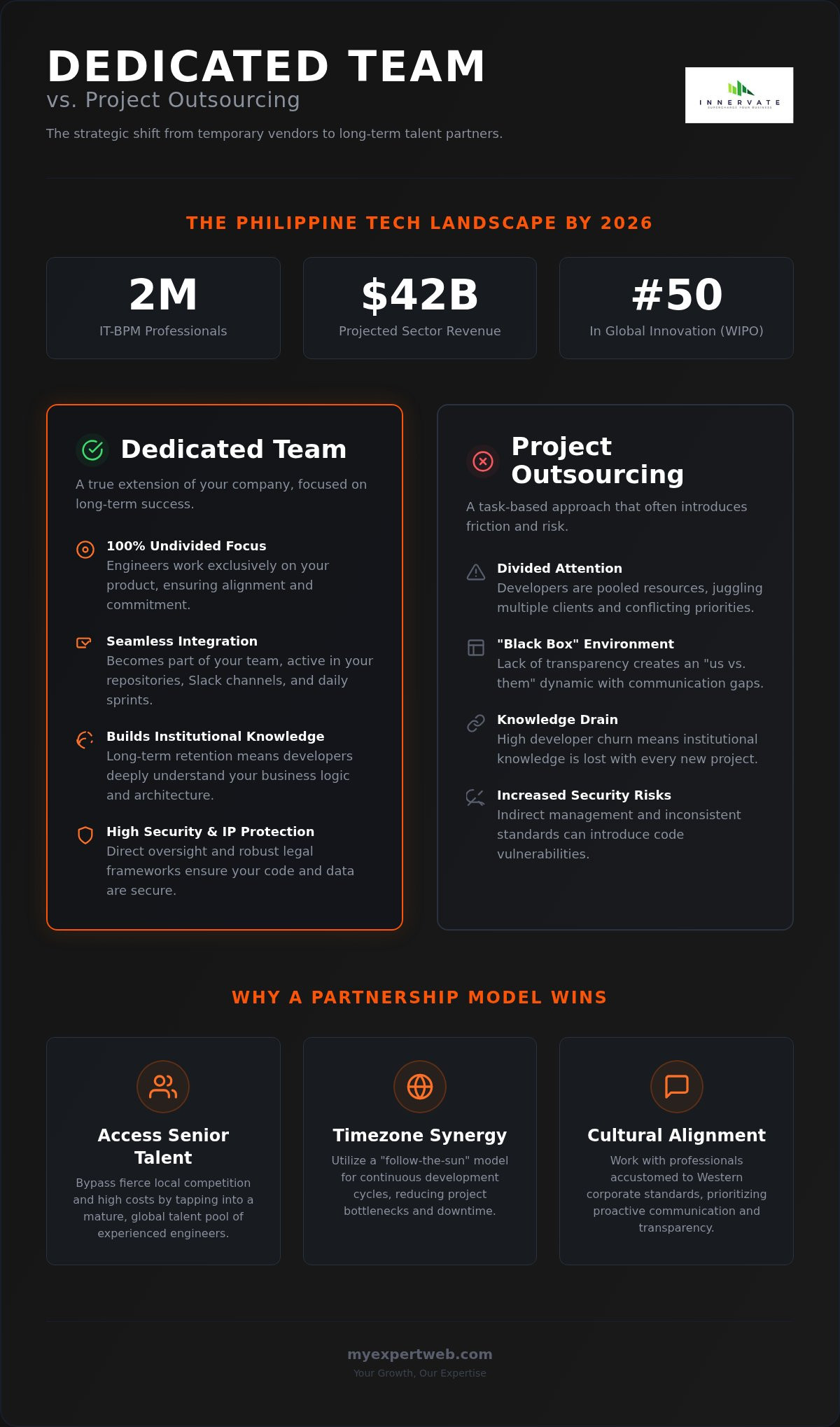
The global tech environment has evolved. In 2026, building an offshore dedicated development team philippines isn’t merely about finding the lowest bidder; it’s about securing a long-term talent extension. Unlike project-based outsourcing, which often feels like a series of disconnected tasks, this model integrates developers directly into your internal workflows and culture. The Philippine IT-BPM sector is projected to reach $42 billion in revenue by the end of 2026, reflecting a mature ecosystem that prioritizes specialized expertise over simple task execution.
Much of this growth is rooted in the long history of Business process outsourcing in the Philippines, which has created a workforce deeply familiar with Western corporate standards. Developers here don’t just write code; they engage in complex product conversations and strategic problem-solving. This capability is supported by the country’s rising status in global tech, having ranked 50th for innovation in the 2025 WIPO Global Innovation Index. This shift proves that the talent pool has moved firmly into high-value services like AI operations and secure application development.
Overcoming the Local Talent Shortage
The gap between the demand for senior engineers and the available supply in markets like Australia and the US continues to widen. Finding a local developer with ten years of experience often involves significant delays and intense competition. An offshore dedicated development team philippines offers a practical resolution by providing immediate access to senior-level talent that may be unavailable in your local market. These professionals are accustomed to a remote-first culture that emphasizes productivity and clear documentation. By tapping into this market, you bypass the local talent war and maintain your focus on shipping critical features.
Timezone Synergy and Work Culture
Operational ease is often a result of cultural and chronological alignment. The Philippines maintains a work culture that mirrors Western ethics, prioritizing transparency and proactive communication. By utilizing a “follow-the-sun” model, your business can maintain continuous development cycles where progress happens while your local team is offline. Because of the significant overlap in working hours with many Western regions, real-time collaboration during daily standups becomes the standard, which effectively reduces asynchronous friction and prevents project bottlenecks. This alignment ensures that your remote engineers feel like a natural part of your office, rather than a distant vendor.
Dedicated Teams vs. Project-Based Outsourcing
Choosing between these two models determines the long-term stability of your software. Many vendors operate as “project shops” that treat your product like a ticket in a queue. This creates a revolving door of developers that eventually kills code quality. You don’t want a different engineer every time you open a pull request. Instead, building an offshore dedicated development team philippines ensures that your engineers are 100% focused on your product. This stability is supported by a robust Philippine economy overview, which highlights a mature sector capable of sustaining long-term technical partnerships.
The Problem with Pooled Resources
Shared developers often lead to divided attention. If an engineer is juggling three different clients, your deadlines will eventually slip. It’s a “black box” environment where you don’t know who is writing your code or how much they truly understand your goals. This lack of transparency introduces security risks and technical debt. By managing an offshore dedicated development team philippines, you integrate talent directly into your repository and daily sprints. They’re part of your Slack channels and Jira boards. This removes the friction of “us vs. them” and creates a “one team” culture that prioritizes your specific milestones.
Building Long-Term Institutional Knowledge
Software is more than just lines of code; it’s business logic. Retention is the most critical metric for offshore success. When an engineer stays with your company for years, they understand the “why” behind every architectural decision. They become proactive. They spot potential bugs before they’re written because they know how your system behaves. This institutional knowledge is the hidden ROI of the dedicated model. It’s much more efficient than constantly retraining new hires. To understand how this impacts your budget, you can read our guide on the Cost of Hiring Developers in the Philippines: The 2026 Strategic Guide.
This model also provides the flexibility to pivot. You can scale your capacity up or down without renegotiating complex contracts for every minor change. If you’re looking for a more predictable way to grow your tech output, our Outsourcing Development Team approach focuses on long-term operational efficiency rather than simple headcount.
Vetting for Quality and IP Security
Vetting a developer in 2026 requires a shift in perspective. It’s no longer enough to rely on a standard technical test or a polished resume. Many businesses fall into the “Seniority Trap,” assuming that a decade of experience automatically translates to modern architectural expertise. In a remote setting, true seniority is defined by a developer’s ability to solve complex problems independently and contribute to the strategic direction of your product. Building a secure offshore dedicated development team philippines starts with identifying talent that possesses both the technical depth and the maturity to handle high-stakes environments.
Cyber Security in Remote Development
Security is a foundational element of any high-performing technical partnership. You shouldn’t settle for basic remote access. Implementing a zero-trust architecture ensures that every user and device is verified before accessing your codebase. This methodical approach includes mandatory secure VPNs, multi-factor authentication, and end-to-end code encryption. For a deeper look at protecting your digital assets, see our guide on Secure Web App Development: Strategic Guide for 2026.
Legal compliance is equally vital for protecting your innovation. The 2026 Privacy Guidelines in the Philippines emphasize a “privacy-by-design” culture, requiring organizations to conduct regular impact assessments. Under the Intellectual Property Code (RA 8293), it’s essential to have written agreements that explicitly transfer copyright ownership of commissioned work to your business. A strict 72-hour breach notification window is also enforced, making it critical to partner with teams that operate in audited, secure environments.
The Vetting Framework: A Strategic Approach
A reliable vetting framework prioritizes live coding sessions over static portfolio reviews. This allows you to observe how a developer thinks under pressure and how they approach edge cases. While technical skills are the baseline, soft skills like communication and product-thinking are what determine long-term success. We define a “Product-Driven Engineer” as a person who understands the “why” behind the code, ensuring they build features that solve real business problems rather than just following a ticket.
Understanding The 2026 Landscape helps in identifying where high-value digital skills are concentrated. As the Philippine digital economy matures, your vetting process should prioritize developers who demonstrate adaptability and a global perspective. This methodical approach ensures your offshore dedicated development team philippines remains a secure, high-quality asset that drives your business forward.
Managing Your Offshore Team for Maximum Velocity
Managing an offshore dedicated development team philippines requires a shift from vendor oversight to genuine team integration. Success isn’t found in a “set and forget” mentality; it’s found in a “One Team” culture where borders are invisible. This means moving beyond email-based development and adopting real-time communication tools like Slack and Jira. By centralizing your technical discussions, you ensure that every developer, regardless of their physical location, has full visibility into the project’s progress and potential roadblocks.
Measuring output is equally vital for long-term health. In 2026, we focus on velocity, sprint health, and code quality metrics rather than simple hours logged. This data-driven approach allows you to identify bottlenecks early and maintain a steady rhythm of delivery. It’s about creating a predictable environment where everyone understands the definition of “done.”
The Synchronous Sprint Cadence
Operational velocity depends on how well you leverage timezone overlap. We recommend structuring daily standups during the hours when your local and remote teams are both online. This synchronous window is critical for real-time code reviews and immediate problem-solving, which prevents the “wait-until-tomorrow” bottlenecking often seen in traditional outsourcing. Setting clear expectations for availability and response times ensures that your offshore dedicated development team philippines operates with the same urgency as your local staff.
Leveraging AI and Automation in 2026
The maturity of AI in 2026 has fundamentally changed how remote teams operate. A 2026 survey by the Customer Xperience Association of the Philippines found that 52% of BPO companies are already integrating AI technologies. High-performing teams now use AI for automated documentation and legacy code refactoring, which frees up senior engineers for high-level architectural tasks. AI pair programming has also become a standard, allowing remote developers to maintain high code quality through real-time suggestions and automated QA checks.
These tools are particularly effective when applied to The Strategic Guide to Custom Business Application Development in 2026. By automating the repetitive aspects of the development lifecycle, your team can focus on the unique business logic that drives your innovation. If you’re ready to scale your technical capacity with a partner that understands these modern workflows, we invite you to explore how MyExpertWeb acts as a methodical guide for your remote staffing needs.
Scaling with MyExpertWeb: Your Methodical Partner
MyExpertWeb has spent over 12 years bridging the gap between Australia and the Philippines. We don’t view our role as a simple vendor. Instead, we act as a methodical guide that helps you navigate the complexities of remote staffing. Our partnership model focuses on long-term operational efficiency rather than just increasing headcounts. We understand that a high-performing offshore dedicated development team philippines needs more than just technical skill; it requires cultural alignment and a shared commitment to your business goals.
Our end-to-end support covers everything from initial talent acquisition to secure deployment. We take a pragmatic approach to every challenge, ensuring that your technical capacity scales without increasing your administrative burden. By acting as an extension of your own team, we help you maintain the momentum needed to stay competitive in the 2026 landscape. This results-oriented focus ensures that your investment translates into functional excellence and long-term viability.
Beyond Staffing: Strategic Talent Management
Managing a remote team involves more than just assigning tasks. We handle the complexities of HR, payroll, and employee retention so your internal leadership can focus entirely on product development. This approach minimizes the turnover risks associated with traditional outsourcing and ensures that your engineers remain loyal and productive. We prioritize the unique challenges of your business over generic solutions, providing a grounded and reassuring experience as you scale.
We also offer a unique advantage by understanding the intersection of technical execution and market visibility. Our background allows us to support businesses that need a cohesive digital strategy. For those looking to align their technical output with their growth goals, our guide on Integrated Web Development and SEO Services: The 2026 Strategic Guide provides a roadmap for combining these critical functions. This dual expertise ensures your software isn’t just well-built, but also positioned for success.
Getting Started with Your Dedicated Team
Building your team follows a methodical roadmap designed to ensure a perfect fit for your tech stack. We don’t offer generic bundles. Instead, we tailor the composition of your offshore dedicated development team philippines to match your specific requirements, whether you need specialists in cybersecurity, mobile app development, or custom business applications. The process is designed to be steady and predictable, building trust at every stage of the journey.
The journey begins with a thorough understanding of your current challenges and future goals. From there, we move into talent selection and integration, leading up to your first remote sprint. We’re here to ensure the transition is smooth and that your new engineers hit the ground running with the right tools and protocols. If you’re ready to scale your tech output with a reliable strategic partner, schedule a free consultation for your dedicated development team.
Future-Proofing Your Technical Roadmap
Transitioning from a traditional vendor mindset to a true talent extension is the key to scaling your software output in the 2026 landscape. By prioritizing institutional knowledge and cultural alignment, you ensure that your technical capacity grows without sacrificing code quality or security. Successfully building an offshore dedicated development team philippines requires a methodical approach that integrates senior-level expertise directly into your internal workflows. This strategy protects your intellectual property while allowing your local leadership to focus on high-level innovation.
MyExpertWeb brings over 12 years of industry experience as a strategic partner for businesses in Australia, the US, and Singapore. Our cybersecurity-focused approach ensures that your remote environment is secure, scalable, and fully compliant with the latest global standards. We act as a methodical guide, handling the complexities of remote staffing so you can focus on building products that matter. If you’re ready to reduce operational overhead and increase your development velocity, build your dedicated offshore development team with MyExpertWeb today. We look forward to supporting your long-term success.
Frequently Asked Questions
What is the difference between staff augmentation and a dedicated development team?
Staff augmentation provides temporary resources to fill immediate gaps, whereas an offshore dedicated development team philippines functions as a permanent extension of your internal staff. In the dedicated model, engineers are 100% focused on your product, allowing them to build deep institutional knowledge. This approach prevents the “revolving door” effect and ensures that your remote talent understands your business logic as well as your local team does.
How do I ensure my intellectual property is protected in the Philippines?
Intellectual property is protected through a combination of local laws and strict contractual agreements. The Intellectual Property Code of the Philippines (RA 8293) provides a legal framework for copyright ownership, while the Data Privacy Act of 2012 (RA 10173) mandates secure data handling. We ensure that all work commissioned is legally owned by your business. Using secure, audited environments and zero-trust architectures further reduces the risk of unauthorized access.
What tech stacks are most common for offshore teams in the Philippines?
Philippine developers are highly proficient in modern web and mobile frameworks. Common stacks include Laravel, React, Node.js, and Python, which are essential for building secure, scalable business applications. You’ll also find extensive expertise in mobile development using Flutter or React Native. As the market matures in 2026, there’s a growing concentration of talent specializing in AI operations, cybersecurity, and cloud-native architecture to support complex digital transformations.
How much overlap in working hours can I expect with a Philippines-based team?
You can expect significant synchronous working hours depending on your home location. For businesses in Australia or Singapore, the overlap is nearly 100%, which facilitates real-time collaboration and daily standups. For US-based firms, teams often shift their schedules to provide several hours of direct overlap. This alignment is critical for preventing asynchronous friction and ensuring that your offshore dedicated development team philippines remains fully integrated with your local sprint cycles.
How long does it typically take to stand up a dedicated development team?
Standing up a dedicated team typically takes between four and eight weeks. This timeframe allows for a methodical vetting process that goes beyond basic technical tests to include soft skills and cultural alignment. We prioritize finding the right “Product-Driven Engineers” who understand your specific tech stack and business goals. A rushed recruitment process often leads to higher churn, so we follow a steady roadmap to ensure long-term operational stability.
Can I interview and select individual developers for my team?
Yes, we encourage you to interview and select every individual who joins your team. This level of involvement is vital for building a “One Team” culture where remote engineers feel like a natural part of your organization. You can conduct live coding sessions, review portfolios, and assess communication styles to ensure each developer meets your internal standards. This transparency builds trust and ensures that everyone is aligned with your technical roadmap.
What happens if a developer on my dedicated team leaves?
If a developer leaves, we initiate a managed replacement process to minimize disruption to your project velocity. We handle the recruitment of a new engineer with comparable skills and facilitate a thorough knowledge transfer using established documentation protocols. Because we focus on high retention rates through strategic talent management, these instances are infrequent. Our goal is to maintain the institutional knowledge that is critical for the long-term success of your software.
Do I need to manage the remote team myself, or do you provide a project manager?
You maintain control over the technical direction and daily tasks, while we handle the operational complexities. This includes HR, payroll, and infrastructure management. If your project requires it, we can provide a dedicated project manager to oversee delivery and communication. Most clients prefer to integrate the remote engineers directly into their existing agile workflows, allowing their internal leads to manage the development sprints while we act as a supportive partner.