


MyExpertWeb Team
July 29, 2026
How to Implement Outsourcing Services: A Strategic Guide for 2026
What if the greatest threat to your growth in 2026 isn’t a lack of vision, but a lack of hands to build it? Most business leaders recognize that the search for local technical talent has become an expensive, uphill battle. You’ve likely felt the weight of rising overheads and perhaps even hesitated to explore outsourcing services because you fear losing control or facing communication barriers with an offshore team. It’s a common concern, especially when your brand’s reputation depends on consistent quality and functional excellence.
We believe that successful scaling requires a strategic partnership rather than a simple transaction. This guide provides a methodical, risk-managed approach to help you expand your operations and technical capabilities with confidence. You’ll learn how to implement a clear roadmap for delegation that grants you access to high-level expertise while significantly reducing your operational costs. We will walk through the essential steps to integrate a dedicated extension of your team, ensuring that your long-term viability remains the priority at every stage of the process.
Key Takeaways
- Learn why the 2026 business environment requires a shift from simple task-based delegation to a strategic, integrated team extension.
- Identify high-impact opportunities for outsourcing services by evaluating your core competencies against a resource-versus-complexity matrix.
- Master a proven two-phase transition framework that prioritizes process documentation, clear KPIs, and seamless communication.
- Understand how a methodical vetting process ensures your chosen partner possesses the technical excellence and industry experience to support your growth.
- Explore how a supportive partnership model bridges the gap between your local operations and high-level global talent.
What Are Outsourcing Services and Why Do Businesses Need Them?
At its core, outsourcing is the practice of engaging a third-party provider to manage specific business functions. While the concept isn’t new, the application of outsourcing services has undergone a significant transformation. In the 2026 business environment, the focus has shifted from simple task-based delegation to deep, strategic integration. Businesses no longer look for a vendor to merely “offload” work; they seek a partner to co-author their growth.
The primary drivers for this shift are clear. Access to global talent has become a necessity as local labor markets tighten. By looking beyond geographical borders, you can tap into specialized technical expertise that might be unavailable or prohibitively expensive in your immediate area. Beyond talent, cost efficiency and operational scalability remain vital. A well-structured partnership allows you to expand your capabilities without the massive capital expenditure typically required for internal infrastructure and full-time local hires.
For small and medium enterprises (SMEs), these advantages are particularly impactful. Technical growth often requires a diverse set of skills, from custom software development to cyber security. Maintaining an in-house team for every niche is rarely feasible for growing companies. Dedicated offshore teams provide a pragmatic solution, offering the high-level technical expertise needed to compete with larger corporations while maintaining a lean, agile operation.
The Difference Between Outsourcing and Staff Augmentation
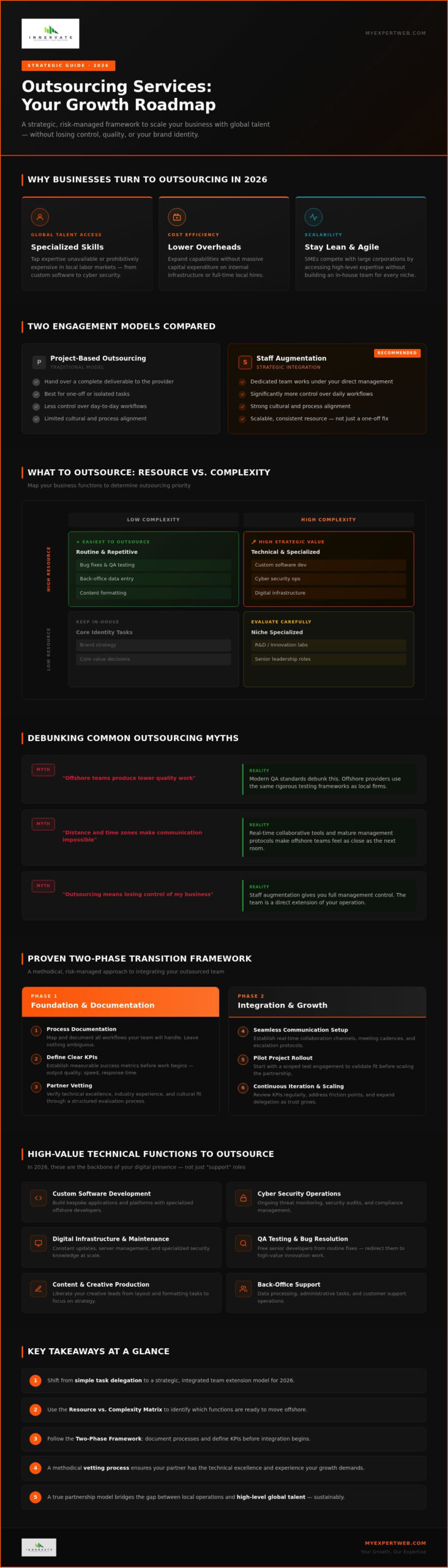
Understanding the nuances between different engagement models is essential for your long-term success. Traditional project-based outsourcing involves handing over a complete deliverable to a provider. In contrast, staff augmentation allows you to hire a dedicated team extension that works directly under your management. This model provides significantly more control over daily workflows and cultural alignment. Your choice should depend on whether you need a one-off solution or a consistent, scalable resource that understands your internal processes. If you’re weighing your options more broadly, understanding the distinction between outsourcing or subcontracting can help you select the staffing model that best fits your growth strategy.
Common Myths About Modern Outsourcing
Many leaders still hesitate due to outdated stigmas regarding quality and communication. Modern QA standards have largely debunked the “low quality” myth, as offshore providers now utilize the same rigorous testing frameworks as local firms. Similarly, distance is no longer a barrier. With real-time collaborative tools and mature management protocols, a team in the Philippines can feel as accessible as a team in the next room. Modern outsourcing services represent a strategic partnership designed to integrate high-level technical expertise directly into your business framework for long-term growth.
How to Identify Which Business Functions to Outsource
Deciding what to delegate is the most critical step in your journey toward operational efficiency. If you try to outsource everything, you risk losing your brand’s unique identity. If you outsource too little, you remain stagnant while competitors move faster. The key lies in distinguishing between your core competencies and your non-core, repetitive tasks. Your core competencies are the unique value propositions that define your business. Everything else, from technical maintenance to back-office support, is a candidate for external management.
To make this decision easier, we recommend using a “Resource vs. Complexity” matrix. Tasks that require high resources but offer low strategic complexity are often the easiest to move offshore. However, the modern application of outsourcing services increasingly focuses on high-complexity technical areas. Digital infrastructure and ongoing software maintenance have become prime candidates because they require constant updates and specialized security knowledge that most internal teams aren’t equipped to handle at scale.
You should also evaluate the internal bottlenecks that currently hinder your ability to grow. Are your senior developers spending a significant portion of their week on routine bug fixes? Is your creative lead bogged down by basic layout adjustments? Identifying these friction points allows you to target your outsourcing efforts where they’ll have the most immediate impact on your bottom line. If you’re unsure where to start, reviewing your current technical debt with a reliable strategic partner can provide the clarity you need.
High-Value Technical Functions to Consider
In 2026, technical functions are no longer just “support” roles; they are the backbone of your digital presence. Consider delegating these areas to ensure consistency and high-level performance:
- Custom software and business application development to streamline your internal workflows.
- Ongoing SEO and digital marketing management to maintain a steady flow of leads without exhausting your internal team.
- Cyber security monitoring and routine web maintenance to protect your data and minimize downtime.
Operational Functions for Improved Efficiency
Operational outsourcing services allow your core team to focus on high-level strategy and client relationships. These functions are ideal for a dedicated offshore team:
- Customer support and back-office administrative tasks that require 24/7 attention or high volume handling.
- Data entry and business process management (BPM) to ensure your records remain accurate and accessible.
- Graphic design and web content production to keep your marketing materials fresh and professional.
Vetting Outsourcing Service Providers for Technical Excellence
Selecting a partner to handle your technical operations is a high-stakes decision that requires more than a surface-level review of a price list. In a market saturated with options, the true differentiator is a proven track record. You should look for a provider with at least a decade of experience, as this longevity suggests they have successfully managed the complexities of various economic shifts and technological evolutions. A partner who has spent 12 or more years refining their processes is far more likely to offer the stability and methodical guidance your business needs to scale safely.
When you evaluate technical portfolios, look beyond the visual aesthetics. Ask for case studies that demonstrate how they solved specific business problems or improved system architecture. A high-quality provider of outsourcing services will be transparent about their methodology and the logic behind their technical choices. You want to see evidence of functional excellence and long-term viability in the software and systems they have built for previous clients. If a provider cannot explain the “why” behind their technical execution, they may not be the strategic partner you need.
Communication protocols and time-zone management are equally vital. Effective collaboration doesn’t happen by accident; it requires a structured strategy. Inquire about their standard overlap hours and the specific tools they use to maintain transparency. Cultural alignment often serves as the silent engine of long-term success. When your offshore team shares your professional values and work ethic, they become a true extension of your internal staff rather than just an external vendor. This alignment reduces friction and ensures that everyone is moving toward the same business goals.
Risk Management and Data Security
Security should never be an afterthought. You must vet potential partners for their adherence to modern cyber security standards and data protection protocols. Ensure that your agreement includes clear provisions for Intellectual Property (IP) protection, confirming that all work produced remains your exclusive property. Additionally, review their Service Level Agreements (SLAs) for specific performance guarantees. These documents should outline clear expectations for uptime, response times, and quality benchmarks to hold the provider accountable.
The Philippines Advantage for Tech Outsourcing
The Philippines has established itself as a premier destination for technical talent, particularly for businesses seeking English-speaking professionals with high cultural compatibility. The region offers a unique balance of cost efficiency and high-level expertise in areas like custom software development and cyber security. By leveraging an offshore outsourcing company with deep roots in both the Philippines and Australia, you benefit from a partner who understands how to bridge the gap between local business requirements and global talent pools. This geographic advantage allows you to maintain high standards of quality while significantly reducing your operational overheads.
Step-by-Step Guide to Transitioning Work to an Outsourced Team
Transitioning your operations to an external partner requires a methodical framework to ensure stability. It isn’t a “set and forget” process. Instead, it’s a gradual integration that builds trust through consistent results. By documenting every step of your internal process, you provide your offshore team with the blueprint they need to replicate your success. This initial investment in clarity prevents the common communication breakdowns that many leaders fear when first exploring outsourcing services.
Phase 1 begins with documenting current processes and defining clear KPIs. You must know what “success” looks like before you can expect someone else to achieve it. Phase 2 involves setting up collaborative tools and communication channels to bridge the physical gap. Once the infrastructure is ready, Phase 3 introduces the “Pilot Project.” Start with a small, measurable task to test the waters. This allows both parties to identify potential friction points without risking major business assets. Phase 4 focuses on feedback loops and iterative improvement, while Phase 5 moves into full integration and scaling the dedicated team. If you are ready to begin this transition, you can consult with our strategic guides to map out your initial pilot project.
Establishing Effective Communication Rhythms
Success in remote collaboration depends on a predictable rhythm. Tools like Slack, Jira, and Zoom are essential for seamless management, but they only work if you have a plan for how to use them. We recommend setting expectations for daily stand-ups and weekly reporting from the very beginning. This ensures that your outsourcing development team remains aligned with your broader business goals. When everyone knows when and where to communicate, distance becomes an afterthought rather than a barrier.
Measuring Success and ROI
You cannot manage what you do not measure. To evaluate the effectiveness of your outsourcing services, you must define quantitative metrics for both productivity and quality. Don’t just look at the reduced overheads. Instead, calculate the value of increased output and the hours your local team has reclaimed for high-level strategy. The ideal KPI structure for a new outsourcing partnership balances quantitative output with qualitative benchmarks to ensure that speed never compromises functional excellence. This balanced approach provides a realistic view of your return on investment over the long term.
Building a Strategic Partnership with MyExpertWeb
MyExpertWeb has spent over 12 years bridging the gap between Australian business requirements and high-level global talent in the Philippines. We understand that the decision to engage outsourcing services is rarely about offloading a single task; it’s about securing a reliable partner who can support your long-term vision. Our history is built on a foundation of consistency and professional excellence, ensuring that every digital solution we deliver is secure, scalable, and mobile-friendly. We prioritize functional utility over technical vanity, focusing on what actually drives your business forward.
Our methodology is characterized by a pragmatic and deeply supportive approach. We don’t believe in high-pressure tactics or one-size-fits-all solutions. Instead, we listen to your specific challenges and adapt our technical expertise to meet your unique operational needs. Whether you require custom software development, robust cyber security monitoring, or targeted digital marketing, our team provides the end-to-end support necessary to maintain your competitive edge in 2026. We remain unfazed by complexity, acting as a steady ally in an ever-changing digital environment.
Why Our Methodical Approach Works
We act as a seamless extension of your internal team rather than just another service provider. This collaborative spirit allows us to prioritize your operational ease and the long-term viability of your projects. By focusing on deep integration, we ensure that our outsourcing services enhance your existing workflows. Our tailored solutions acknowledge your unique business goals, providing the methodical guidance needed to scale without losing the quality your clients expect. We value hard work and consistency, positioning ourselves as a quiet but authoritative force behind your technical success.
Getting Started with a Free Consultation
Taking the first step toward scaling your operations should be a clear and logical process. We begin by assessing your current business needs to find the right fit for your specific goals. From there, we guide you through the first steps of building your dedicated offshore team, ensuring the transition is handled with the same care and precision we apply to our software development. We invite you to contact us today to explore how our 12 years of experience can support your growth and help you navigate the technical demands of 2026.
Scaling Your Technical Capabilities for the Future
The business landscape of 2026 demands a shift from traditional task-based delegation to a high-level strategic partnership. By identifying non-core bottlenecks and implementing a methodical transition plan, you can unlock significant growth without sacrificing quality or control. Modern outsourcing services provide more than just cost savings; they offer a pathway to access specialized global expertise that keeps your business agile and competitive. Success depends on choosing a partner who understands your unique challenges and values long-term functional excellence.
With 12+ years of experience in digital outsourcing, MyExpertWeb provides dedicated development teams tailored specifically to your business goals. We specialize in secure and scalable custom software solutions that integrate seamlessly with your existing operations. If you’re ready to reduce overheads while improving your technical output, the first step is a clear, low-risk assessment of your current needs. Book a free consultation with MyExpertWeb to scale your business and start building your dedicated offshore team today. Your journey toward operational ease and sustainable growth begins with a single, strategic conversation.
Frequently Asked Questions
What are the most common outsourcing services for small businesses?
Small businesses frequently outsource technical and repetitive back-office tasks to maintain a lean operation. Common examples include custom software development, graphics design, and social media marketing. These outsourcing services allow SMEs to access specialized skills without the high cost of hiring full-time local staff for every niche requirement.
How do I ensure the quality of work from an offshore outsourcing company?
Quality assurance is maintained through clear documentation and consistent feedback loops. You should request a pilot project to test the provider’s capabilities before committing to a long-term contract. Establishing measurable KPIs and regular code reviews ensures that the output meets your brand’s functional standards and professional aesthetics.
Is outsourcing safe for my company’s sensitive data and IP?
Yes, provided you have a robust legal agreement and secure infrastructure in place. Your contract should explicitly state that all intellectual property remains your exclusive ownership. We recommend vetting providers for their cyber security protocols and ensuring they use encrypted communication channels to protect your sensitive business information.
How much can a business save by using outsourcing services in 2026?
Businesses often see a significant reduction in operational overheads by moving technical functions offshore. While exact figures depend on your specific needs, savings typically come from reduced payroll taxes, lower office infrastructure costs, and decreased recruitment fees. These outsourcing services allow you to reinvest capital into core growth strategies rather than administrative maintenance.
What is the difference between a project-based fee and a monthly retainer?
A project-based fee is a one-time payment for a specific deliverable, while a monthly retainer provides ongoing access to a dedicated team. Project fees are ideal for defined tasks like landing page design. Retainers are better for long-term needs like software maintenance or SEO, as they ensure your partner remains available to adapt to your evolving business goals. For a deeper look at how different engagement structures compare, our guide on outsourcing or subcontracting as a strategic choice for business growth breaks down the key differences to help you decide which model suits your operational needs.
How do I manage time zone differences with a team in the Philippines?
Effective management relies on a strategic overlap of working hours. Most teams in the Philippines are accustomed to working in shifts that align with Australian or Western business hours. By scheduling daily stand-ups during these overlap periods and using asynchronous tools like Jira, you can maintain a steady workflow without delays.
What should be included in an outsourcing service level agreement (SLA)?
An SLA must define clear performance benchmarks and accountability measures. Essential components include response time guarantees, system uptime requirements, and specific quality standards for deliverables. It should also outline the penalties for non-compliance and the process for resolving disputes to protect your operational interests.
Can I outsource my entire digital marketing and SEO strategy?
Yes, you can delegate your entire digital presence to a strategic partner. This often includes social media marketing, local SEO, and PPC management. A comprehensive approach ensures that your branding remains consistent across all platforms while freeing your internal team to focus on high-level business development and client relationships.