


MyExpertWeb Team
August 8, 2026
Outsourcing or Subcontracting: A Strategic Comparison for Business Growth in 2026
What if the primary bottleneck in your 2026 growth strategy isn’t a lack of budget, but a fundamental misunderstanding of how to scale your workforce? Many Australian business leaders feel the weight of rising operational costs and the constant struggle to find specialized tech talent within local borders. You likely recognize the frustration of seeing a critical project stall because your internal team is stretched too thin or a freelancer lacks the long-term commitment your business requires. Choosing between outsourcing or subcontracting often feels like a gamble when project costs are unpredictable and legal terminology is confusing.
This article provides a clear framework to help you choose the most efficient staffing model for your digital and tech operations. You’ll discover how to reduce operational costs and access high-quality talent without the traditional hiring headache. We will compare the task-based nature of subcontracting against the capacity-building power of outsourcing, specifically looking at how dedicated teams in hubs like the Philippines are supporting Australian firms. By the end, you’ll have a methodical guide to building a resilient, scalable workforce that aligns with your long-term business goals.
Key Takeaways
- Understand the fundamental shift from task-based hiring to strategic function allocation to ensure your 2026 growth plans are built on a stable operational foundation.
- Learn how to navigate the choice between outsourcing or subcontracting by identifying whether your business needs a temporary project fix or a permanent capacity boost.
- Discover how leveraging dedicated development teams in the Philippines can provide high-quality tech expertise while significantly reducing your operational overhead compared to local Australian hiring.
- Use our decision matrix to assess your internal management bandwidth and project complexity, helping you avoid the hidden costs of excessive management overhead.
- Identify the specific criteria for selecting a reliable strategic partner that acts as a methodical extension of your team rather than just a simple vendor.
Defining Outsourcing and Subcontracting in the 2026 Digital Economy
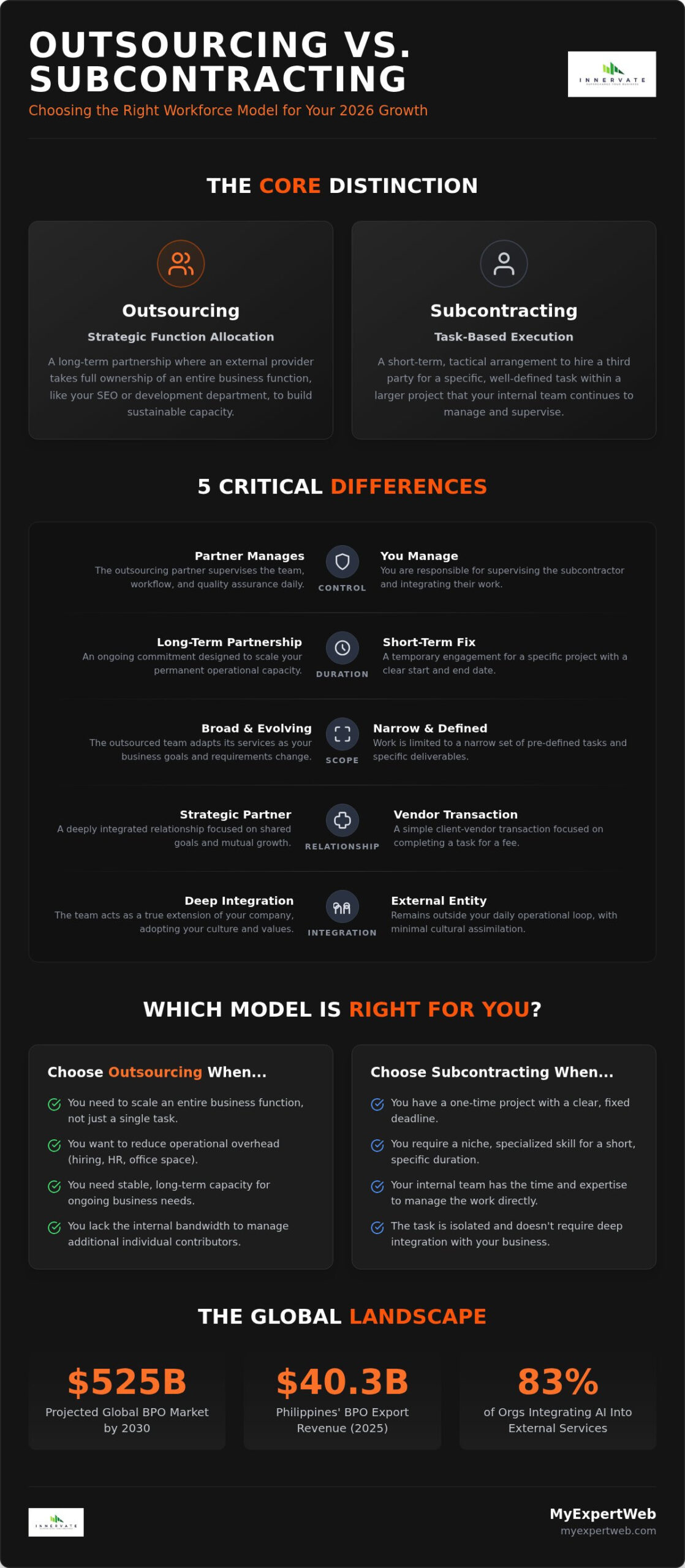
The 2026 digital economy moves at a pace that demands both agility and specialized expertise. As the global Business Process Outsourcing (BPO) market climbs toward a projected $525 billion by 2030, Australian business leaders are increasingly faced with a choice between outsourcing or subcontracting. While these terms are often used interchangeably in casual conversation, they represent two distinct operational philosophies. One focuses on building long-term capacity; the other addresses immediate, isolated gaps in a project timeline.
At its heart, the difference lies in process ownership. According to Wikipedia’s definition of outsourcing, the practice involves a company contracting out a business process to another party. In a modern strategic context, this means you aren’t just buying a result. You’re partnering with an entity that manages the entire function, from talent acquisition to daily workflow and quality assurance. Subcontracting, by contrast, is a tactical arrangement where a third party is hired to complete specific tasks within a larger project you still manage.
The Core Mechanics of Outsourcing
Strategic outsourcing is defined by long-term Service Level Agreements (SLAs) and a deep integration with your internal company culture. It’s about creating a team extension rather than a vendor relationship. When you implement outsourcing services for your entire SEO and content department, you’re handing over the responsibility for that function’s success. This model is particularly effective when leveraging talent hubs like the Philippines, which generated $40.3 billion in export revenue in 2025. It allows Australian firms to scale their operational capacity without the overhead of local recruitment.
The Tactical Nature of Subcontracting
Subcontracting serves a project-based focus with a clear start and end date. The subcontractor typically uses their own established processes and standards to deliver a specific component. For instance, if your internal team is building a platform but needs a specialist for a one-time secure web application development audit, subcontracting is the logical choice. You maintain control over the broader project while delegating a specialized task to an expert who remains outside your daily operational loop.
The lines between these models are blurring as 83% of organizations integrate AI into their external services. The rise of offshore dedicated teams has made it easier to treat outsourced talent as a permanent part of the business, even if they aren’t on the local payroll. Understanding this distinction is the first step toward reducing management overhead and stabilizing your project costs.
Outsourcing vs. Subcontracting: 5 Critical Differences Every Leader Must Know
Distinguishing between outsourcing or subcontracting requires looking beyond the surface level of hiring help. It is about where the core accountability sits within your business structure. While an SBA guide to prime and subcontracting helps clarify the legal hierarchy of one party hiring another for a specific project, the operational reality for a tech business is more nuanced. Leaders must evaluate these five pillars to make a strategic choice:
- Control and Supervision: In an outsourcing model, the partner manages the daily workflow and talent. Subcontracting often requires you to supervise how the worker integrates into your existing project.
- Duration and Commitment: Subcontracting is typically a short-term fix for a specific deadline. Outsourcing represents a long-term commitment to scale your permanent operational capacity.
- Scope of Work: Subcontractors work within narrowly defined deliverables. Outsourced teams adapt to evolving service requirements as your business grows.
- Relationship Dynamics: One is a vendor-client transaction; the other is a strategic partnership where the provider acts as an extension of your brand.
- Risk and Responsibility: With outsourcing, the partner shares the burden of performance. Subcontracting often leaves you holding the risk if the third party fails to meet the prime contract’s standards.
Management Overhead and Chain of Command
By 2026, tools like integrated AI project management platforms have blurred the physical distance, yet the chain of command remains vital. Subcontracting demands a project manager approach where you track individual tasks and milestones. Outsourcing requires a partnership manager mindset. You focus on high-level outcomes while the partner handles the granular details. If you want to scale without increasing your internal workload, you can partner with a dedicated development team that acts as a methodical extension of your own.
Financial Structures: Fixed Price vs. Monthly Retainers
Budgeting for these models follows two distinct paths. Subcontracting typically uses a fixed-price or milestone model, which is great for one-off tasks but can lead to scope creep fees. Choosing software development outsourcing provides more predictable long-term costs because you aren’t renegotiating every time a new feature is needed. This stability allows Australian businesses to forecast their A$ expenditure with much higher accuracy, avoiding the volatility of project-by-project billing. It moves the conversation from “how much for this task” to “how much for this capability.”
Navigating the Pros, Cons, and Common Misconceptions
Many leaders fear that choosing outsourcing or subcontracting means surrendering the steering wheel. This is the “Control Myth.” In reality, modern outsourcing models provide more visibility than traditional in-house management. By 2026, 83% of organizations have integrated AI into their outsourced services, providing real-time data on productivity and code quality. This transparency ensures you aren’t just hoping for results; you’re monitoring them through a methodical, data-driven lens. You maintain high-level authority while your partner handles the operational heavy lifting.
Australia’s tech talent shortage often leaves firms competing for the same local experts, driving up costs and slowing down development. Tapping into global hubs like the Philippines offers a pragmatic solution. When you partner with a mobile app development company that utilizes offshore talent, you gain access to a workforce that generated $40.3 billion in export revenue in 2025. This isn’t about finding the cheapest option. It’s about finding the highest concentration of specialized skills. As highlighted by Forbes on outsourcing models, the strategic nuance lies in how you integrate these experts into your existing workflows to ensure long-term viability. To ensure you select the right partner for this integration, our guide on choosing the right offshore outsourcing company walks you through the evaluation criteria Australian businesses need in 2026.
Why Subcontracting Fails at Scale
Subcontracting works well for isolated tasks, but it often crumbles under the weight of long-term growth. The primary issue is the “knowledge silo.” When a contractor finishes their piece of the puzzle and leaves, they take the internal logic of their work with them. This leads to inconsistency in code quality and brand voice across different projects. You’ll find yourself trapped in a cycle of constant re-briefing and onboarding; these are hidden costs that drain your A$ budget and stall innovation. It’s a tactical fix that creates a management headache as your project list grows.
The Strategic Advantage of Dedicated Teams
Dedicated teams solve the silo problem by building institutional memory. They don’t just “get it done”; they learn your business logic and evolve with you. This methodical approach provides pragmatic support for your custom business application development goals. Because the team acts as a permanent extension of your brand, they can anticipate needs and suggest improvements rather than waiting for a task list. This shift from tactical to strategic allows you to scale up or down with minimal friction, ensuring your operational agility remains a competitive advantage in a crowded market.
The Decision Matrix: When to Choose Subcontracting vs. Dedicated Outsourcing
Selecting the right model depends on more than just the immediate task. It requires an honest assessment of your project’s complexity and your team’s internal capacity. If you’re managing a unique build that won’t require future maintenance, your approach will differ from a leader building a long-term digital presence. You must ask: do I have the bandwidth to manage a contractor daily, or do I need a partner who handles the management for me? Your answer often determines whether you should pursue outsourcing or subcontracting for your next phase of growth.
Many Australian businesses are moving toward a hybrid strategy to maintain a balanced tech stack. This approach allows you to use subcontracting for highly specialized, short-term needs while relying on a dedicated team for your core operations. It ensures you aren’t over-committing to permanent staff for temporary gaps; yet you aren’t losing institutional knowledge on your most critical products. You can hire an outsourcing development team to establish this steady operational core today.
When to Subcontract
Subcontracting is the ideal choice when you face niche technical requirements that don’t justify a long-term seat. For example, a specific cybersecurity audit or a one-time migration of legacy data requires a specialist who can come in, execute, and leave. These projects are strictly time-bound and have no future maintenance needs. If the task is completely outside your core business competency and won’t be repeated, hiring a third party for that specific task protects your internal team from unnecessary distractions.
When to Outsource a Dedicated Team
A dedicated team is the superior choice for continuous software development and feature updates. If your project requires ongoing digital marketing, SEO, or content production, a dedicated partner builds the memory and momentum a freelancer cannot. This model is particularly effective when you need to scale your operations nationally across Australia without the overhead of local office space. It provides a stable, predictable workforce that understands your long-term vision and evolves alongside your company’s needs. Before committing to a provider, understanding how to identify and vet a reliable offshore outsourcing company will help you avoid costly mismatches and secure the right long-term partner.
Building a Resilient Tech Strategy with MyExpertWeb’s Solutions
MyExpertWeb has spent over 12 years refining a methodical approach to digital growth for Australian firms. We understand that the decision between outsourcing or subcontracting isn’t just about filling a seat; it’s about securing the long-term viability of your technical infrastructure. Our philosophy moves beyond the traditional vendor mindset. We position ourselves as a steady, results-focused ally that acts as a true extension of your internal team. This partnership model ensures that every line of code is clean, every application is secure, and every solution is built to scale alongside your business.
We take the complexity out of remote management by handling the rigorous vetting and daily oversight of our dedicated teams. Our experience in the Philippines allows us to identify high-quality talent that matches your specific company culture and technical requirements. This methodical guidance ensures you receive functional excellence without the management overhead often associated with independent contractors. We prioritize your unique challenges, adapting our supportive framework to meet the specific needs of your software or marketing operations.
Why the Philippines is Your Strategic Advantage
Choosing the Philippines as your strategic hub provides a unique blend of high English proficiency and deep cultural alignment with Australian business standards. Our teams excel in modern tech stacks, including Laravel, React, and mobile app development. This expertise allows us to deliver professional aesthetics and robust functionality that meet the high expectations of the Australian market. By leveraging this global perspective, you achieve significant cost-efficiency in A$ without compromising the quality of your digital presence. To understand the full financial picture, including 2026 developer rates and mandatory employer contributions, review our detailed breakdown of the cost of hiring developers in Philippines so you can budget your offshore expansion with confidence. It’s a pragmatic way to access a deep pool of technical talent that is ready to drive your innovation.
Getting Started with a Free Consultation
Your journey toward a resilient tech strategy begins with defining your specific staffing goals. During our initial consultation, we help you identify the right model to support your current project needs and future growth. We then move through a methodical matching process to ensure your developers possess both the technical skills and the professional temperament to thrive within your organization. Our commitment doesn’t end with a successful hire. We focus on the long-term viability of the partnership, providing the supportive framework necessary for your business to grow sustainably through 2026 and beyond.
Scaling Your Digital Operations with Confidence
Deciding between outsourcing or subcontracting is a critical step in defining your business’s trajectory for 2026. While subcontracting provides a tactical solution for isolated, niche tasks, a dedicated outsourcing model offers the long-term stability required for continuous software development and operational scaling. By choosing a partner that acts as an extension of your own team, you eliminate the friction of constant re-briefing and secure the institutional memory your brand needs to thrive.
MyExpertWeb brings 12+ years of global experience to the table, providing dedicated offshore development experts who deliver custom software tailored to your specific goals. Our methodical approach ensures that your digital infrastructure remains secure, scalable, and efficient without the traditional hiring headache. Building a resilient tech strategy is about more than just filling gaps; it’s about creating a partnership that values your unique challenges and adapts to your needs.
Book your free consultation with MyExpertWeb today to start building your dedicated team. We look forward to helping you achieve functional excellence and sustainable growth.
Frequently Asked Questions
Is outsourcing better than subcontracting for a small business?
Choosing between outsourcing or subcontracting depends entirely on your specific growth stage and goals. Subcontracting is excellent for small businesses needing a one-time fix, such as a single landing page design or a specialized security audit. However, outsourcing is superior if you intend to scale operations without increasing local headcount. It provides a dedicated team that grows with your business, offering a more stable foundation for long-term expansion than project-based contractors.
What are the legal differences between an outsourcing agreement and a subcontracting contract?
An outsourcing agreement typically focuses on service levels and an ongoing operational partnership where the provider manages a specific function. A subcontracting contract is usually tied to a specific project or “prime” contract, where the subcontractor performs work on behalf of another party. In Australia, these differences affect how you manage professional indemnity and liability. It is essential to ensure your agreements reflect the chain of accountability and the specific nature of the work.
Can a subcontractor also be considered an outsourced worker?
A worker can technically fall into both categories depending on how you define the relationship and the management model. If you hire a specialist through a third-party agency for a permanent role within your operations, you are outsourcing the function. If that same person is hired for a six-week sprint with no long-term commitment, they are effectively a subcontractor. The distinction is more about the duration and management overhead than the individual’s job title.
What is an example of subcontracting in the digital marketing industry?
A common example is an SEO agency hiring a specialized technical auditor to perform a deep-dive analysis on a client’s website. The auditor is a subcontractor because they are hired for a specific deliverable within a larger project managed by the agency. This allows the agency to access niche skills without hiring a full-time specialist. It contrasts with outsourcing, where an agency might hire a dedicated content production team in the Philippines to handle all client copywriting indefinitely.
How much can I save by using an offshore outsourcing company in the Philippines?
Australian businesses often see substantial labor cost savings by leveraging talent in the Philippines. While local Australian tech salaries are among the highest globally, the Philippines offers a deep pool of skilled professionals at a lower cost. These savings allow you to reinvest capital into other growth areas. For a comprehensive breakdown of 2026 rates, employer contributions, and hidden operational costs, our guide on the cost of hiring developers in Philippines provides the transparent budget framework Australian businesses need. It is important to consider the total cost of employment, including office space and benefits, which a professional outsourcing partner typically covers as part of their service.
Will I still have control over my intellectual property when outsourcing?
You maintain full control over your intellectual property provided your agreement includes clear “work for hire” clauses. A professional partner ensures that all code, designs, and strategic documents created by the dedicated team belong to your business. This is a standard part of a methodical partnership. We recommend reviewing your contracts to confirm that IP rights transfer to you immediately upon creation, protecting your long-term assets and brand value across all markets.
What happens if my project needs change during an outsourcing retainer?
One of the primary advantages of an outsourcing retainer is its inherent flexibility. Unlike a rigid subcontracting agreement tied to a fixed scope, an outsourcing model allows you to pivot your team’s focus as your business evolves. If you need to shift from web development to mobile app updates, your dedicated team adapts to those new priorities. This agility ensures your technical strategy remains aligned with market demands without the need for constant contract renegotiations or new hiring rounds.