


MyExpertWeb Team
August 9, 2026
How to Master Landing Page Development in 2026: The Strategic Technical Guide
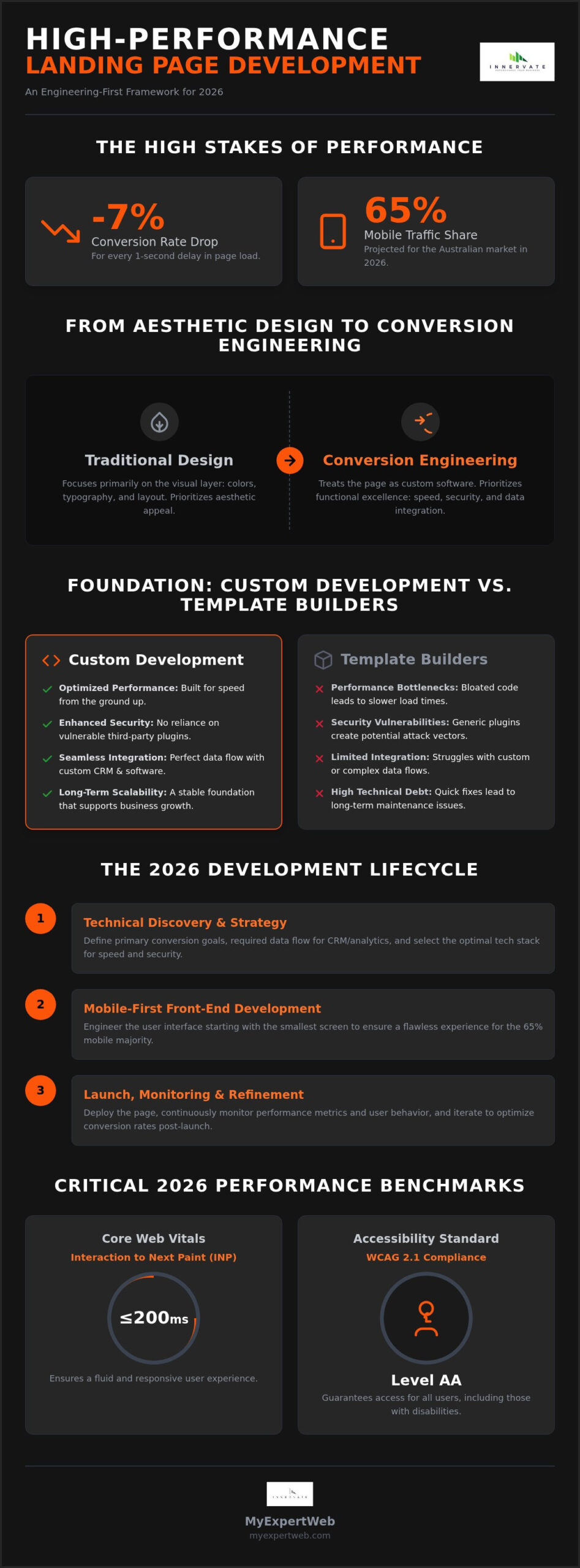
Did you know that a single second of delay on your landing page can slash your conversion rates by 7%? Within the Australian market of 2026, where mobile traffic accounts for 65% of all visits, technical performance is no longer a luxury; it’s a baseline requirement for business survival. Many organisations find that while their pages look professional, they struggle with slow load speeds and security vulnerabilities inherent in generic plugins. Modern landing page development demands a shift from basic aesthetics to rigorous technical standards.
You likely recognise that a landing page should be more than just a digital flyer, yet the frustration of disconnected CRM data and poor mobile conversion rates remains a common hurdle. We understand these challenges and believe that high-performance results require a methodical, engineering-first approach. This guide provides a strategic technical framework to build secure, scalable, and conversion-optimised pages that integrate perfectly with your custom software and business applications.
We’ll examine the critical 2026 benchmarks for Core Web Vitals, such as maintaining an Interaction to Next Paint (INP) of 200 milliseconds or less. From there, we’ll outline a roadmap for seamless lead data integration and WCAG 2.1 Level AA compliance to ensure your digital presence is both accessible and highly effective.
Key Takeaways
- Understand the fundamental shift in landing page development from purely aesthetic design to a high-performance engineering discipline focused on functional excellence.
- Learn why the pre-code strategy and wireframing phase is the most critical step in ensuring your campaign achieves a conversion rate in the top quartile of the Australian market.
- Evaluate the long-term cost-efficiencies of custom development over generic template builders, particularly regarding scalability and seamless CRM integration.
- Discover the technical infrastructure required to optimize load speeds and security, including the strategic use of server-side enhancements and CDNs.
- Gain a framework for selecting a strategic development partner who bridges the gap between technical depth and integrated SEO services for long-term viability.
Understanding Landing Page Development: Beyond Basic Web Design
Effective digital marketing in Australia relies on precision. While a standard website serves as a broad digital storefront, a landing page is a surgical tool designed for a single outcome. Strictly speaking, What is a Landing Page? It is a standalone web entity created specifically for a marketing or advertising campaign. It’s where a visitor arrives after clicking a link in an email, an ad, or a social media post. Unlike your homepage, which encourages exploration, this page exists to drive a specific action.
Many businesses confuse web design with landing page development. Design focuses on the visual layer, such as colours, typography, and layout. Development, however, is the technical engine that drives performance. It involves building the functional framework that ensures the page loads instantly, handles data securely, and integrates with your existing CRM. A page can look stunning but still fail if the backend code is bloated or if the lead capture form breaks on mobile devices. We believe that professional development prioritises functional excellence over mere aesthetic appeal.
This shift in focus leads to what we call “Conversion Engineering.” Instead of just building a page, we engineer a pathway. This methodical approach treats the page as a piece of custom software rather than a static document. By focusing on technical performance, you ensure that your marketing spend isn’t wasted on high bounce rates caused by preventable technical glitches.
The Role of Technical Architecture in Conversion
The underlying code structure dictates how a visitor interacts with your call-to-action. If the technical architecture is inefficient, scripts may delay the rendering of your primary button, creating unnecessary friction. Clean, semantic code also signals quality to search engines, supporting your organic visibility even if the page is primarily for paid traffic. This level of technical rigour ensures that your campaigns remain scalable across search and social channels without performance degradation. It’s about building a stable foundation that supports growth rather than just a temporary fix.
Landing Pages vs. Microsites: When to Use Which?
Choosing the right format depends on your specific business objective. A landing page is a single-purpose tool; it removes all distractions to focus the user on one goal. In contrast, a microsite provides a broader experience for high-value offerings that require deep education or multiple interactive elements. While a landing page often sits on a subdomain or a specific URL path, a microsite might require separate hosting and domain management to handle its increased complexity. Understanding these technical differences is vital for managing your digital assets and ensuring each campaign has the right technical support.
The 2026 Landing Page Development Lifecycle
While template builders suggest you can launch a digital campaign in minutes, they often overlook the engineering rigour required for high-stakes business outcomes. A professional landing page development lifecycle follows a methodical path from technical discovery to post-launch refinement. This structured approach ensures that every element, from the hero section to the lead capture form, performs reliably under the pressure of high-volume traffic. Strategy and wireframing must occur before a single line of code is written to ensure the user journey is mapped to specific business objectives.
Phase 1: Technical Discovery and Strategy
Successful execution begins by identifying the primary conversion goal and the specific data flow required for your CRM and analytics tools. We define technical discovery as the foundation of all successful secure web application development. During this phase, you must determine the tech stack based on speed and security requirements. Addressing these complexities of landing page development early prevents the technical debt often found in “fast” template builds and ensures long-term viability.
Phase 2: Mobile-First Front-End Development
With mobile devices accounting for 65% of traffic in 2026, developing for the smallest screen first is a logical necessity. This approach ensures that functional excellence is maintained regardless of the user’s device. By implementing modern, lightweight CSS frameworks, developers can create fast-loading visuals that meet the 2.5-second Largest Contentful Paint (LCP) threshold. It’s also essential to meet WCAG 2.1 Level AA accessibility standards to ensure your message reaches all segments of the Australian audience effectively.
Phase 3: Backend Integration and Quality Assurance
The final phase involves connecting forms to secure databases or third-party lead management tools. This step requires adhering to website security best practices to protect user data and maintain brand trust. Rigorous cross-browser testing is performed to ensure the page remains stable across all devices, preventing the 58% lower conversion rate often seen on poorly optimised mobile sites. We also conduct load testing to ensure the page maintains an Interaction to Next Paint (INP) of 200 milliseconds or less during peak PPC traffic. If you’re looking to build a more robust digital presence, our team can help you navigate landing page design and development with a focus on these technical essentials.
Custom Development vs. Template Builders: A Comparison
Choosing between a template builder and custom landing page development often feels like a choice between speed and quality. For many Australian businesses, the allure of a low upfront cost is strong. However, the true cost of a landing page isn’t just the build fee; it’s the potential revenue lost to poor performance. While builders allow for rapid deployment, they often introduce a “template tax” in the form of bloated code that can hinder browser rendering and user experience.
The belief that builders are always cheaper is a common misconception. When you factor in the loss of conversions due to slow load speeds and the technical limitations of generic layouts, custom development often delivers a superior ROI for established brands. Clean, bespoke code ensures your page meets the strict technical benchmarks required in 2026, directly influencing your Quality Score in paid search campaigns and lowering your overall acquisition costs.
When No-Code Builders Make Sense
No-code platforms are a pragmatic choice for low-budget testing or short-term campaigns where long-term scalability isn’t a priority. If you need to validate a simple offer within a few days, these tools provide an accessible entry point. The primary limitation lies in platform lock-in and restricted data ownership. As your requirements grow, you’ll likely find that templates fail to support the complex integrations required for custom business application development. These builders are often unable to handle unique backend logic or the high-security standards necessary for sensitive lead data.
The Strategic Advantage of Custom Development
Bespoke development offers a level of precision that off-the-shelf templates cannot match. By building from the ground up, you gain complete control over the user journey and unique brand aesthetics. This approach allows for unmatched page load speeds, ensuring you hit the 2.5-second Largest Contentful Paint (LCP) target with ease. Custom landing page development also provides the flexibility to build secure, scalable applications that align perfectly with your specific operational goals. You aren’t just creating a page; you’re developing a high-performance asset that integrates seamlessly with your existing technology stack, providing a stable foundation for multi-channel marketing growth.
Optimising Technical Performance and Security
Speed serves as the silent engine of digital conversion. A one-second delay in load time can result in a 7% reduction in conversions, making technical efficiency a non-negotiable priority for Australian businesses. Professional landing page development focuses on the structural optimisations that generic builders often ignore. By leveraging server-side caching and Content Delivery Networks (CDNs), we ensure that your content is delivered from the nearest local server, reducing the physical distance data must travel. This methodical approach ensures your visitors remain engaged from the first click rather than bouncing due to latency.
Engineering for Speed: Core Web Vitals in 2026
Achieving sub-second load times requires a precise approach to asset management. We focus on minifying code and optimising images to ensure the browser renders content without delay. The choice of hosting environment is equally critical for national campaigns. Servers strategically located within Australia provide the low-latency response needed to keep users on the page. Page speed directly correlates to PPC ROI. When a page loads instantly, your Quality Score rises, effectively lowering your advertising costs while increasing lead volume.
Security-First Development Practices
Protecting user data is a core component of building brand authority. We implement robust security protocols, including SSL encryption and secure form handling, to prevent common web threats. Compliance with Australian privacy regulations ensures that your lead collection processes are both ethical and legal. For high-value B2B prospects, seeing a secure, professionally developed page builds the reassurance necessary to share contact details. If you’re ready to improve your technical performance, our team provides expert landing page design and development services to protect your digital assets.
Modern marketing relies on data, but heavy tracking scripts can cripple page performance. We use advanced techniques like server-side tagging to ensure your analytics and heatmaps function correctly without slowing down the user journey. This balance of data depth and technical speed is what separates professional engineering from basic web design. It ensures your landing page development efforts yield actionable insights without sacrificing the very speed that drives conversions in the first place.
Choosing a Strategic Partner for Landing Page Development
Selecting a partner for landing page development is a decision that extends beyond reviewing a visual portfolio. While many individual designers can create an attractive layout, a strategic partner possesses the technical depth to ensure that the page functions as a high-performance business tool. We believe the ideal collaborator demonstrates strategic empathy, taking the time to understand your unique operational challenges before proposing a technical solution. This methodical approach ensures that your digital assets are reliable, secure, and capable of handling the complexities of the Australian market.
The value of a professional agency lies in its ability to bridge the gap between technical execution and market visibility. A partner that understands integrated web development and SEO services provides a significant advantage. They don’t just build a page in isolation; they ensure that the technical framework supports your organic search goals and handles paid traffic with maximum efficiency. This holistic perspective prevents the common issue of having a beautiful page that fails to attract or convert high-quality leads due to poor technical foundations.
We view our role as an extension of your own team rather than a simple vendor. This collaborative partnership focuses on long-term viability and consistent results. By acting as a methodical guide, we help you navigate the evolving landscape of 2026, from strict data privacy regulations to the latest Core Web Vitals benchmarks. This steady, results-focused alliance ensures that your landing page development projects are executed with professional excellence and functional precision.
The MyExpertWeb Approach: Partnership and Performance
Our team leverages 12+ years of industry experience to solve complex business challenges through custom code. We prioritise clean, mobile-friendly designs that drive measurable growth for our clients. Instead of relying on generic templates, we build secure, scalable applications tailored to your specific goals. This focus on engineering excellence allows us to integrate your landing pages seamlessly into your broader digital marketing ecosystem, ensuring that data flows correctly between your ads, your website, and your CRM.
Next Steps: From Consultation to Conversion
The transition from a single campaign to a comprehensive digital strategy begins with a clear understanding of your objectives. We recommend starting with a professional consultation to align technical solutions with your business goals. This step allows you to explore how a custom-built page can outperform generic alternatives and provide a stable foundation for future growth. If you’re ready to elevate your digital presence, you can Contact MyExpertWeb for a free consultation on your next development project. Our team is here to provide the pragmatic support and technical expertise required to turn your vision into a high-converting reality.
Elevating Digital Performance through Strategic Engineering
Building a high-performance digital asset requires a shift from basic design to rigorous technical engineering. Success in the 2026 Australian market depends on meeting specific benchmarks for speed, accessibility, and data security. By focusing on a custom framework rather than a generic template, you ensure your landing page development efforts support long-term scalability and provide a superior user experience that drives conversions.
We understand that managing these technical requirements is complex. MyExpertWeb offers a pragmatic, supportive strategic partnership backed by 12+ years of experience. We specialise in creating secure, scalable web applications that integrate perfectly with your business goals. Our methodical approach ensures every line of code serves a purpose, protecting your brand and your marketing ROI.
Partner with MyExpertWeb for High-Performance Landing Page Development to start building a more effective digital presence today. We’re ready to help you turn technical challenges into competitive advantages.
Frequently Asked Questions
How long does landing page development typically take?
Professional landing page development typically spans two to four weeks. This timeframe allows for the technical discovery, custom coding, and rigorous testing phases required for high-performance results. While template builders offer a same-day launch, they often bypass the security audits and CRM integration checks that protect your data. A methodical approach ensures your page is stable and ready to handle high-volume traffic without performance degradation or unexpected technical failures.
What is the difference between a landing page and a website?
A landing page is a standalone destination designed for a specific marketing campaign, whereas a website serves as a comprehensive digital hub for your entire brand. The primary difference lies in focus; a website encourages exploration through multiple links, while a landing page removes distractions to drive a single action. This single-purpose design is why these pages often achieve higher conversion rates for targeted Australian PPC campaigns than a standard homepage.
Do I need custom development if I already use a CRM like Salesforce or HubSpot?
Custom development is often essential even with a top-tier CRM to ensure seamless data synchronisation without affecting page speed. Generic embedded forms from platforms like Salesforce or HubSpot can sometimes introduce heavy scripts that slow down your load times. Custom-coded hooks allow you to capture lead data securely and transfer it to your CRM in the background, maintaining the fast user experience required for modern digital performance.
How does landing page development affect my Google Ads Quality Score?
Technical landing page development directly impacts your Quality Score by improving page speed and landing page experience. Google rewards pages that load quickly and provide a relevant, secure environment for users with higher scores and lower costs per click. By optimising your technical architecture and reducing script bloat, you effectively increase your advertising ROI while outperforming competitors who rely on slower, generic templates for their paid campaigns.
What technical features are essential for a high-converting landing page in 2026?
Essential features for 2026 include sub-second load times and full compliance with national accessibility standards. You also need server-side tracking to maintain data accuracy in a privacy-first environment and robust SSL encryption to protect user information. These technical standards ensure your page remains accessible and secure for a broad national audience. Prioritising these elements helps you meet the high expectations of modern Australian consumers and business prospects.
Can a landing page be optimized for SEO, or is it only for paid traffic?
While often used for paid traffic, a landing page can be optimised for SEO to capture organic leads. Using clean, semantic HTML and ensuring your page meets Core Web Vitals targets helps search engines index your content more effectively. This dual-purpose approach allows you to maximise your visibility across both paid search and organic results, providing a more stable and cost-effective source of traffic for your business.
Is mobile-first development really necessary for B2B landing pages?
Mobile-first development is critical for B2B pages because decision-makers increasingly use mobile devices for initial research and quick comparisons. Even in professional sectors, a significant portion of your traffic arrives via smartphones during the work day. A desktop-only focus will likely alienate a large segment of your potential leads. Ensuring your functional excellence carries over to smaller screens prevents the conversion drop-off often seen on non-responsive B2B sites.
What are the security risks of using cheap landing page builders?
Cheap builders often rely on outdated plugins and shared hosting environments that are vulnerable to cyber threats. These platforms may lack the sophisticated encryption and secure form handling required to protect sensitive Australian lead data. Using a professional development partner ensures your page is built with a security-first mindset, reducing the risk of data breaches that can damage your brand’s reputation and lead to legal complications under national privacy standards.