


MyExpertWeb Team
August 24, 2026
How to Write a Website Design Brief: 2026 Strategic Guide
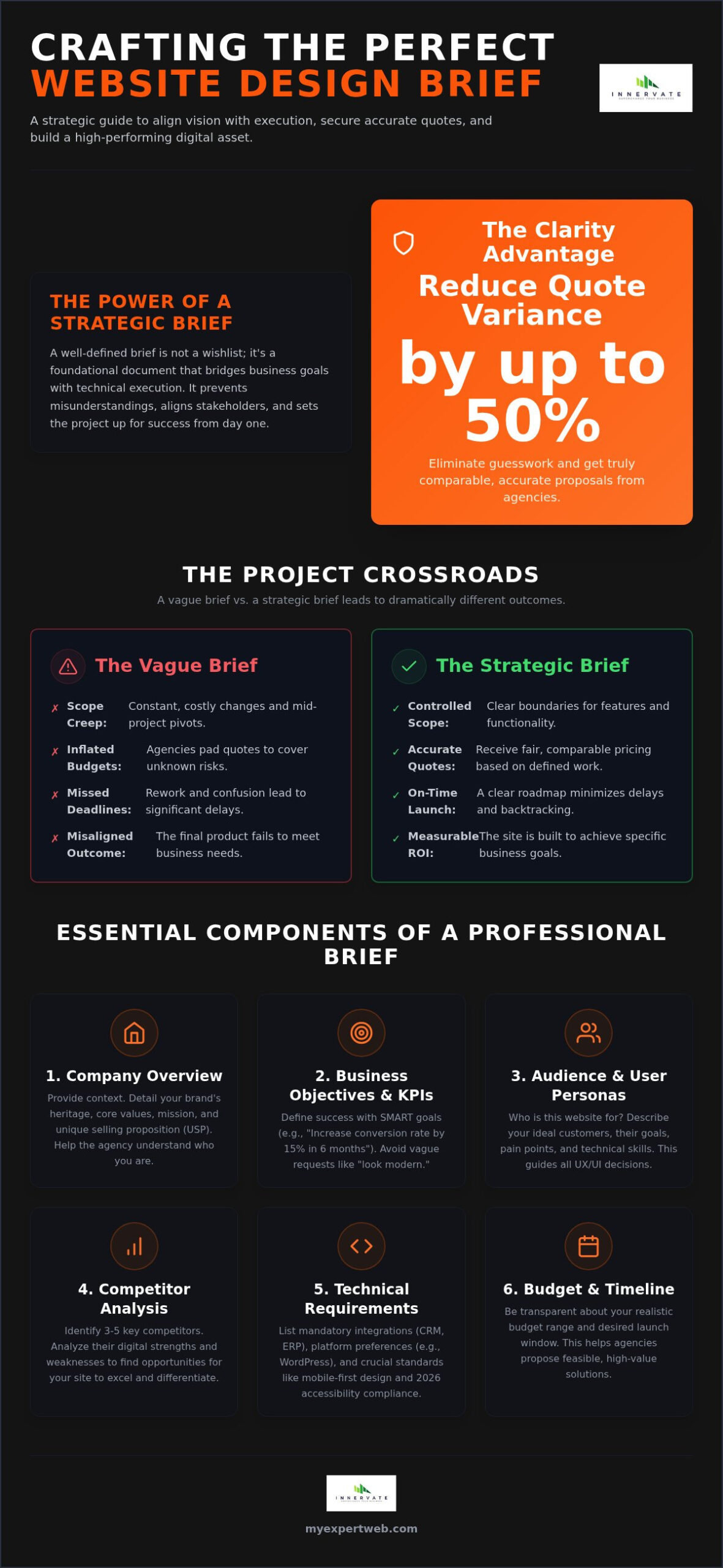
According to recent industry data, a well-defined website design brief can reduce the variance in agency quotes by as much as 50 percent. When you’re clear about your requirements from the start, you eliminate the guesswork that leads to inflated budgets and missed deadlines. Most business leaders feel a natural anxiety when approaching a digital overhaul. You might worry about getting lost in technical jargon or investing in a platform that fails to drive real growth. It’s a common concern, especially when your website needs to serve as a high-performing business asset rather than just a digital brochure.
This guide will show you exactly how to write a website design brief that aligns your strategic goals with technical execution. By following a methodical approach, you can ensure every internal stakeholder is on the same page and every agency understands your vision. We’ll walk through the essential components of a professional brief, including user experience standards and the latest accessibility requirements for 2026. You’ll finish this article with a clear roadmap to secure accurate quotes and build a site that delivers measurable results.
Key Takeaways
- Understand why a design brief is a strategic document rather than a simple wishlist, helping you prevent scope creep and manage budgets effectively.
- Master how to write a website design brief by establishing SMART goals that align your internal business objectives with technical project requirements.
- Learn to prioritize scalability and mobile-first design to ensure your new website remains a high-performing asset throughout 2026 and beyond.
- Follow a methodical process for gathering internal data and interviewing stakeholders to ensure the final product supports every department in your organization.
- Use your completed brief as a professional vetting tool to identify and build a reliable partnership with the right development agency.
Defining the Website Design Brief as a Strategic Asset
A website design brief is more than a simple set of instructions; it is a foundational document that bridges the gap between your business vision and technical execution. At its core, this document outlines your project goals, functional scope, and technical constraints. By clearly defining these elements before a single line of code is written, you create a safeguard against scope creep and unexpected budget overruns. Understanding how to write a website design brief is the first step in moving from a vendor-client transaction to a reliable strategic partnership. This document ensures that when you approach a digital agency, you aren’t just asking for a website; you’re inviting them to solve a specific business problem.
Before contacting external partners, the brief serves as a vital tool for internal alignment. It forces stakeholders to agree on priorities, preventing mid-project pivots that often derail timelines. When Marketing, Sales, and IT are all aligned on the document’s contents, the project proceeds with a unified purpose. Learning how to write a website design brief effectively ensures that your internal team remains focused on long-term business utility rather than getting distracted by fleeting aesthetic trends.
Why “Good Enough” Leads to Project Failure
Vague requirements are the primary cause of project friction in custom software development. When a brief lacks detail, agencies are forced to make assumptions. If those assumptions don’t align with your functional needs, the result is often a site that looks right but fails to perform. This mismatch leads to expensive change orders and pushes back launch dates, sometimes by months. A weak brief essentially gambles with your timeline, as developers must backtrack to fix foundational errors that should have been addressed during the initial planning phase.
The Business Value of Strategic Clarity
Strategic clarity translates your high-level objectives into actionable technical tasks. For instance, a goal like “increase lead generation” becomes a requirement for specific CRM integrations or automated landing page workflows. A well-constructed brief also allows you to obtain truly comparable quotes. Research indicates that a detailed brief can reduce the variance in quotes from different vendors by 30 to 50 percent. Most importantly, the brief establishes the metrics for success, ensuring your website functions as a long-term business asset with a clear path toward a positive return on investment. It turns a capital expense into a measurable growth engine.
Essential Components of a Professional Design Brief
A successful project starts with a detailed exchange of information. When you’re learning how to write a website design brief, you must begin with a clear company overview. This section provides the necessary context for an agency to understand your brand’s heritage, core values, and unique selling proposition. Without this foundation, an agency might produce a site that looks polished but feels disconnected from your actual brand identity. Providing this context allows your digital partner to align their creative strategy with your established market position and long-term vision.
Beyond the basics, your brief must include a methodical competitor analysis. This isn’t just about listing other businesses in your space; it’s about identifying their digital strengths and weaknesses. By evaluating their site speed, navigation structures, and content strategies, you can pinpoint opportunities for your own site to excel. This benchmarking process ensures your new platform isn’t just catching up to the market but is actively setting a higher standard for your industry.
Defining Your Business Objectives and KPIs
Strategic clarity requires distinguishing between vanity goals and functional business objectives. While “looking modern” is a common request, it isn’t a measurable business goal. Instead, focus on SMART objectives that have a direct impact on your bottom line. For example, you might aim to increase your conversion rate by 15 percent within the first six months or reduce your bounce rate on key service pages. Key Performance Indicators (KPIs) like page load speed and user retention rates provide the data needed to judge project success. Being honest about current challenges, such as a high drop-off rate at checkout, allows an agency to build specific solutions into the new architecture. If you need help translating these challenges into technical requirements, our team at MyExpertWeb can assist in refining your digital strategy.
Understanding Your Audience and User Personas
User personas serve as the guiding light for every UX design decision made throughout the development process. To create a site that truly resonates, you must profile your target audience beyond simple demographics like age or location. Identify the specific pain points your users face and explain how the website will solve them. Mapping the user journey from the initial discovery phase to the final conversion point is essential for creating intuitive navigation. When you understand the emotional and logical triggers that drive your users, you can ensure the final design supports their needs at every touchpoint. This level of detail is a critical part of how to write a website design brief that results in a high-converting digital asset.
Technical Requirements and Scalability Considerations
Selecting a Content Management System (CMS) is not about following trends; it is about operational fit. If your organization manages complex internal workflows, you need a system that offers granular control. Conversely, a smaller team might prioritize a platform that allows for rapid content updates without technical intervention. In the 2026 digital environment, mobile-first design is a mandatory requirement. Your brief should specify that the user experience must be optimized for touch interfaces and smaller screens before desktop layouts are finalized. This ensures your site remains accessible to the majority of users who now browse primarily via mobile devices.
Integrations are the connective tissue of your digital presence. When documenting how to write a website design brief, you must list every third-party tool that needs to communicate with your site. This includes CRMs for lead management, payment gateways for secure transactions, and ERP systems for inventory or resource planning. Defining these requirements early prevents expensive technical debt later in the project. You should also outline expectations for ongoing maintenance and support. Industry data shows that the total cost of ownership over three years can be 2 to 3.4 times the initial build cost. Planning for these recurring expenses ensures your website remains a reliable, high-performing asset.
Prioritizing Cyber Security and Performance
Security must be integrated into the design phase rather than treated as a final checklist item. This proactive approach is the standard for secure web application development, where protection measures are baked into the architecture to safeguard sensitive data. Performance is equally critical. Your brief should demand a scalable architecture that can handle traffic spikes and future business expansion without requiring a complete rebuild. A site that loads quickly and remains secure builds immediate trust with your audience.
Integrating SEO and Content Strategy
SEO requirements should be defined before the first wireframe is drawn. This ensures that the site structure, URL hierarchy, and internal linking are all optimized for visibility from day one. This is especially vital for businesses utilizing local seo services to gain national traction. If you are redesigning an existing platform, your brief must include a detailed content migration plan. This prevents the loss of established search rankings and ensures a smooth transition for your existing users. Understanding how to write a website design brief with these technical nuances ensures your project delivers long-term strategic value.
Step-by-Step: How to Draft Your Website Design Brief
Drafting a strategic brief requires a structured approach to ensure no critical business requirement is overlooked. The process begins with internal discovery. You must gather existing data and audit your current digital presence to understand the baseline from which you’re building. Once you have a clear picture of your current state, the next step is to interview key stakeholders from departments such as Sales, HR, and Marketing. Each department interacts with the website differently; for instance, HR might need a streamlined recruitment portal, while Sales requires high-performing landing pages. Identifying these departmental needs early ensures the final document is comprehensive and representative of the entire organization.
To guide the aesthetic direction, create a visual mood board or a curated list of reference sites. This helps the design team understand your preferences for layout, color, and interaction without relying solely on descriptive adjectives. Finally, review the document for brevity. A professional brief should be concise enough to be actionable but detailed enough to be accurate. Mastering how to write a website design brief is about striking a balance between strategic depth and operational clarity. This methodical preparation ensures that when you hand the document over, the agency has everything they need to succeed.
Conducting a Digital Audit
A thorough digital audit identifies what currently works and where the user experience fails. Start by reviewing your analytics to find pages with high bounce rates or broken conversion funnels. You should also compile a checklist of your existing brand assets, including high-resolution logos, typography, and established style guides. Don’t ignore technical debt. If your current site suffers from slow load times or outdated plugins, document these issues so the new agency can prioritize their resolution. This audit provides the evidence needed to justify strategic changes in the new design.
Setting Realistic Budgets and Timelines
Communicating your budget is essential for managing agency expectations, but you can do so strategically. Instead of a single figure, provide a budget range. This allows agencies to propose different tiers of service or technical complexity based on your financial comfort zone. Remember that project duration is directly linked to technical requirements; a site with complex third-party integrations will naturally take longer than a standard corporate site. Always include buffer time for thorough testing and quality assurance before the final launch. If you’re ready to start this process with an experienced partner, you can contact our team at MyExpertWeb to discuss your project requirements and receive a tailored consultation.
Navigating the Agency Partnership: From Brief to Launch
Your completed brief is the ultimate litmus test for potential partners. It allows you to move beyond aesthetic impressions and evaluate an agency based on their strategic comprehension. When you understand how to write a website design brief that includes specific technical constraints, you can quickly identify which firms possess the necessary expertise. For projects requiring complex logic or internal systems integration, partnering with an agency that specializes in custom business application development ensures your platform is built on a scalable foundation. This level of technical depth is often missing in agencies that focus solely on visual design.
Long-term success also depends on search visibility and operational consistency. Choosing integrated web development and SEO services ensures that your site is built to be found, not just seen. For high-complexity briefs, many organizations benefit from dedicated development teams. Unlike project-based freelancers, a dedicated team acts as an extension of your own staff. They provide the consistent focus needed for intricate builds and the adaptability required for long-term maintenance in a shifting digital market.
Evaluating Agency Proposals
When comparing proposals, look for how each agency addresses the specific challenges outlined in your brief. A significant red flag is any response that ignores your technical constraints or misses the accessibility standards mandated for 2026. Cultural fit is equally important. Pay attention to their communication style and whether they ask clarifying questions about your goals. A partner who listens and adapts to your specific business needs is far more valuable than one who offers a generic, one-size-fits-all solution. This initial interaction sets the tone for the entire project lifecycle.
The Brief as a Living Document
The brief isn’t a static document; it evolves as the project moves forward. During the discovery phase, your strategic brief matures into a functional specification document that guides every development sprint. This document also provides a clear framework for managing change requests, ensuring that any adjustments remain aligned with your budget and timeline. By maintaining this clarity, you prevent the project from drifting away from its original business goals. If you’re ready to turn your vision into a high-performing digital asset, contact MyExpertWeb for a free consultation on your next digital project.
Turning Your Strategic Vision into a Digital Reality
Building a high-performing website in 2026 requires more than just a list of aesthetic preferences. It demands a document that aligns your internal business goals with technical execution. By mastering how to write a website design brief, you eliminate the ambiguity that leads to project delays and budget overruns. You’ve learned that a successful brief must address everything from user personas and SMART goals to accessibility standards and scalable architecture. This preparation isn’t just about documentation; it’s about establishing the foundation for a reliable strategic partnership.
With over 12 years of industry excellence, our team understands the complexities of custom software and scalable business applications. We provide dedicated development teams that act as an extension of your own staff, ensuring that even the most intricate technical integrations are executed with precision. If you’re ready to translate your strategic requirements into a long-term business asset, partner with MyExpertWeb for your next custom web project. We’re here to guide you through every stage of the process, ensuring your digital presence remains secure, visible, and focused on growth.
Frequently Asked Questions
How long should a website design brief be?
A standard website design brief should be as concise as possible while remaining comprehensive. For a typical business site, five to ten pages are often sufficient to cover the necessary strategic and technical details. If you’re managing a complex custom software project, the length might increase to accommodate deeper technical requirements. The goal is to provide enough clarity so that an agency can provide an accurate quote without wading through unnecessary fluff.
Do I need to include a budget in my design brief?
You should always include a budget range in your brief to help agencies determine if they are the right fit for your project. Providing a range rather than a fixed number allows for flexibility in the proposed solutions. Agencies can offer different tiers of service or technical sophistication based on your financial comfort zone. This transparency prevents wasted time for both parties and ensures the proposals you receive are realistic and executable within your resources.
What is the difference between a design brief and a functional specification?
A design brief focuses on high-level business goals, target audience, and the overall vision for the project. In contrast, a functional specification is a technical document that details exactly how every feature will work. While you are responsible for knowing how to write a website design brief to set the direction, the agency often develops the functional specification during the discovery phase. This technical roadmap translates your strategic requirements into specific developer instructions.
Should I include wireframes in my brief or leave that to the agency?
It is generally better to leave the wireframing to the professional design team. Agencies use their expertise in user experience and conversion optimization to determine the best layout for your goals. Instead of wireframes, include a mood board or a list of reference sites to communicate your aesthetic preferences. This provides the creative team with a clear visual direction while allowing them the freedom to apply best practices to the site’s structural design.
How do I handle a brief for a website redesign versus a new build?
A brief for a website redesign must include a detailed audit of your current platform to identify what works and what fails. You also need a content migration plan to protect your existing search rankings. For a new build, the focus shifts to establishing a foundational brand identity and defining the initial user journey from scratch. Both scenarios require clear business objectives, but a redesign carries the additional responsibility of managing established digital assets and technical debt.
Can I use a template for my website design brief?
Using a template is an excellent way to ensure you don’t miss any essential components. However, you must customize the template to reflect your unique business challenges and technical needs. A generic document often fails to capture the specific nuances required for how to write a website design brief that results in a high-performing business asset. Treat the template as a structural guide rather than a finished product to ensure your strategic vision remains at the center.
How do I ensure my brief covers mobile responsiveness and accessibility?
You should explicitly state that the project must follow mobile-first design principles and comply with WCAG 2.1 Level AA standards. In the 2026 digital landscape, these requirements are non-negotiable for both user experience and legal compliance. Specify that the site must be fully functional across all device types and accessible to users with varying abilities. Including these requirements in the brief ensures that accessibility is baked into the architecture from the very beginning of the project.
What happens if we need to change the brief halfway through the project?
If your requirements change mid-project, you must follow a formal change management process. This involves documenting the new requirements and assessing their impact on the existing timeline and budget. While a well-crafted brief minimizes these shifts, flexibility is sometimes necessary for complex builds. Your agency partner should help you evaluate the trade-offs to ensure the final product still aligns with your core business goals without causing unnecessary project delays or budget overruns.