


MyExpertWeb Team
September 10, 2026
Strategic Landing Page Design and Development: The 2026 Conversion Guide
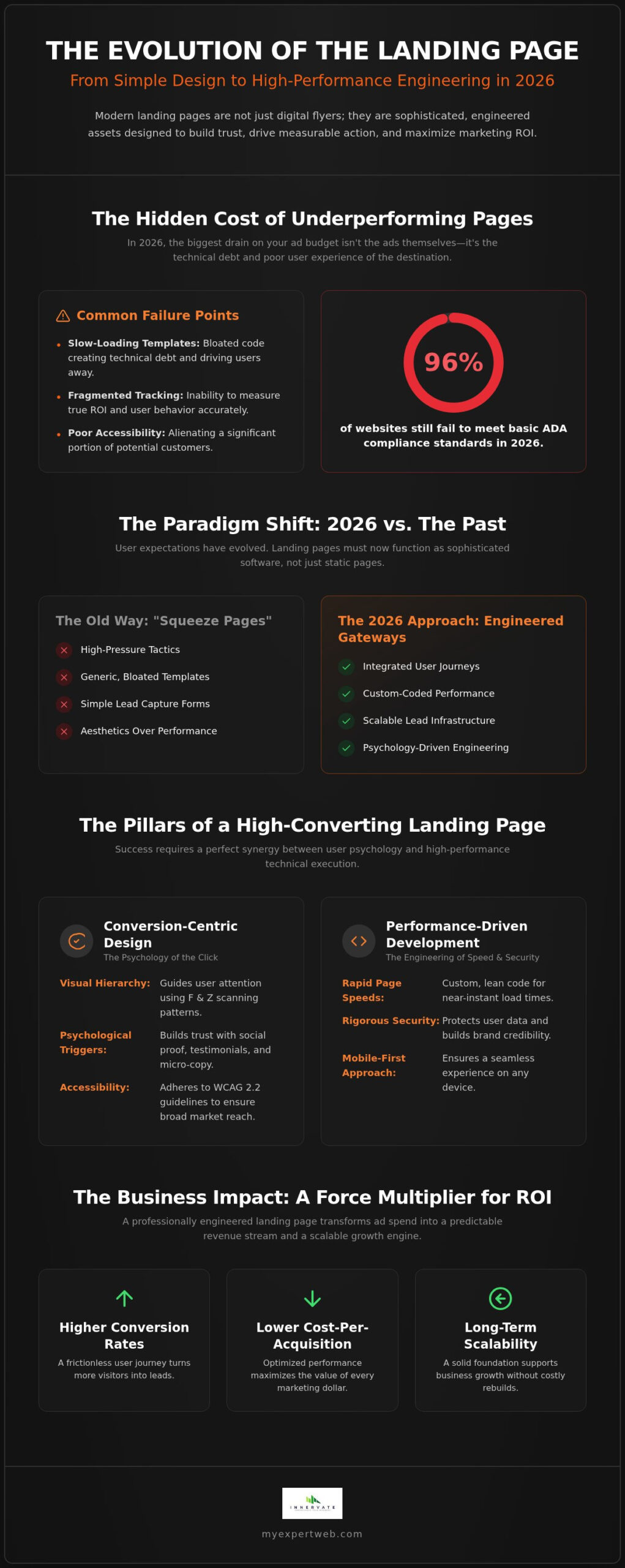
What if the most expensive part of your marketing isn’t the ads you’re running, but the hidden technical debt in your destination? In 2026, roughly 96% of websites still fail to meet basic ADA compliance standards, and many more lose potential leads because of slow-loading templates and fragmented tracking. You likely already know that a standard web page isn’t enough to justify a modern advertising budget. Effective landing page design and development requires more than just a clean layout; it demands a synergy between user psychology and high-performance engineering.
We understand how frustrating it is to watch your cost-per-acquisition climb while your conversion rates remain stagnant. This guide focuses on transforming those challenges into a scalable lead generation infrastructure. You’ll discover how to fuse psychological triggers with secure, accessible code to create a seamless brand experience that builds trust instantly. We’ll explore the methodical steps needed to lower your CPA and ensure your digital presence is both a reliable asset and a growth engine for your business.
Key Takeaways
- Learn why modern landing page design and development requires a shift from simple lead capture to integrated user journeys that build long-term brand trust.
- Discover how to apply 2026 visual hierarchy standards, including updated scanning patterns, to guide visitors naturally toward your primary call-to-action.
- Understand the technical engineering required to balance rapid page speeds with the rigorous security protocols necessary for high-performance business applications.
- Follow a methodical development roadmap that uses wireframing and prototyping to align your digital assets with measurable business growth.
- Compare the scalability of custom-built solutions against standard templates to determine the most effective path for lowering your long-term cost-per-acquisition.
What is Landing Page Design and Development in 2026?
Defining landing page design and development in 2026 requires looking beyond simple aesthetics. It’s a unified discipline where psychological triggers meet high-performance engineering. To build a foundation, it’s helpful to consider the basic premise: What is a landing page? While the core definition remains a standalone destination for a marketing campaign, the execution has shifted. We’ve moved away from the high-pressure “squeeze pages” of the past. Modern Australian businesses now utilize these pages as sophisticated gateways that align with complex, multi-stage user journeys. This evolution means a page isn’t just a digital flyer; it’s a functional piece of software designed to convert.
Standard web design often prioritizes broad information and brand awareness. In contrast, conversion-focused engineering is built for a singular purpose: measurable action. This requires a national strategic approach that considers speed, security, and user intent as equal priorities. When development is handled strategically, the page becomes a reliable asset that can scale alongside a growing business. This transition from “designing” to “engineering” is what separates high-growth brands from those struggling with stagnant conversion rates.
The Evolution of the Landing Page
User expectations in 2026 are higher than ever. AI and deep personalization have changed how visitors interact with content. They don’t want generic messages. They want solutions that feel tailored to their immediate needs. This shift has led many professionals to abandon generic templates in favor of custom-coded performance. Templates often come with bloated code that creates technical debt, slowing down load times and hurting search rankings. Since mobile devices drive the majority of traffic, a mobile-first approach is now the baseline requirement for any serious project. It ensures that the experience is seamless, regardless of the screen size or connection speed.
The Business Impact of Professional Development
A high-performing page acts as a force multiplier for your marketing ROI. It’s often the most visible layer of custom business application development, serving as the point where a visitor becomes a lead. By focusing on reducing friction in the customer acquisition funnel, professional development turns traffic into a predictable revenue stream. It provides the methodical structure needed to transform a simple click into a long-term business relationship. When you treat your landing page as a strategic investment rather than a one-off expense, you create a scalable infrastructure for lead generation that outperforms the competition.
Conversion-Centric Design: The Psychology of the Click
Successful landing page design and development isn’t merely about artistic expression; it’s about guiding a visitor through a specific mental process. In 2026, we still rely on the F-Pattern for content-heavy pages and the Z-Pattern for visual-heavy layouts to ensure the most important information sits where eyes naturally land. This structure allows users to scan and find value within seconds. If the layout is cluttered, the visitor loses interest. If it’s too sparse, they lose trust. Striking this balance is the core of conversion-centric design.
Visual hierarchy uses size, color, and placement to create a clear path toward the call-to-action. High-quality graphics design isn’t just decoration; it serves as a visual shorthand for professional reliability and brand authority. When a visitor sees a polished, cohesive visual style, their perceived risk of engaging with your business drops. This trust is further reinforced by adhering to accessibility standards. Following WCAG 2.2 guidelines ensures your page is usable for all individuals, which has become a vital requirement for modern Australian businesses looking to maintain a broad market reach.
Psychological Triggers and Social Proof
Trust is built through the strategic placement of social proof, such as testimonials, case studies, and industry trust badges that validate your claims. These elements should be placed near decision points to provide a final nudge of confidence. Micro-copy, those small snippets of text near buttons or form fields, helps reduce user anxiety by clarifying exactly what happens after a click. For example, a simple “No credit card required” or “We value your privacy” can significantly lower the friction at the point of conversion. Color theory also remains a powerful tool, where specific palettes can evoke stability or urgency depending on your business goals.
Mobile-Responsive vs. Adaptive Design
Your page must function perfectly on everything from a pocket-sized smartphone to a massive ultra-wide monitor. While adaptive design serves specific layouts for specific devices, responsive design is the non-negotiable standard for 2026 because it fluidly adjusts to any screen size. We focus on optimizing touch-points for mobile users, ensuring buttons are easy to tap and forms are simple to fill with a thumb. This methodical approach to detail is what turns a casual browser into a committed lead. If you need help refining these elements, our team provides expert landing page design and development services tailored to your specific growth needs.
Performance-Driven Development: Building for Speed and Security
While design captures a visitor’s attention, engineering is what retains it. In 2026, page speed isn’t just a technical convenience; it’s a critical SEO ranking factor and a direct influence on your bottom line. Every millisecond of delay increases the likelihood of a bounce, especially for mobile users on varying connection speeds. This is why high-performance landing page design and development requires a focus on clean, efficient code. High Core Web Vitals scores aren’t achieved through luck; they’re the result of meticulous development that avoids the heavy bloat found in generic templates and DIY builders.
A strategic landing page must also act as a functional bridge to your internal systems. Integration with third-party APIs, such as CRMs, email marketing platforms, and advanced analytics tools like GA4, ensures that your lead data flows seamlessly into your business ecosystem. This connectivity allows for accurate conversion tracking and better decision-making. If your landing page doesn’t communicate effectively with your sales tools, you’re losing valuable lead intelligence and creating unnecessary manual work for your team. We treat every page as a high-performance engine that powers your wider marketing strategy.
High-Performance Tech Stacks
Choosing the right framework is the first step in building a fast, reliable destination. We often evaluate modern frameworks like React or Vue, or utilize headless CMS solutions to deliver content with minimal overhead. Server-side rendering (SSR) plays a vital role in 2026, allowing pages to load almost instantly for the user by pre-rendering content on the server. Custom-built pages consistently outperform “page builder” plugins because they don’t carry the weight of unnecessary features or redundant scripts. This methodical approach ensures your site remains agile, responsive, and ready to handle sudden traffic spikes without a dip in performance.
Security and Data Privacy
Security is a core component of secure web application development. In 2026, users are more protective of their personal data than ever before. Your lead capture forms must be encrypted and fully compliant with the Australian Privacy Act and global standards like GDPR. Implementing SSL certificates and secure hosting is just the beginning. Regular maintenance is necessary to protect your assets from bot traffic and form spam, which can skew your data and waste your team’s time. By prioritizing security throughout the development process, you’re not just protecting data; you’re protecting your brand’s reputation and building long-term trust with your audience.
The Roadmap: From Discovery to Successful Launch
A successful project begins long before the first line of code is written. We follow a methodical roadmap to ensure every element of your landing page design and development aligns with your overarching business objectives. This process starts with a deep discovery phase where we identify your target user personas and define exactly what success looks like for your campaign. Without this foundational clarity, even the most visually striking design will fail to deliver measurable growth for your business.
Discovery and Strategy Alignment
Before any visual work begins, we establish key performance indicators (KPIs) to track progress. This includes analyzing competitor positioning for national campaigns to find gaps your brand can exploit. A central part of this phase is identifying your “One Core Offer”. By focusing on a single, high-value proposition, we remove the cognitive load from the user and maximize the potential for a conversion. This strategic alignment ensures that every pixel serves a specific business purpose.
Once the strategy is set, we move into the wireframing and prototyping stage. This allows all stakeholders to visualize the user journey without being distracted by final colors or imagery. It is an iterative cycle where feedback is integrated into the structural layout. By refining the flow early, we prevent costly technical changes during the final development phase. This collaborative approach builds a shared understanding of how the page will function and convert.
Quality Assurance and Deployment
Rigorous testing is the final gatekeeper of quality. We perform extensive cross-browser checks and speed testing to ensure every visitor has a high-performance experience, regardless of their hardware. This is also where we ensure your integrated web development and SEO services are perfectly aligned. Our pre-launch checklist covers everything from tracking pixel verification to form routing and final page speed audits to ensure a flawless user experience from day one.
A coordinated launch is just the beginning of the asset’s lifecycle. Post-launch optimization involves monitoring real-world user behavior and making data-driven adjustments. We use A/B testing to refine headlines and calls-to-action, ensuring your page continues to improve its conversion rate over time. This consistent focus on performance helps lower your long-term cost-per-acquisition. If you are ready to build a high-performance asset for your brand, explore our landing page design and development services to start your project today.
Choosing a Strategic Partner for Landing Page Excellence
Selecting the right partner for landing page design and development is a decision that impacts your long-term marketing efficiency. While many agencies focus solely on the visual layer, a strategic ally looks deeper into how the page integrates with your broader business infrastructure. MyExpertWeb positions itself as a methodical guide, drawing on over 12 years of industry experience to help businesses navigate the complexities of digital growth. We prioritize understanding your unique challenges over offering generic, one-size-fits-all solutions, ensuring every asset we build serves a practical purpose.
Custom vs. Template: The ROI Debate
Off-the-shelf templates often appear cost-effective initially, but they frequently lead to higher long-term costs due to technical inflexibility and bloated code. These rigid structures can limit your ability to scale as your business needs evolve or as user expectations change. In contrast, custom-developed pages provide the scalability required for growing SMEs to adapt their messaging and functionality without rebuilding from scratch. Custom design eliminates the “sameness” that often plagues competitive markets, ensuring your brand stands out with a unique, high-performance destination that visitors trust instantly.
Leveraging Offshore Dedicated Teams
Scaling your digital presence requires consistent, high-quality technical support that remains cost-effective. MyExpertWeb utilizes dedicated offshore development teams to provide high-value engineering at a scale that fits your specific business budget. This isn’t a simple vendor-client transaction; it’s a partnership-first approach where our team acts as an extension of your own. By leveraging this model, you gain access to seasoned experts who understand the nuances of cross-market adaptability and functional excellence without the overhead of traditional agency models.
We specialize in bridging the gap between front-end marketing and complex back-end systems, a critical need in the 2026 landscape. Whether your landing page needs to feed into custom business application development or sync with a specific CRM, we ensure the technical integration is seamless and secure. This focus on business utility over technical vanity ensures your assets remain viable and productive for years to come. If you’re ready to define your 2026 digital strategy, we invite you to discuss your goals with our team to see how a methodical, partnership-driven approach can transform your results.
Engineering Your Competitive Advantage for 2026
A high-performing landing page is no longer a static asset; it’s a methodical conversion engine where psychological design meets secure engineering. We’ve explored how moving away from generic templates toward custom solutions allows your business to scale while maintaining high Core Web Vitals and stringent data privacy standards. By aligning your destination with a clear user journey and a singular core offer, you create a reliable infrastructure that transforms traffic into measurable growth. Success in this landscape requires a focus on functional excellence and a deep understanding of your audience’s unique challenges.
As custom software specialists with over 12 years of industry experience, MyExpertWeb provides a national strategic perspective to every project. We act as your reliable partner, guiding you through the complexities of modern landing page design and development to ensure your digital presence is both efficient and visible. If you’re ready to lower your cost-per-acquisition and build a seamless brand experience, we’re here to help you navigate the process. Book a Free Consultation for Your Next Landing Page Project to start building your scalable lead generation infrastructure today. We look forward to supporting your business growth.
Frequently Asked Questions
What is the average timeline for landing page design and development?
The average timeline for landing page design and development typically ranges from two to four weeks. This duration allows for a methodical approach involving discovery, wireframing, custom coding, and rigorous cross-browser testing. Complex projects requiring advanced API integrations or custom business application features may take longer. We prioritize a thorough process to ensure the final asset is both high-performing and secure, providing a reliable foundation for your marketing campaigns.
How much does a custom-designed landing page cost in 2026?
The cost of a custom landing page varies based on technical complexity and the specific business goals involved. Factors such as custom graphics, advanced lead capture encryption, and integration with internal software systems influence the final investment. While templates might appear cheaper initially, custom engineering often delivers a better return on investment by reducing technical debt and lowering your cost-per-acquisition through higher performance and better user trust.
Does a landing page need its own domain or a subdomain?
A landing page can sit on a subdomain or within a subfolder of your main domain depending on your campaign goals. Subdomains are often used to separate promotional traffic from your core site, while subfolders can help consolidate search authority. We evaluate your specific marketing strategy to recommend the structure that provides the best balance of tracking accuracy, SEO visibility, and a seamless brand experience for your visitors.
How do landing pages improve my Google Ads quality score?
Landing pages improve your Google Ads quality score by increasing the “Landing Page Experience” metric. Google rewards pages that load quickly, offer mobile-friendly layouts, and provide content highly relevant to the searcher’s query. Professional landing page design and development ensures these technical and content requirements are met, which can lower your cost-per-click and improve your ad positioning within search results across Australia.
Can I integrate my landing page with my existing CRM?
Yes, we can integrate your landing page with almost any modern CRM or email marketing platform. Using secure API connections, lead data flows instantly from your capture forms into systems like Salesforce, HubSpot, or custom-built internal applications. This automation reduces manual data entry and ensures your sales team can respond to new leads immediately, which is a critical factor in maintaining a high conversion rate.
What is the difference between a landing page and a homepage?
A homepage serves as a broad introduction to your brand, while a landing page is a focused destination for a specific offer. Homepages typically feature multiple navigation options and general information. In contrast, a landing page removes distractions and utilizes a single call-to-action to guide visitors toward a measurable goal. This specificity is why landing pages consistently outperform homepages when used in targeted advertising or email campaigns.
How often should I update or A/B test my landing page?
You should monitor performance continuously and consider A/B testing every few weeks or after reaching a significant traffic volume. Testing different headlines, button placements, or visual elements helps you understand what resonates with your audience. Regular updates ensure your page remains technically sound and compliant with the latest security standards. This iterative process is essential for maintaining a competitive edge and maximizing your long-term marketing ROI.
Do I need a custom developer or can I use a template builder?
While template builders are accessible, they often include bloated code that slows down your page and limits scalability. A custom developer can build a lean, high-performance asset that is tailored to your specific business logic and security requirements. Custom development eliminates the “sameness” of generic templates and ensures your page is fully accessible and optimized for Core Web Vitals, which is vital for professional brands in 2026.