


MyExpertWeb Team
August 19, 2026
12 Signs You Need a New Business Website in 2026: The Strategic Checklist
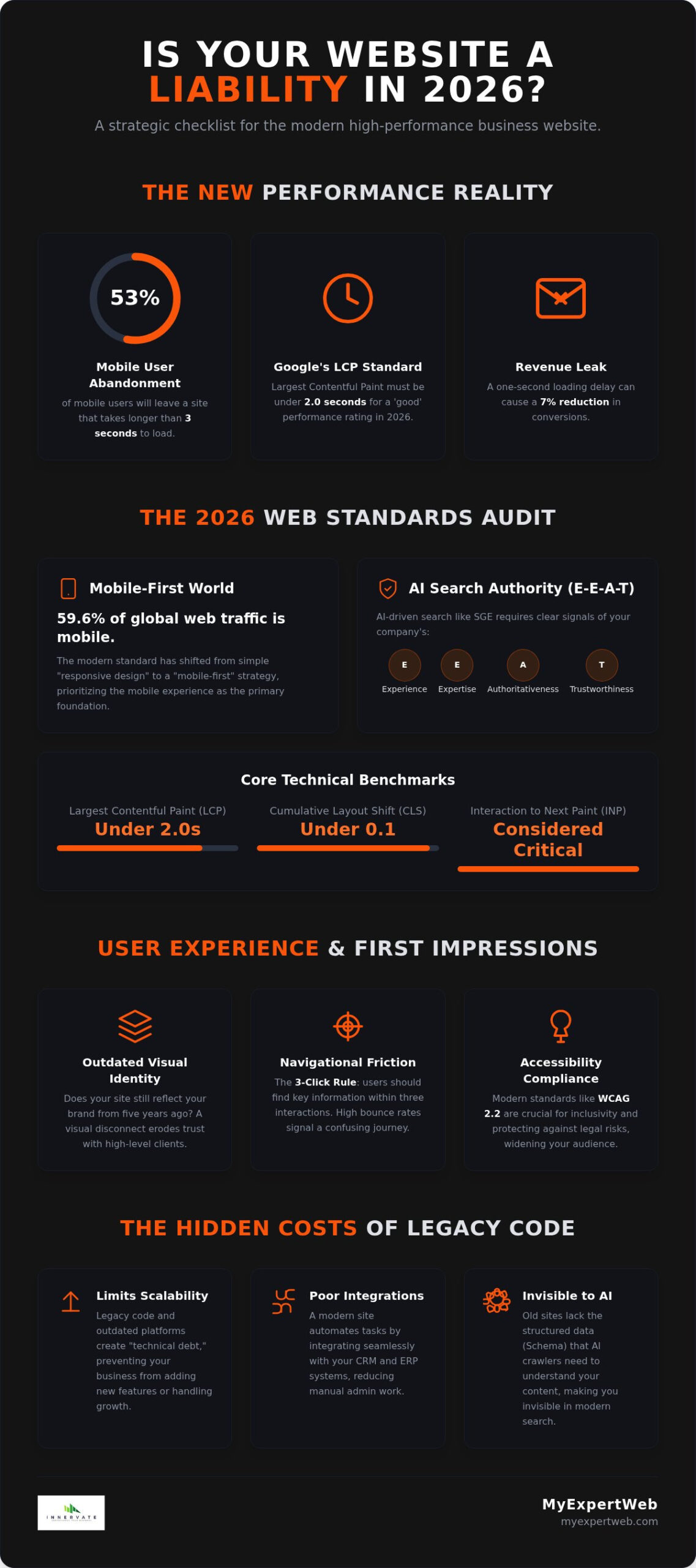
Did you know that 53% of mobile users will abandon a site if it takes more than three seconds to load? In 2026, the technical standards for success have shifted, and Google now requires a Largest Contentful Paint of under 2.0 seconds to maintain a high-performance rating. If your current platform feels sluggish or fails to capture high-quality leads, you’re likely seeing the clear signs you need a new business website. It’s frustrating when a digital tool that should support your growth starts to feel like a liability. We believe your website should function as a seamless extension of your team, providing security and operational ease rather than technical headaches.
This article provides a strategic checklist to help you identify critical performance, security, and operational gaps in your current presence. We’ll explore how modern standards like WCAG 2.2 compliance and Interaction to Next Paint thresholds impact your bottom line. You’ll gain a clear understanding of the return on investment a modern redesign offers and the confidence to choose a partner who treats your business goals as their own. Let’s evaluate whether your site is still working for you or if it’s time to build a more resilient foundation for the future.
Key Takeaways
- Learn to identify the technical and operational signs you need a new business website to stay ahead of AI-driven search trends and evolving user expectations.
- Understand how legacy code creates hidden technical debt that leads to frequent site crashes and limits your company’s ability to scale.
- Discover how a modern web presence can automate manual admin tasks by integrating seamlessly with your current CRM and ERP systems.
- Audit your user journey to pinpoint exactly where navigational friction is causing potential leads to drop out of your sales funnel.
- Evaluate whether a traditional CMS or a custom-built business application is the right strategic choice for your long-term operational efficiency.
The Evolution of Web Standards: Why “Good Enough” is Failing in 2026
The digital environment of 2026 is fundamentally different from even two years ago. Search Generative Experience (SGE) has moved search from a list of links to a direct synthesis of information. If your site doesn’t allow AI crawlers to parse your data efficiently, your brand essentially disappears from the most valuable real estate on the web. A website that was “good enough” in 2024 now lacks the technical architecture required to feed these AI-driven engines the context they need to recommend your services.
Performance benchmarks have also reached a critical tipping point. As of March 2026, Google tightened the “good” rating for Largest Contentful Paint (LCP) to under 2.0 seconds. High bounce rates and stagnating traffic are often the primary signs you need a new business website in this performance-heavy era. When 53% of mobile users abandon a site that takes more than three seconds to load, a one-second delay can result in a 7% reduction in conversions. This isn’t just a technical metric; it’s a direct leak in your revenue funnel.
Security expectations have evolved toward a “Zero Trust” framework. Even for small business sites, users now look for visible signals of advanced protection beyond a simple SSL certificate. Failing to adopt modern security standards creates a “technical debt” that grows more expensive every month. The cost of inaction isn’t just the risk of a breach, but the slow erosion of brand authority as competitors adopt more secure, resilient platforms.
The New Benchmark for Digital Authority
Search engines now evaluate your business through the lens of E-E-A-T: Experience, Expertise, Authoritativeness, and Trustworthiness. Modern web standards require a site structure that explicitly signals these traits through deeply integrated structured data. A five-year-old site architecture typically lacks the Schema markup needed to help AI understand the relationship between your content and your professional credentials. Without this methodical organization, your most valuable insights remain invisible to the algorithms that drive 2026’s search landscape.
User Expectations in a Mobile-First World
With 59.6% of global web traffic originating from mobile devices, the distinction between B2B and B2C user behavior has largely vanished. Professional clients expect the same fluid, app-like experience on their phones that they get from major consumer platforms. Simple responsive design, which merely reshuffles desktop elements, is no longer sufficient to hold a user’s attention or drive high-quality leads.
Mobile-First Design is the strategic practice of prioritizing the mobile user’s functional requirements and interaction patterns as the primary foundation for a 2026 business website.
User Experience and Visual Identity: The First Impressions Audit
Your visual identity should act as a silent ambassador for your expertise. If your brand has evolved into a high-level consultancy but your website still reflects a small-scale operation from five years ago, you’re creating a disconnect that erodes trust. This misalignment is one of the primary signs you need a new business website. In 2026, users are highly attuned to professional aesthetics and expect minimalist layouts with clean typography that prioritize readability over decorative clutter. Legacy sites often suffer from high Cumulative Layout Shift (CLS), where elements jump around as they load. Maintaining a CLS score under 0.1 is now a standard requirement for a stable and professional user experience.
High bounce rates on key landing pages often signal a deeper issue with the “clutter factor.” Modern users are frequently distracted and have little patience for hunting through dense blocks of text or confusing imagery. When a site feels overwhelming, visitors simply leave. A methodical redesign focuses on visual hierarchy, ensuring that your most important value propositions are immediately visible without competing for attention. This clarity is essential for converting visitors who may only give your site a few seconds of their time.
Auditing Your Site Navigation and Flow
Identifying friction points in your navigation is among the most reliable signs you need a new business website. We follow the 3-click rule: a user should find their desired information or contact point within three interactions. Identifying “dead ends” where a user journey stops without a clear call to action is vital for maintaining engagement. This structural health directly impacts your visibility, as poor navigational flow can negatively affect your local SEO services performance by signaling to search engines that your site is difficult to navigate.
Accessibility and Inclusivity Standards
Accessibility is a technical and legal necessity. As of 2026, WCAG 2.2 is the operative standard for digital inclusivity. Research shows that 95.9% of the top million homepages still fail basic compliance tests, averaging 56.1 failures per page. By addressing these gaps, you don’t just avoid legal risk; you improve the experience for every visitor. Tools like Google Lighthouse can help you identify contrast issues or missing alt-text that might be hindering your reach. If you’re unsure where your current platform stands, our team can help you perform a methodical visual and functional audit to ensure your site meets these modern expectations.
Technical Performance and Security: The Hidden Cost of Legacy Code
Legacy code is not simply old software; it represents a growing financial burden known as technical debt. This occurs when your website’s underlying architecture becomes so outdated that the cost of routine maintenance exceeds the value the site provides. When you encounter frequent site crashes or the “white screen of death,” these are terminal signs you need a new business website. These failures suggest that your site’s foundation can no longer support modern browser updates or handle the complex scripts required for 2026 web standards.
Google continues to penalize outdated infrastructure through its Core Web Vitals metrics. While we previously discussed these benchmarks, it is vital to understand that slow server response times are often rooted in messy, inefficient code. If your site’s infrastructure cannot maintain an Interaction to Next Paint (INP) under 200 milliseconds, you are likely losing visibility in search results. Upgrading to a modern framework is often the only way to resolve these deep-seated performance issues.
The Vulnerability Gap in Outdated CMS Platforms
Many legacy sites rely on “abandoned” plugins and themes that no longer receive developer updates. These unpatched components serve as open doors for malicious actors. Relying on manual patches is a temporary fix for a structural problem that eventually compromises your entire digital presence. Running your site on outdated PHP versions creates critical entry points for modern cyber threats that current security patches cannot resolve. To protect your customer data, you must be able to implement current cyber security protocols, which often require a complete platform modernization.
Speed as a Competitive Advantage
In 2026, the correlation between page load speed and conversion rate is stronger than ever. A one-second delay in page load time can reduce conversions by 7%, making technical speed a direct driver of revenue. Modern hosting environments and clean code architecture differ significantly from budget, “one-size-fits-all” solutions. By prioritizing a fast Largest Contentful Paint (LCP) and optimizing server response times, you turn technical performance into a competitive edge. If your current site feels sluggish despite multiple “optimizations,” it is one of the most urgent signs you need a new business website built on a high-performance foundation.
Aligning Your Digital Presence with Modern Business Operations
A business website should function as a high-performance member of your team, not an isolated digital brochure. When your site is disconnected from your internal systems, it creates significant manual work for your sales and administrative staff. If your employees are still manually entering lead data from emails into your database, you’re seeing one of the clearest operational signs you need a new business website. This inefficiency doesn’t just waste time; it introduces human error and delays your response time to potential clients.
Data silos represent the single biggest barrier to scaling a modern company. If your website cannot communicate with your current CRM or ERP systems, your business intelligence remains fragmented. Leveraging custom business application development allows you to transform your site from a simple front-end into a powerful workflow tool. This integration ensures that every user interaction feeds directly into your operational ecosystem, providing a single source of truth for your entire organization.
Integrating Your Website into Your Sales Funnel
Modern sales funnels require more than a basic contact form. A strategic redesign moves your site toward automated lead qualification, where the system itself filters and routes prospects based on their specific needs. By synchronizing web data with your marketing automation tools, you create a real-time flow of information that empowers your sales team to act with precision. This methodical approach ensures that your high-value resources are focused on the most promising opportunities rather than being drained by low-quality inquiries.
Scalability: Is Your Website Holding You Back?
Your digital presence must be able to adapt as your business evolves. Template-based sites often reach a ceiling when you try to introduce new product lines or handle sudden traffic spikes. If your current platform feels rigid and prevents you from innovating, it’s time to consider a more scalable architecture. For businesses looking to extend their reach even further, a reliable mobile app development company can help bridge the gap between web utility and mobile-specific functionality. This ensures your brand remains accessible and efficient across every touchpoint your customers prefer. If you’re ready to turn your website into a strategic asset, our team can help you integrate your digital presence with your core operations.
Transitioning to a High-Performance Business Website
Once you recognize the signs you need a new business website, the transition should be viewed as a strategic upgrade rather than a simple repair. This process begins with a methodical audit to determine which legacy assets still provide value and which technical structures require a complete rebuild. The audit involves a granular look at your data architecture, user journey maps, and current security vulnerabilities. This approach ensures that no critical functionality is lost during the migration and that every new element serves a specific operational purpose.
You must also decide whether a traditional CMS meets your needs or if your operations require a custom-built business application. While a CMS offers ease of use for basic content updates, a custom application provides the specialized functionality needed to eliminate manual workflows and integrate deeply with your internal systems. Success in 2026 is defined by measurable outcomes. You should set clear KPIs for your new digital presence, focusing on specific targets for lead quality, server response times, and security compliance.
Building Your Redesign Roadmap
A successful roadmap begins with your long-term business objectives for the next 3-5 years. If you plan to scale or diversify your offerings, your site’s architecture must be flexible enough to accommodate that growth. Content strategy must always precede design and development. Designing a site before defining your message often leads to functional gaps and expensive mid-project corrections. Budgeting for this transition should focus on long-term viability and operational efficiency rather than short-term fixes that only mask underlying problems.
Why a Strategic Partner Beats a Generic Vendor
Choosing the right ally for this transition is as important as the technology itself. A generic vendor may deliver a functional site, but a strategic partner understands how that site fits into your broader business ecosystem. With over 12 years of experience in cross-border digital solutions, we provide the stability and expertise required for complex transitions. Our offshore dedicated development teams in the Philippines offer the technical muscle needed to build secure, scalable applications without the overhead of local-only firms. We invite you to schedule a professional audit of your current digital presence to see if you are showing the signs you need a new business website and to identify the most effective path forward for your organization.
Securing Your Business Advantage for 2026 and Beyond
Your website functions as the operational engine of your company. We’ve explored how technical debt, security vulnerabilities, and fragmented data silos act as the primary signs you need a new business website. In 2026, staying competitive requires more than a simple visual refresh. It demands a resilient platform that integrates with your internal workflows and meets stringent performance standards like WCAG 2.2 and sub-two-second load times.
At MyExpertWeb, we bring 12+ years of industry-leading experience to every partnership. Our team focuses on delivering proven results in custom software and SEO through a supportive, pragmatic approach. We don’t just build websites; we create scalable digital ecosystems that grow alongside your business. Ready to bridge the gap between your current site and your future goals? Book a Free Strategic Consultation with MyExpertWeb to audit your digital presence today. Taking the first step toward a high-performance site is a commitment to your long-term success, and we’re here to guide you through every stage of that journey.
Frequently Asked Questions
How often should a business website be redesigned?
Most industry professionals recommend a strategic redesign every two to three years to keep pace with evolving search standards and security protocols. While some platforms last longer, a redesign becomes necessary when technical debt begins to slow your load times or limits your ability to integrate with modern CRM tools. Regular updates are helpful, but a full overhaul ensures your brand remains visible in an AI-driven search environment where standards change rapidly.
What is the average cost of a professional business website redesign in 2026?
Professional redesign costs vary significantly based on the complexity of your requirements and the level of operational integration needed. Projects range from informational sites to complex custom web applications that serve as central business hubs. Instead of focusing on a single price point, you should evaluate the long-term ROI of a site that automates manual tasks and generates higher-quality leads. A professional consultation helps determine a budget that aligns with your specific growth goals.
Can I just update my current website instead of building a new one?
Updates are possible for minor visual tweaks, but they often fail to address the underlying signs you need a new business website. If your current platform relies on legacy code or outdated CMS versions, simple updates act as temporary patches for structural problems. A fresh build allows you to adopt modern security protocols and a mobile-first architecture that a legacy site simply cannot support without significant, costly modifications that often exceed the price of a new build.
How long does it take to develop a custom business website?
A custom project typically takes between 8 to 16 weeks depending on the scope and technical complexity of the build. This timeline includes a methodical discovery phase, content strategy, design, and rigorous testing for security and performance. While template-based sites are faster to launch, a custom solution provides the scalability and operational efficiency required for long-term growth. We prioritize a thorough process to ensure your new site functions as a reliable strategic asset for your team.
Will a new website improve my Google rankings immediately?
Rankings don’t change overnight, but a new site provides the technical foundation needed for improved visibility. By resolving slow load times and Cumulative Layout Shift issues, you signal to search engines that your site is authoritative and user-friendly. Google needs time to crawl and index your new structure. Over several months, the combination of clean code and a focused content strategy typically leads to more sustainable ranking improvements than an outdated site could ever achieve.
How do I know if my website is mobile-friendly enough for 2026?
You should test your site’s performance using tools like Google Lighthouse and check if your Largest Contentful Paint is under 2.0 seconds on mobile devices. In 2026, mobile-friendliness goes beyond fitting content to a screen; it requires a seamless, app-like experience with an Interaction to Next Paint under 200 milliseconds. If your mobile users experience navigational friction or slow response times, it’s a clear signal that your current infrastructure is failing to meet modern expectations.
What is the difference between a website and a custom business application?
A website primarily serves as a digital storefront for information and lead generation, while a custom business application functions as a dedicated tool for internal operations. Applications often include complex features like client portals, automated inventory tracking, or deep ERP integrations. If your site needs to handle specific business logic or automate manual admin tasks, a custom application is the superior choice for driving operational efficiency and supporting your team’s unique workflow requirements.