

MyExpertWeb Team
August 23, 2026
25 Essential Questions to Ask a Web Design Agency Before Hiring in 2026
Most business owners treat a website redesign like a one-off purchase, but in 2026, treating your digital presence as a static asset is the fastest way to lose market share to more agile competitors. You’ve likely felt the frustration of agencies that speak in riddles of technical jargon, only to deliver a site that looks good but fails to generate a single lead. It’s exhausting to worry about hidden fees or whether you’ll even own your data once the final invoice is paid. You might even have experienced that sinking feeling when a developer disappears right after launch, leaving you with a broken system and no path forward.
You deserve a partnership built on transparency and technical excellence. This guide provides the exact questions to ask a web design agency before hiring to ensure they can handle everything from custom software integration to modern cybersecurity standards. We’ve developed a comprehensive vetting framework to help you identify a strategic partner rather than just another vendor. We’ll walk through a 25-point checklist that covers intellectual property rights, ROI-focused strategy, and the long-term scalability your business needs to thrive in a complex digital economy.
Key Takeaways
- Learn how to distinguish between a static template-based site and a custom technical roadmap designed to meet your specific business growth goals.
- Discover the 25 essential questions to ask a web design agency before hiring to ensure your partner delivers secure, scalable, and high-performing digital solutions.
- Protect your digital assets by clarifying intellectual property rights and verifying specific cybersecurity protocols before the development process begins.
- Understand the operational benefits of a hybrid development model that combines strategic local oversight with the efficiency of a dedicated offshore team.
- Establish a clear post-launch plan for maintenance and ongoing SEO to ensure your website remains a functional, lead-generating asset through 2026 and beyond.
Why Vetting Your Web Design Agency is a Strategic Business Decision
In 2026, the distinction between a decorative website and a high-performing business engine is critical. Strategic vetting is a methodical process where you align an agency’s technical capability with your specific growth goals. It’s the only way to ensure your investment becomes a profitable asset rather than a liability. When you prepare your questions to ask a web design agency before hiring, you aren’t just looking for a designer; you’re interviewing a potential strategic partner.
Your digital presence acts as a 24/7 sales representative and a core operational hub. It handles everything from customer inquiries to complex data processing. If an agency uses outdated frameworks or proprietary code, they’re saddling you with technical debt. This debt eventually becomes too expensive to maintain and limits your ability to scale. A reliable partner focuses on five pillars: strategy, technology, security, communication, and long-term growth support.
The Real Cost of the “Wrong” Agency Choice
The impact of poor user experience (UX) is measurable through lost conversion opportunities. If a visitor can’t find what they need in seconds, they’ll leave. Beyond the immediate loss of a lead, unscalable code and weak SEO foundations create a cycle of expensive fixes. A mismatched partnership often results in project delays and budget overruns that could have been avoided with a more thorough vetting process. By understanding the web design process, you can better evaluate if an agency has the technical depth to support your business as it evolves.
Defining Your Internal Goals Before the First Meeting
Success begins with identifying your primary business objectives. You might need a site focused on lead generation, or perhaps you require complex custom software development to streamline your operations. Determining your needs for ongoing support and maintenance is equally important. A static site won’t serve you well in a fast-moving market. When setting your budget, look at the potential ROI rather than just the initial price tag. A strategic partner will help you understand how a secure, scalable site pays for itself through increased efficiency. This clarity makes it much easier to evaluate the questions to ask a web design agency before hiring during the interview stage.
Questions to Ask About Strategy and Technical Capability
A beautiful website is useless if it doesn’t solve a business problem. When you begin your search, the initial questions to ask a web design agency before hiring should focus on how they bridge the gap between aesthetics and operations. Deciding between a DIY approach and hiring a web developer often depends on the complexity of your goals. A strategic partner will ask: “How do you translate my business goals into a technical roadmap?” They should provide a clear plan that connects user features to your specific revenue targets or efficiency metrics.
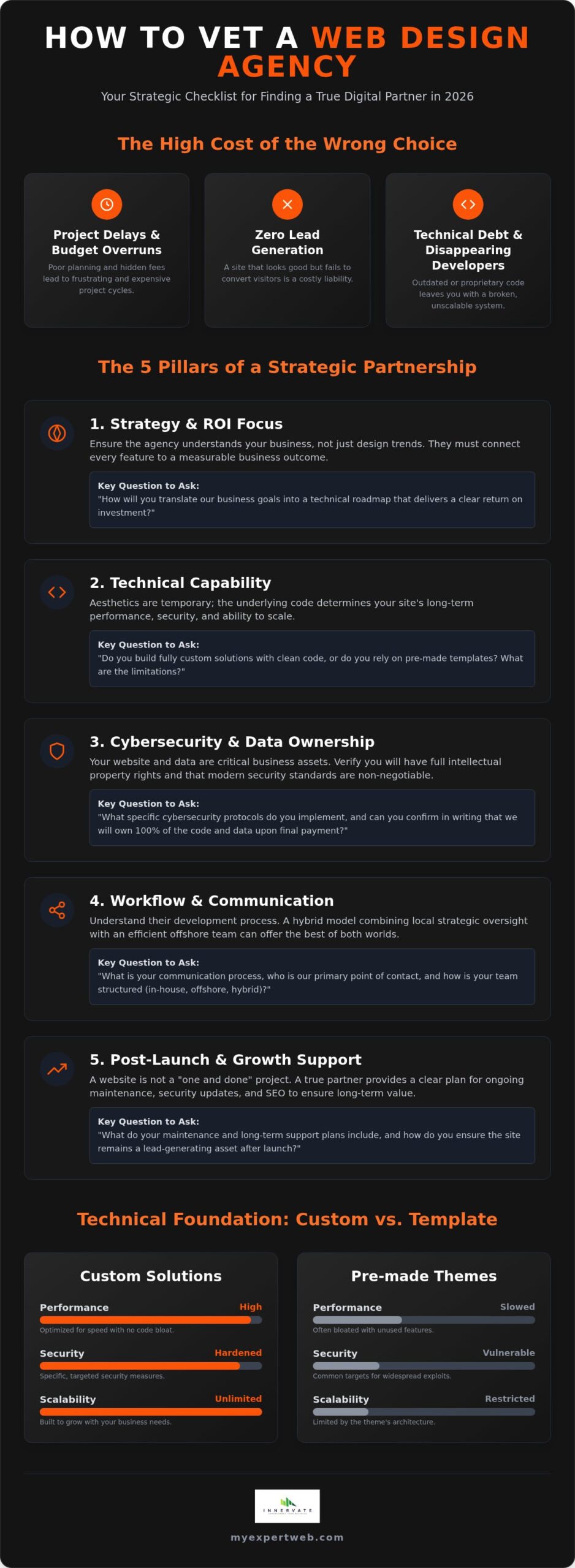
Ask: “Do you build fully custom solutions or rely on pre-made templates?” This distinction impacts your site’s longevity. While templates offer a faster start, they often come with limitations that hinder growth. Use the table below to evaluate which path suits your current business stage. If you’re evaluating questions to ask a web design agency before hiring, their answer here reveals whether they are a simple vendor or a true technical partner.
| Factor | Custom Solutions | Pre-made Themes |
|---|---|---|
| Performance | High speed; no code bloat. | Often slowed by unused features. |
| Security | Hardened and specific. | Common targets for exploits. |
| Scalability | Virtually unlimited. | Restricted by theme architecture. |
Custom Application Development vs. Theme Customization
A standard business site might suffice for basic visibility, but complex operations require custom business application development. If you need your site to process unique data, integrate with proprietary software, or provide a tailored user portal, custom code is non-negotiable. Clean, scalable code ensures you won’t have to rebuild from scratch when your business evolves. If you’re ready to build for the long term, exploring custom software development can secure your technical foundation.
Integrating SEO and Performance from Day One
Performance shouldn’t be an afterthought. Ask: “How do you ensure the site is optimized for mobile-first indexing and core web vitals?” Google’s 2026 standards prioritize sites that load instantly and provide a stable mobile experience. This requires integrated web development and SEO services to ensure that technical SEO architecture, such as schema markup and site speed, is baked into the initial build. Finally, ask: “Can you demonstrate how your designs directly influence lead generation?” Your agency must show how their UX choices guide a visitor toward a conversion point, turning traffic into tangible business growth.
Questions Regarding Cybersecurity and Data Ownership
A website in 2026 functions as a vault for your customer data and brand identity. You shouldn’t overlook security during the vetting process. When you prepare your list of questions to ask a web design agency before hiring, move beyond aesthetics and focus on protection. Ask: “Who legally owns the website code, graphics, and content upon final payment?” Many agencies bury clauses in contracts that keep the intellectual property in their name, making it difficult for you to move to a different provider later.
Ask: “What specific cybersecurity protocols do you implement during development?” For a deeper dive, you might look at in-depth questions for a web design agency to understand how they handle team access and server permissions. Ask: “How do you handle regular software updates and security patches?” A site that isn’t updated is a target. Finally, ask: “What is your protocol for data backups and disaster recovery?” You need to know that if a server fails, your business stays online.
Protecting Your Intellectual Property (IP)
A common pitfall is hiring an agency that uses a proprietary CMS. This effectively keeps your business hostage because you can’t take the site with you if the relationship ends. Ensure your contract includes a “Work for Hire” clause that transfers all rights to you upon final payment. Use this checklist for a clean IP transfer:
- Full access to Git repositories or source code files.
- Original design files in formats like Figma or Adobe XD.
- Administrative credentials for your domain registrar and hosting accounts.
Ensuring Secure Web Application Development
Cybersecurity is a non-negotiable requirement for any modern digital presence. Your agency must prioritize secure web application development through regular audits and hardened code. Ask how they mitigate common vulnerabilities such as SQL injection or Cross-Site Scripting (XSS). Modern standards require more than just an SSL certificate. They demand robust firewalls and isolated hosting environments. If an agency can’t explain their security stack, they aren’t equipped to protect your business data or your customers’ privacy. This is one of the most critical questions to ask a web design agency before hiring to ensure your long-term safety.
Vetting the Workflow: In-House vs. Dedicated Offshore Teams
Understanding how an agency operates behind the scenes is just as vital as reviewing their previous portfolio. When you are determining the right questions to ask a web design agency before hiring, you need to identify who is actually writing your code. Ask: “Will a dedicated team be assigned to my project, or is it a shared resource model?” A shared model often leads to fragmented attention as developers rotate between multiple clients. Conversely, a dedicated team ensures your project remains the primary focus, leading to faster iterations and deeper technical understanding.
Ask: “How do you bridge communication gaps if using an offshore development team?” and “How do you ensure quality control across different time zones?” These are practical concerns that a seasoned agency should answer with established protocols. Transparency is maintained through professional project management tools. Ask which platforms they use for reporting so you can track progress in real time. This level of visibility prevents the “black box” development style where you only see results at the very end of the project.
The Hybrid Model: Local Strategy and Offshore Efficiency
Many businesses find that a hybrid model offers the ideal balance of strategic oversight and production scale. Utilizing an offshore dedicated development team in the Philippines allows for high efficiency without sacrificing technical excellence. At MyExpertWeb, we manage remote talent to ensure every project meets rigorous professional standards. You benefit from a local point of contact for strategic planning while a specialized team handles the complex development work. This approach provides the technical rigor required for custom builds while remaining cost-effective for growing businesses. If you’re looking to scale your capacity with a reliable partner, explore our outsourcing development team services.
Communication and Project Milestones
A methodical workflow prevents projects from stalling or exceeding their initial scope. A high-performing build typically moves through five distinct stages: discovery, design, development, testing, and launch. During your initial consultation, ask about the frequency of status updates and the availability of your project manager. A “single sentence” project update is insufficient for complex builds because it fails to provide the context you need to make informed business decisions. You should expect detailed reporting that highlights milestones achieved and any potential technical roadblocks. Clear communication is the foundation of a successful partnership, and it is one of the most revealing questions to ask a web design agency before hiring. When an agency can clearly define their milestones, it demonstrates the organized approach needed to deliver your project on schedule.
Post-Launch: Maintenance and Long-Term Growth Support
The launch of your website is a significant milestone, but it isn’t the finish line. A professional digital presence requires consistent attention to remain functional and secure. When you are compiling your final list of questions to ask a web design agency before hiring, you must look beyond the “go-live” date. Ask: “What happens if the site breaks three months after launch?” and “Will I receive training on how to use the CMS and update content?” These questions help you determine if the agency is interested in a quick transaction or a long-term partnership. You need to know that your team can manage basic updates internally while having a reliable expert on standby for technical emergencies.
Business needs change, and your website must adapt. Ask: “How do you handle scaling the site as my business grows?” and “Do you offer monthly retainers for ongoing SEO and marketing growth?” If an agency only builds the “shell” without considering future traffic or data requirements, you’ll face a costly rebuild later. A strategic partner anticipates these shifts. They ensure the underlying architecture remains flexible enough to support new features, such as custom user portals or advanced lead tracking systems, without compromising performance.
Ongoing Maintenance and Security Audits
Adopting a “set it and forget it” mentality is dangerous for modern businesses. In 2026, cyber threats evolve daily. Monthly security patches and plugin updates are essential to protect your initial investment from vulnerabilities. Recurring maintenance isn’t just about fixing bugs; it’s about optimizing the database and ensuring your server environment remains current. This proactive approach prevents small technical glitches from turning into catastrophic failures that could take your business offline. Regular audits also ensure that your site continues to meet the high performance standards required for search engine visibility.
Scaling with Integrated Digital Marketing
Once your technical foundation is secure, the focus shifts to visibility and lead generation. Transitioning from a development project to a growth strategy often involves utilizing local SEO services to capture national or regional market share. A comprehensive partner integrates PPC management, social media marketing, and web content services into a single, cohesive roadmap. This ensures your brand voice remains consistent across all channels. By choosing an agency that offers these adjacent services, you ensure that your website evolves alongside your business goals. This holistic view is why these are among the most important questions to ask a web design agency before hiring to secure your future ROI.
Securing Your Digital Future in 2026
Choosing the right partner is the difference between a static website and a scalable business engine. You now have a framework to evaluate technical roadmaps, protect your intellectual property, and ensure your site remains secure against the evolving threats of 2026. By focusing on strategy rather than simple aesthetics, you’re positioning your brand for measurable ROI and long-term operational ease. A website shouldn’t just exist; it should actively work to achieve your specific business goals.
Preparing your questions to ask a web design agency before hiring is the first step toward a successful transformation. MyExpertWeb brings 12+ years of digital excellence to every project, offering end-to-end custom software solutions and dedicated offshore development specialists to help you scale efficiently. We’re here to listen to your unique challenges and build a technical foundation that grows with your vision. Your digital presence is too important to leave to chance.
Book a Free Consultation with MyExpertWeb Today and take the first step toward a more secure, high-performing future. We look forward to helping you build something exceptional.
Frequently Asked Questions
How much should a professional web design project cost in 2026?
Professional web design costs are determined by the scope of your technical roadmap and the level of custom software integration required. A simple landing page involves different resources than a complex business application. Instead of looking for the lowest price, focus on the projected ROI and the long-term value of a secure, scalable foundation. Investing in high-quality development early prevents expensive rebuilds and security vulnerabilities as your business expands throughout 2026.
What is the difference between a web designer and a web developer?
A web designer focuses on the visual aesthetics, user interface, and overall user experience to ensure your brand looks professional. A web developer builds the underlying code and functionality that makes the site work. Most high-performing agencies employ both specialists to ensure your site is both beautiful and technically sound. This collaboration is one of the key things to look for when preparing questions to ask a web design agency before hiring.
Do I really need a custom website, or is a template enough?
A template might be sufficient for a basic brochure site, but a custom website is essential for businesses that require specific functionality and lead generation. Custom builds allow you to create a unique user journey that is optimized for your specific conversion goals. They also offer better performance and security because they don’t include the bloated code often found in generic themes. Choosing custom development ensures your digital presence is a true strategic asset.
How long does it typically take to launch a new business website?
The timeline for launching a new website varies based on the complexity of the project and the speed of the feedback loops. A standard professional site might take six to ten weeks, while complex custom software applications can take several months to develop and test. A methodical agency will provide a clear schedule with specific milestones for discovery, design, and quality assurance. This structured approach ensures that the final product is stable and ready for launch.
Why should I consider an offshore dedicated development team?
An offshore dedicated development team provides high-level technical expertise and operational efficiency that helps your budget go further. By utilizing a hybrid model with local strategy and specialized production in the Philippines, you can scale your project more effectively. This approach allows you to access a wider pool of developers who are experts in secure, scalable web development. It’s a pragmatic way to build complex custom applications while maintaining professional standards and clear communication.
What happens if I want to switch agencies later on?
You can switch agencies easily if you ensure that you legally own all website code, graphics, and content from the start. A reliable partner will include a “Work for Hire” clause in your contract and provide full access to your Git repositories and domain credentials. If an agency uses a proprietary CMS, you might find yourself locked into their ecosystem. Always verify these ownership details during your initial interview to protect your long-term intellectual property.
Do I need to provide all the content and images myself?
You don’t necessarily need to provide everything yourself if the agency offers comprehensive web content services and graphics design. While you understand your business best, professional writers and designers can translate your knowledge into high-converting copy and visuals. A supportive partner will work collaboratively with you to identify which assets you already have and which ones need to be created. This ensures your site has a cohesive, professional look that resonates with your target audience.
How do you ensure my website will be mobile-friendly?
Mobile-friendliness is ensured by using responsive design techniques and optimizing for Google’s mobile-first indexing standards. A professional agency prioritizes core web vitals to ensure your site loads quickly and functions perfectly on every device. This is a critical part of the questions to ask a web design agency before hiring because mobile traffic often accounts for the majority of user sessions in 2026. Testing across various screen sizes and operating systems is a standard part of the development process.