


MyExpertWeb Team
September 3, 2026
API Development for Business: 2026 Strategic Guide
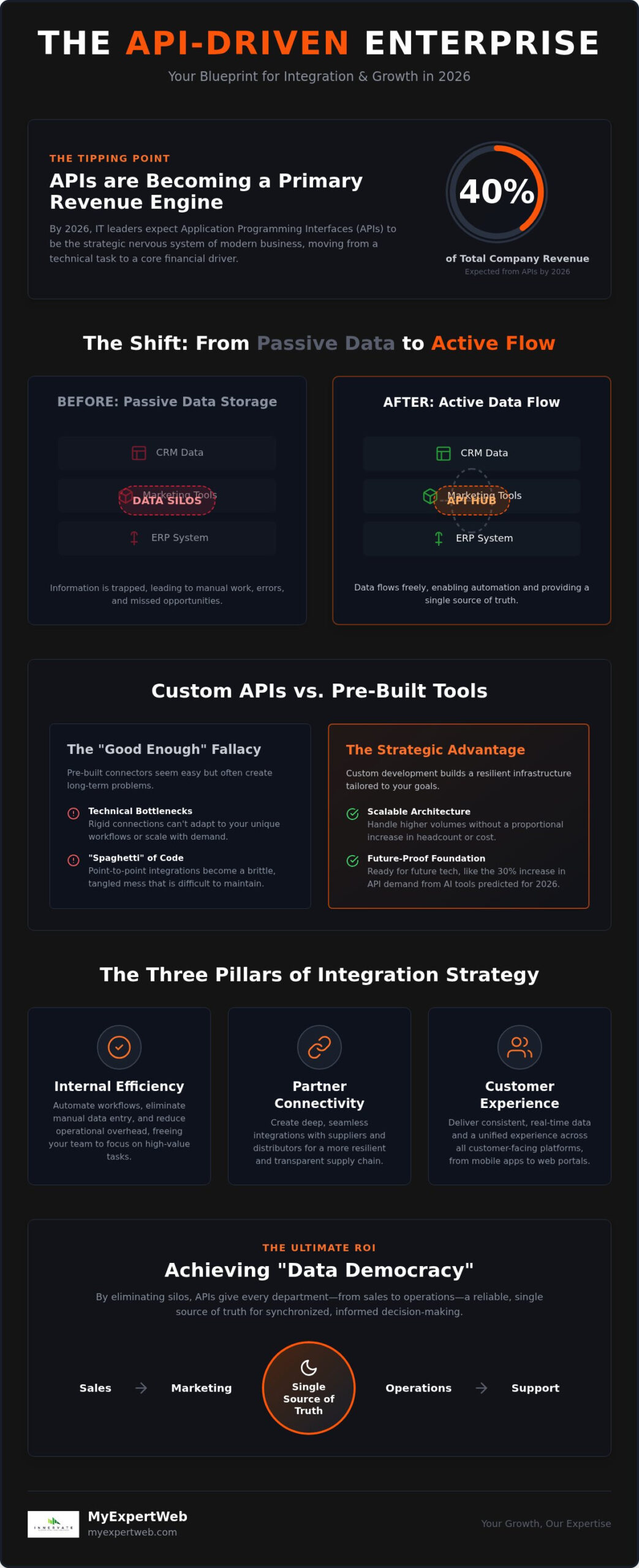
Did you know that by 2026, IT leaders expect APIs to account for 40% of total company revenue? This shift proves that api development for business integration is no longer just a backend technical task; it’s the strategic nervous system of a modern enterprise. If you’ve spent your morning manually copying data between your CRM and your marketing tools, you’ve already felt the friction of a fragmented system. Data silos don’t just slow you down; they create invisible walls that prevent you from seeing a single, clear source of truth for your operations.
It’s frustrating to watch your team lose hours to repetitive workflows that should be automated. We believe in a collaborative approach where technology serves your specific business goals rather than creating more work. This guide will show you how custom API development can eliminate those bottlenecks and significantly reduce your operational overhead. We’ll explore how building a scalable infrastructure today prepares your business for the autonomous AI agents of tomorrow, ensuring your digital ecosystem remains resilient and ready for growth.
Key Takeaways
- Learn how to transition from passive data storage to an active data flow that automates cross-platform workflows and reduces manual labor costs.
- Discover why strategic api development for business integration is necessary to bypass the “good enough” fallacy of pre-built tools that often lead to technical bottlenecks.
- Understand the essential security protocols and documentation standards required in 2026 to maintain a secure and scalable digital infrastructure.
- Explore the concept of “Data Democracy” and how it provides your entire organization with a reliable, single source of truth for informed decision-making.
- See how a dedicated development team acts as a methodical partner to manage technical complexity, allowing you to focus on high-level growth.
Understanding API Development as a Business Growth Engine
At its core, api development for business integration is the intentional creation of custom interfaces that allow disparate software systems to communicate without friction. In 2026, the industry has shifted away from “passive data storage,” where information essentially gathers dust in isolated databases. Successful organizations now focus on “active data flow,” ensuring that every piece of information is dynamic and accessible. This transition transforms your technology from a cost center into a growth engine by enabling real-time decision-making and operational agility.
This transformation is built upon three strategic pillars that serve as the foundation for a modern, digital-first strategy:
- Internal Efficiency: Custom APIs remove the burden of manual data entry, automating repetitive tasks and reducing operational overhead.
- Partner Connectivity: Deep integration with suppliers and distributors creates a more resilient and transparent supply chain.
- Customer Experience: Users receive consistent, real-time data across every platform they use, from mobile apps to web portals.
By focusing on these areas, you ensure your digital ecosystem is robust enough to handle the 30% increase in API demand driven by AI tools that Gartner predicts for 2026. Custom APIs provide a level of flexibility that off-the-shelf connectors simply cannot match, ensuring your tech stack is a unified machine rather than a collection of tools.
What is API Integration in a Modern Business Context?
Most modern businesses rely on a mix of CRM, ERP, and e-commerce platforms. Without a clear plan for Understanding API Development, these tools often operate as silos. While some might try “point-to-point” integration, these direct connections quickly become a brittle “spaghetti” of code that’s difficult to maintain. Using api development for business integration allows you to replace these rigid links with flexible, reusable components that support a scalable architecture. API integration is the strategic glue of the modern digital enterprise.
Why 2026 is the Year of the Connected Enterprise
The maturation of cloud ecosystems in 2026 has made real-time data a basic requirement rather than a luxury. We’re seeing a definitive move away from monolithic software suites toward specialized, integrated stacks that offer best-in-class features for specific tasks. Facilitating these connections requires a focus on custom business application development to ensure your unique workflows are preserved. This connected model allows you to pivot quickly as market demands change, ensuring your infrastructure is an asset for long-term viability rather than a technical bottleneck.
Maximizing ROI through Strategic API Architecture
Investing in a strategic API architecture is a financial decision as much as a technical one. Organizations that prioritize api development for business integration effectively replace high-cost, error-prone manual labor with automated, cross-platform workflows. This shift creates what we call “Data Democracy.” By making information accessible across every department, you ensure that the sales, marketing, and operations teams all work from the same source of truth. When data flows freely, your staff can focus on high-level strategy instead of repetitive data entry.
While manual processes might seem cost-effective in the short term, the long-term cost-to-benefit ratio heavily favors custom development. Manual workflows don’t scale. As your business grows, the cost of human error and delayed processing increases exponentially. Custom APIs allow your infrastructure to handle higher volumes without a proportional increase in headcount. This structural efficiency is essential for future-proofing your business against the rapid technological shifts expected throughout 2026 and beyond.
Eliminating Data Silos and Improving Operational Efficiency
The “Silo Effect” occurs when departments operate on disconnected data, leading to conflicting reports and missed opportunities. It’s difficult to make informed decisions when your CRM doesn’t talk to your accounting software. Integrated systems solve this by creating a 360-degree view of your customer journey. For example, integrated web development and SEO services rely on these unified data streams to track user behavior from the first search click to the final invoice. This level of visibility ensures that every marketing dollar is spent based on accurate, real-time insights.
Preparing Your Infrastructure for AI and Automation
AI models are only as effective as the data they can access. If your information is locked behind closed systems, your AI tools remain blind and ineffective. Following Best Practices for Secure and Scalable Business Integration ensures that your data is accessible to “Agentic AI.” These are autonomous agents that use APIs to perform business tasks, such as inventory reordering or customer support resolution, without human intervention. To build an AI-ready API layer, consider this roadmap:
- Standardize data formats to ensure compatibility with large language models.
- Implement robust authentication protocols to protect sensitive business logic.
- Prioritize real-time connectivity to support instant AI-driven decision making.
By focusing on api development for business integration now, you’re not just solving today’s problems; you’re building the foundation for tomorrow’s innovations. If you’re ready to streamline your operations, a methodical partner in custom software development can help you navigate these technical complexities while you focus on growth.
Custom API Development vs. Pre-Built Integration Tools
Choosing between custom-built interfaces and pre-built tools like Zapier or Make is a critical decision for any growing organization. While no-code platforms offer a low barrier to entry, they often lead to the “Good Enough” fallacy. This occurs when a business relies on a tool that works for simple tasks but becomes a rigid bottleneck as operations scale. For api development for business integration, the difference lies in the level of optimization and reliability you can achieve. Pre-built connectors often introduce unnecessary latency and performance limitations because they act as a generic middle layer between your systems.
Proprietary API code also provides significant security and ownership advantages. When you rely on third-party integration layers, you’re essentially trusting a middleman with your most sensitive business logic. Custom development allows you to build a secure, direct pipeline that you own entirely. This eliminates the risk of a third-party vendor changing their pricing, deprecating a feature you rely on, or suffering a breach that exposes your data.
When Zapier or Off-the-Shelf Connectors Aren’t Enough
Custom development becomes necessary when you deal with high transaction volumes, complex business logic, or highly sensitive data. Third-party middleware can create “Technical Debt” where you spend more time managing the limitations of the integrator than improving your own workflows. This is particularly true if your business requires real-time synchronization or multi-step transformations that standard triggers can’t handle. As noted in this authoritative guide from IBM, a structured integration strategy is vital for maintaining system integrity. Custom APIs offer 100% control over the data journey.
The Long-Term Cost Benefits of Proprietary API Solutions
While the initial cost of custom software might seem higher, it’s important to consider the long-term ROI. Subscription fatigue is a real issue; many businesses find themselves paying thousands of dollars annually in “per-task” fees to integration platforms. A one-time development investment allows you to own your code, turning your integrations into valuable intellectual property. This proprietary approach ensures that your infrastructure remains an asset rather than a monthly liability.
To manage these budgets effectively, many organizations look toward offshore partnerships. Understanding the cost of hiring developers in the Philippines can help you build high-quality, custom api development for business integration solutions without the overhead of local enterprise-scale agencies. This methodical approach ensures you get a tailored solution that fits your specific business needs while maintaining full ownership of your digital infrastructure.
Best Practices for Secure and Scalable Business Integration
Building a bridge between systems is only half the battle. To ensure long-term success, api development for business integration must prioritize stability and protection. In 2026, this means implementing modern security protocols like OAuth 2.0 for authorization and JSON Web Tokens (JWT) for secure data exchange. Every data transmission should be encrypted at rest and in transit to mitigate the risk of interception. These aren’t just technical preferences; they’re the standard requirements for any business that values its data integrity.
Scalability also requires a disciplined approach to versioning. As your business grows and your software evolves, versioning ensures that updates to your API don’t break existing connections. Without a clear versioning strategy, a simple update could bring your entire digital ecosystem to a halt. Additionally, implementing rate limiting and real-time monitoring is essential to prevent system abuse and ensure consistent performance during peak traffic periods. These measures protect your server resources and ensure that legitimate users always have a smooth experience.
Prioritizing Cyber Security in API Design
APIs have become a primary target for data breaches because they provide a direct path to your core business data. Unlike traditional web pages, an API endpoint can be queried thousands of times per second by automated scripts, making them vulnerable to brute-force attacks and injection attempts. Adopting “Security by Design” principles means integrating security checks into every stage of the development lifecycle. This methodical approach is a cornerstone of secure web application development, ensuring that vulnerabilities are identified and neutralized before they ever reach a production environment.
Managing the API Lifecycle: From Documentation to Maintenance
Effective api development for business integration follows a structured lifecycle that includes design, mocking, implementation, and eventually, sunsetting. A common pitfall for many businesses is neglecting documentation once the initial build is complete. Providing clear, interactive documentation through tools like Swagger or the OpenAPI Specification is a non-negotiable requirement for long-term maintainability. It allows new developers to understand the system quickly and reduces the time spent on troubleshooting or manual handovers.
Regular audits are the final piece of the puzzle. Just as you wouldn’t leave a physical building without maintenance, your digital integrations require periodic health checks to ensure they still meet current security standards and performance benchmarks. If you’re concerned about the integrity of your current systems, our team can help you build a more resilient infrastructure. Contact us today to learn how our custom software development services can secure your business for the future.
Implementing Your API Strategy with a Dedicated Development Team
Choosing the right people to execute your api development for business integration strategy is just as important as the architecture itself. While “gig-based” freelancers might seem convenient for small, isolated tasks, they often lack the long-term commitment needed for complex integration projects. A dedicated development team, on the other hand, acts as a methodical guide. They don’t just write code; they learn your business logic and anticipate potential hurdles before they become costly delays. This level of consistency ensures that your digital ecosystem remains stable as your requirements evolve.
For businesses in Australia and the US, the Philippine-based offshore model offers a pragmatic solution to the high costs of local agencies. It isn’t just about budget management. It’s about accessing a stable, highly skilled workforce that operates as a seamless extension of your own staff. This collaborative approach ensures that your custom software remains maintainable and secure for years to come, providing a level of partnership that transactional vendors simply can’t match.
Why Outsourcing API Development Accelerates Time-to-Market
The global shortage of specialized developers can stall even the most ambitious integration projects. Outsourcing allows you to bypass these local hiring bottlenecks and tap into a broader talent pool immediately. By leveraging 24/7 development cycles, your business can achieve faster turnarounds on critical milestones. However, speed shouldn’t come at the expense of quality. Success depends on finding a partner with both technical expertise and cultural alignment. A team that understands your market’s professional standards ensures that communication remains clear and expectations are always met.
How MyExpertWeb Bridges the Integration Gap
With over 12 years of experience in custom software development, we’ve seen how the right api development for business integration can transform an organization. We don’t believe in generic solutions. Our team focuses on building secure, scalable applications that solve your unique challenges. We pride ourselves on being a reliable strategic partner rather than just another vendor. Our goal is to handle the technical complexity so you can focus on high-level growth and long-term viability.
Starting your project is a methodical process. We begin by understanding your current digital ecosystem and identifying the data silos that hold you back. From there, we design a roadmap for a custom API layer that is ready for an AI-driven future. If you’re ready to unlock the full potential of your business systems, we invite you to contact us for a consultation to map out your specific integration needs.
Future-Proofing Your Digital Ecosystem
The transition from passive data storage to an active, connected infrastructure is no longer a luxury for businesses looking to stay competitive. By prioritizing api development for business integration, you move beyond the limitations of generic connectors and build a proprietary asset that scales with your ambitions. You’ve seen how strategic architecture reduces manual overhead, eliminates silos, and creates the high-quality data streams necessary for autonomous AI implementation. Ownership of your code ensures that your security and performance remain entirely under your control.
Managing this technical complexity requires a partner who understands the nuances of long-term maintainability. With over 12 years of expertise, MyExpertWeb provides dedicated offshore development teams that act as a seamless extension of your own. We focus on delivering secure and scalable solutions that address your unique operational challenges. If you’re ready to streamline your workflows and prepare for what’s next, Book a Free Consultation with MyExpertWeb to Scale Your Business Integration. We look forward to helping you build a more resilient and efficient future.
Frequently Asked Questions
What is the difference between an API and an integration?
An API is the technical interface that defines how systems communicate, while an integration is the actual process of connecting those systems to share data. You can think of an API as the doorway and the integration as the hallway connecting two rooms. Strategic api development for business integration ensures that these doorways are secure and optimized for your specific workflows rather than relying on generic, one-size-fits-all solutions.
How much does custom API development typically cost for a business?
The cost of custom development depends on the complexity of your systems and the specific business logic required. While we don’t provide flat rates, pricing is typically based on the scope of work and the technical depth of the project. Many businesses manage their budgets by utilizing a dedicated offshore development team, which provides high-level expertise without the overhead of local enterprise agencies. This model allows for a methodical, project-based investment.
Is it better to use a pre-built connector or build a custom API?
Pre-built connectors are often suitable for simple, low-volume tasks between popular apps. However, custom APIs are superior when you need to handle complex logic, sensitive data, or high transaction volumes. Custom solutions eliminate the technical debt and subscription fees associated with third-party middleware. If your business requires 100% control over the data journey and long-term scalability, a custom-built interface is the more pragmatic and resilient choice.
How long does it take to develop a custom API for business systems?
Development timelines vary based on the project’s technical requirements and the number of systems involved. A simple integration might take a few weeks to implement, while a comprehensive API layer for a complex ERP system could take several months. Using a dedicated team can accelerate this process through consistent development cycles and a deep focus on your specific business goals. We prioritize a methodical approach to ensure the final product is stable and functional.
What are the main security risks associated with API integration?
The primary security risks include unauthorized data access, brute-force attacks on endpoints, and injection vulnerabilities. Because APIs provide a direct path to your core business data, they are high-value targets for breaches. Protecting your digital ecosystem requires implementing security by design principles, such as robust authentication and encryption. Regular audits and real-time monitoring are also essential to identify and neutralize potential threats before they can impact your operations or compromise customer trust.
Can APIs help my business become ready for AI implementation?
Yes, APIs are the essential foundation for any modern AI strategy. AI models and autonomous agents require real-time access to clean, structured data to perform tasks effectively. By building a custom API layer now, you ensure that your business information is accessible to the AI tools of the future. This preparation allows you to implement agentic AI that can autonomously handle complex workflows like inventory management or customer support resolution without constant human intervention.
Do I need an internal IT team to manage custom APIs?
You don’t necessarily need a large internal IT department to maintain your systems. Many organizations successfully manage their infrastructure by partnering with a dedicated development team that acts as an extension of their own staff. This outsourcing model provides access to specialized expertise for the duration of the project and ongoing maintenance. It allows you to focus on high-level growth while your technical partners handle the underlying complexity and security of the integration.
What protocols should my business use for API development in 2026?
In 2026, your business should prioritize secure and modern protocols like OAuth 2.0 and JSON Web Tokens for authentication. For data architecture, REST remains the industry standard for its reliability, though GraphQL is increasingly used for complex data fetching. It’s also vital to use OpenAPI or Swagger for documentation to ensure long-term maintainability. These protocols provide the security and flexibility needed to support a scalable, digital-first business strategy across diverse platforms.