


MyExpertWeb Team
September 1, 2026
Custom Software Development Cost Australia: 2026 Strategic Budgeting Guide
Is the most expensive software quote in your inbox actually the safest bet, or are you simply paying for a prestigious postcode? It’s a frustrating reality for many Australian business leaders that high local developer rates often feel like an entry tax, while low-cost offshore alternatives frequently lead to project scope creep. You want a solution that works without draining your capital, but accurately calculating the custom software development cost australia feels nearly impossible in a market where national IT spending has surpassed $172 billion as of 2026.
We understand that you need a reliable roadmap to manage your budget while maintaining high standards. This guide provides a clear framework for budgeting across various project scales, from low-complexity applications to enterprise platforms. You’ll learn how to navigate the fiscal impact of the Privacy Act 1988 and the Cyber Security Rules 2025 without compromising on quality. We’ll also explore a methodical hybrid delivery model that combines local strategic leadership with dedicated offshore teams, ensuring your project achieves long-term viability and a measurable return on investment.
Key Takeaways
- Understand the 2026 market dynamics and how current talent shortages influence the total custom software development cost australia.
- Identify the primary budget drivers, ranging from technical complexity to the necessity of high-fidelity UX/UI design.
- Evaluate the pros and cons of local, offshore, and hybrid models to find the right balance between strategic oversight and cost efficiency.
- Access realistic price ranges for different project tiers, helping you set accurate expectations for MVPs and full-scale enterprise tools.
- Learn how a methodical discovery phase and a partnership-focused approach can protect your budget and maximise long-term ROI.
Understanding the Australian Custom Software Pricing Landscape in 2026
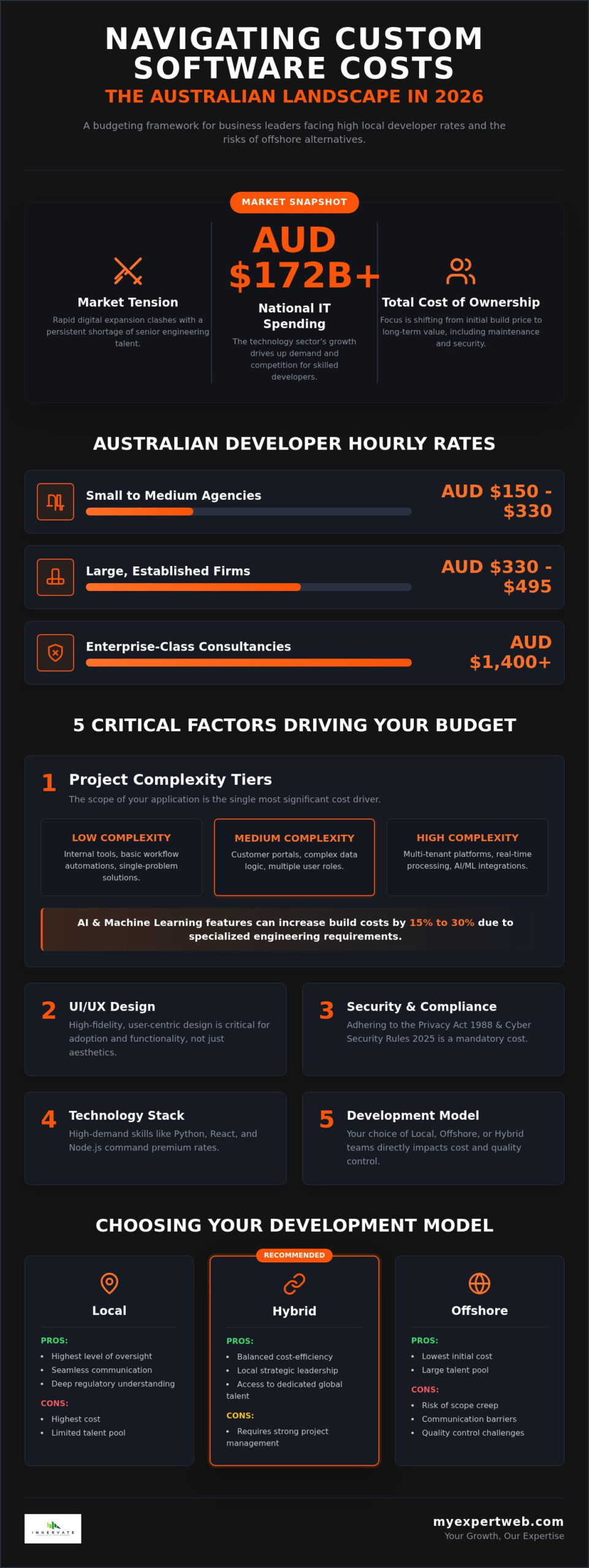
The Australian technology sector is currently defined by a sharp tension between rapid digital expansion and a persistent shortage of senior engineering talent. National IT spending has climbed past AUD $172 billion, yet the supply of local developers hasn’t kept pace. This scarcity is a primary driver of the custom software development cost australia. When you seek local expertise, you aren’t just paying for code; you’re competing for a limited pool of specialists who understand the Australian regulatory environment.
However, the definition of “custom” is evolving. In 2026, building a bespoke application doesn’t always mean starting from a blank page. The integration of AI-assisted development and modular frameworks allows teams to assemble core functionalities rapidly. This shift helps offset some labor costs while allowing developers to focus on the unique business logic that provides your competitive edge. Modern software development methodologies prioritize this hybrid approach to ensure efficiency without sacrificing the “bespoke” nature of the final product.
It’s also essential to look beyond the initial build price. Professional agencies now emphasize the Total Cost of Ownership (TCO), which accounts for managed infrastructure, security updates, and the evolution of the software over its lifecycle. We’re seeing a clear transition toward value-based pricing. Instead of a simple tally of hours, quotes are increasingly tied to the operational efficiency and revenue growth the software is expected to generate. This pragmatic approach ensures your investment aligns with tangible business outcomes.
Market Rates for Australian Software Engineering
Hourly rates in Australia reflect the high cost of living and the specialized skills required for modern builds. Small-to-medium agencies generally charge between AUD $150 and $330 per hour. Larger, established firms often command rates from AUD $330 to $495, while enterprise-class consultancies can exceed AUD $1,400 per hour for high-level strategic work. Your choice of tech stack also influences the budget. Python, React, and Node.js remain high-demand skills because they offer the security and scalability required for 2026 compliance standards. Regional factors also play a role, as agencies in major commercial hubs often have higher overheads that are reflected in their national pricing models.
Off-the-Shelf vs. Custom: The Cost of Compromise
Many businesses gravitate toward “cheap” SaaS options to save on upfront capital, but the long-term reality is often different. Subscription fees can balloon as your user base grows, and you’re frequently left with a tool that doesn’t quite fit your internal processes. These solutions often lack deep ownership, leaving you vulnerable to platform changes or price hikes. Custom software eliminates “workaround” costs over time by ensuring the technology adapts to your specific business workflows rather than forcing your team to adapt to rigid software limitations. If you’re weighing these options, consider Why Off-the-Shelf Software Might Be Costing Your Business.
5 Critical Factors Driving Your Software Development Budget
Calculating a realistic budget for your project requires an objective look at the technical and operational requirements. The custom software development cost australia isn’t a static number; it fluctuates based on the specific hurdles your team needs to clear. Current technology labour market trends also play a significant role, as the availability of developers proficient in secure, modern frameworks directly impacts project timelines and resource allocation.
Complexity Tiers and Their Budgetary Impact
The scope of your application is the most significant cost driver. Small-scale projects typically involve internal tools or basic workflow automations that solve a single, specific problem. Medium-scale projects often feature customer-facing portals with complex data logic and multiple user roles. At the high end, large-scale builds include multi-tenant platforms with real-time processing or AI integrations. Research indicates that adding AI features can increase build costs by 15% to 30%, reflecting the specialized engineering required to implement these models safely.
The Role of UI/UX in Total Cost
Design is more than just aesthetics; it’s a functional blueprint that dictates how users interact with your business. Investing in a thorough discovery and wireframing phase can save up to 30% on rework costs during the development stage. You’ll need to decide between using existing design systems, which provide efficiency, or investing in “pixel-perfect” custom branding for a unique market presence. If you’re planning a smartphone-centric solution, our Choosing a Mobile App Development Company: 2026 Guide offers deeper insights into these design tradeoffs.
Beyond design and complexity, three other factors frequently shift the financial needle. Third-party integrations, such as connecting to legacy CRM systems or secure payment gateways, require meticulous API management. Security and compliance are also non-negotiable in 2026. Adhering to the Privacy Act 1988 and the latest Cyber Security Rules is a mandatory part of the development process that ensures long-term viability. Finally, your choice of platform, whether it’s a web-based tool, a native mobile app, or a cross-platform solution, will dictate the depth of the engineering team required. If you’re ready to map out these factors for your own project, we can help you define your technical roadmap to ensure every dollar spent contributes to your growth.
Comparing Development Models: Local vs. Offshore vs. Hybrid
Choosing the right delivery model is perhaps the most significant decision affecting the custom software development cost australia. While technical requirements set the baseline, how you source your talent determines the final efficiency and risk profile of the build. Australian businesses generally choose between three distinct paths, each offering a different balance of control, strategic depth, and financial outlay.
Local Australian agencies remain a reliable choice for high-touch strategy and immediate accountability. They’re ideal for projects requiring deep face-to-face collaboration, but their higher overheads often lead to a premium price point. Conversely, pure offshore freelancing offers the lowest entry price. However, this model carries the highest risk of project failure, communication breakdowns, and intellectual property loss. Many businesses find themselves caught between these two extremes, searching for a way to scale without sacrificing quality.
The hybrid managed model bridges this gap by combining local strategic oversight with a dedicated offshore execution engine. At MyExpertWeb, our 12 years of experience have shown that this approach provides the stability of a local partnership with the scalability of global talent. We act as a methodical guide, ensuring that your vision is translated into high-quality code while keeping costs manageable. This structure minimizes the friction often found in traditional outsourcing while providing a clear path to project completion.
Why the Managed Offshore Model is Dominating in 2026
Many Australian firms are now moving toward managed dedicated teams in the Philippines to optimize their budgets. This isn’t simple task-based outsourcing; these teams act as a seamless extension of your internal staff. By leveraging this model, you gain access to senior engineers at a fraction of the local cost, allowing you to reallocate resources toward marketing or further product innovation. It’s a pragmatic way to scale your technical capabilities without the high-pressure overhead of a 100% local team. To understand the specific financial benefits, you can explore our Cost of Hiring Developers in the Philippines: The 2026 Strategic Guide.
Protecting Your Investment: IP and Security
A common concern with international development is the safety of intellectual property and data. Protecting your investment requires robust legal frameworks and secure international contracts that align with Australian standards. We prioritize these safeguards from day one, ensuring that every line of code remains your exclusive property. Our approach to Secure Web App Development: Strategic Guide for 2026 details how we integrate these protections into the development lifecycle, providing peace of mind while you scale your digital presence.
Estimating the Numbers: Realistic Price Ranges for Australian Projects
Determining the custom software development cost australia requires a clear understanding of the project’s functional depth and long-term goals. In 2026, the financial blueprint for a build is shaped by a combination of engineering hours, technical complexity, and the integration of emerging technologies. While every project is unique, market analysts categorize software investments into three primary tiers based on the scope of the solution and its intended impact on the business.
Low-complexity projects generally focus on solving a single operational bottleneck, such as a basic CRM or a streamlined internal workflow tool. These builds prioritize core functionality over extensive third-party integrations. Medium-complexity projects represent the bulk of the Australian market, often involving customer-facing portals that require sophisticated data logic and secure payment gateways. At the highest level, enterprise-scale platforms are designed to support thousands of concurrent users and may include real-time data processing or complex AI components. It’s important to remember that adding AI features typically increases the build cost by 15% to 30%, reflecting the specialized engineering talent required for safe implementation.
The MVP Budget: Getting to Market Faster
A Minimum Viable Product (MVP) is the most pragmatic way to launch a new digital product without overextending your initial capital. This approach allows you to focus your budget on the features that provide the most immediate value to your users. An MVP reduces the risk of building unwanted features by validating core functionality with real users before committing to a full-scale build. By launching early, you can gather feedback and refine your roadmap based on actual usage patterns rather than assumptions. This iterative process ensures that your ongoing investment is always aligned with market demand.
Scaling to Enterprise: The Long-Term Financial Roadmap
As your application grows, the financial focus shifts from initial construction to scalable architecture and iterative improvements. Budgeting for phased rollouts allows you to manage cash flow while gradually expanding the system’s capabilities. It’s also vital to consider the 15% to 25% of the initial build cost that should be allocated annually for ongoing maintenance, security updates, and infrastructure management. Choosing a scalable cloud architecture early in the process prevents expensive refactoring as your user base expands. For a deeper look at managing these transitions, see The Strategic Guide to Custom Business Application Development in 2026.
You should be cautious of “fixed price” quotes in the early stages of a project. In agile software development, a rigid price often leads to hidden compromises in code quality or “feature cutting” when unforeseen technical hurdles arise. A transparent, milestone-based approach is a much more reliable way to ensure your project remains on track and within a realistic budget. If you’re ready to define the specific financial requirements for your next build, you can request a tailored project estimate from our strategic team.
Maximising ROI: How to Partner with a Strategic Guide
Achieving a high return on investment requires shifting your perspective from a simple transaction to a long-term technical partnership. The custom software development cost australia is not just a line item on a balance sheet; it’s the foundation for your business’s future operational efficiency. Working with a methodical guide ensures that your capital is used strategically, focusing on features that drive growth while maintaining a secure and scalable architecture.
A thorough discovery phase is the most effective tool for preventing budget blowouts. By investing time in detailed scoping and wireframing before the first line of code is written, you eliminate the ambiguity that often leads to expensive scope creep. This phase allows us to identify potential technical hurdles early, ensuring that the project timeline remains predictable and aligned with your business goals. It’s about building a roadmap that respects your budget while delivering high-quality results.
Your financial roadmap must also account for the Total Cost of Ownership (TCO) beyond the initial launch. We recommend budgeting between 15% and 25% of the initial development cost annually for ongoing maintenance. This includes cloud hosting, managed infrastructure, and vital security updates to ensure your application remains compliant with the latest Australian data standards. Integrating cyber security as a built-in part of the development lifecycle protects your investment from future vulnerabilities and regulatory risks.
The MyExpertWeb Method: 12 Years of Methodical Delivery
Our approach is built on over 12 years of industry experience across Australia, Singapore, the Philippines, and the US. This global perspective allows us to design architectures that are both innovative and grounded in practical business utility. We provide dedicated project managers who act as a bridge between your strategic vision and the technical execution of our engineering teams. This ensures that every project maintains a focus on clean, mobile-friendly design and robust, secure functionality that acts as a true extension of your business.
Starting Your Project the Right Way
Before your first consultation, it’s helpful to define your primary business objectives and identify the key users of your application. You should also have a realistic budget range in mind, which allows us to tailor the technical roadmap to your specific resources. Vetting an agency requires looking beyond their portfolio; you need to assess their technical expertise and ensure their communication style fits your team’s culture. If you’re ready to map out your technical goals, you can contact MyExpertWeb for a free custom software consultation to begin your journey with a reliable strategic partner.
Securing Your Technical Future with Strategic Budgeting
Navigating the custom software development cost australia requires more than just comparing quotes; it demands a clear understanding of how technical complexity and modern regulatory standards shape your total investment. By prioritizing a thorough discovery phase and adopting a hybrid delivery model, you can effectively mitigate the risks of scope creep while accessing high-tier engineering talent. This pragmatic approach ensures that your capital is directed toward building secure, scalable business applications that offer long-term viability and operational excellence.
With over 12 years of industry experience, we’ve refined a methodical process that bridges the gap between Australian strategic leadership and global technical execution. Our dedicated teams in the Philippines act as a seamless extension of your staff, providing the high-value ROI required to stay competitive in an evolving digital market. We’re here to help you move beyond the role of a client to become a true strategic partner in the development process. This collaborative mindset is what turns a technical requirement into a powerful asset for your organization.
Book a Free Strategy Consultation with MyExpertWeb to map out your specific software goals today. We look forward to helping you transform your vision into a high-performing digital reality that supports your growth for years to come.
Frequently Asked Questions
How much does custom software development cost in Australia for 2026?
The custom software development cost australia generally starts at AUD $50,000 for low-complexity builds and can exceed AUD $1,000,000 for enterprise platforms. A typical medium-complexity project often falls between AUD $90,000 and $250,000. These figures depend on your specific feature set, the technology stack chosen, and the depth of third-party integrations required. We recommend requesting a tailored quote to get an accurate estimate based on your unique business requirements.
Is it cheaper to hire a local Australian agency or an offshore team?
Offshore teams generally offer lower hourly rates, but a hybrid model is often the most cost-effective choice for Australian businesses. This approach combines local strategic oversight with a dedicated development team in the Philippines. It provides a high-value alternative to 100% local builds, which command premium rates of $150 to $495 per hour. By leveraging managed offshore execution, you reduce labor costs while maintaining the accountability of a seasoned strategic partner.
What are the hidden costs of custom software development?
Beyond the initial build, you should budget for managed cloud hosting, software licensing, and ongoing security compliance. Maintenance typically requires 15% to 25% of the initial development cost annually to cover routine updates and iterative improvements. Other potential costs include API subscription fees for third-party services and the expense of training your internal staff to use the new platform effectively. Planning for these operational expenses ensures the long-term viability of your software.
How long does it take to build a custom business application?
A functional Minimum Viable Product (MVP) typically takes three to five months to launch, while complex enterprise platforms may require nine months or longer. The timeline is influenced by the discovery phase, the complexity of your data logic, and the number of user roles involved. We prioritize a methodical delivery process to ensure each milestone is met without compromising on code quality or security standards. Clear scoping early on is vital for preventing timeline extensions.
Can MyExpertWeb help if I already have an internal team?
Yes, we frequently provide dedicated developers or designers to act as a seamless extension of your internal team. This outsourcing development team service allows you to scale your technical capacity quickly without the overhead of local recruitment. Our engineers integrate into your existing workflows, following your established software development methodologies. This collaborative approach is ideal for businesses that need specialized skills for a specific project phase or ongoing product evolution.
How do you ensure my intellectual property is safe with an offshore team?
We protect your intellectual property through robust international contracts and secure legal frameworks that align with Australian standards. Every line of code developed by our teams remains your exclusive property from day one. We also implement strict cyber security protocols and data access controls during the build process. With over 12 years of experience, we’ve refined our security measures to ensure that your sensitive business data and proprietary logic are always protected.
Do you provide ongoing maintenance and support after the software launch?
We provide comprehensive maintenance and support packages to ensure your software remains secure and high-performing after launch. This includes managed infrastructure, routine bug fixes, and mandatory updates for compliance with the Privacy Act 1988 and Cyber Security Rules. Our team monitors your application performance and handles any technical issues that arise, allowing you to focus on your core business operations. Consistent support is essential for maintaining a positive user experience and protecting your ROI.
What is the difference between a project fee and a monthly retainer?
A project fee is a one-time investment for the initial design and implementation of your custom software or application. In contrast, a monthly retainer is a recurring fee for ongoing services like SEO, PPC management, or dedicated staffing support. Most businesses use a project fee for the build phase and then transition to a retainer for long-term growth and lead generation. This structure provides financial predictability for both the construction and the evolution of your digital presence.