

MyExpertWeb Team
August 5, 2026
Custom vs Off-the-Shelf Software: 2026 Strategic Guide
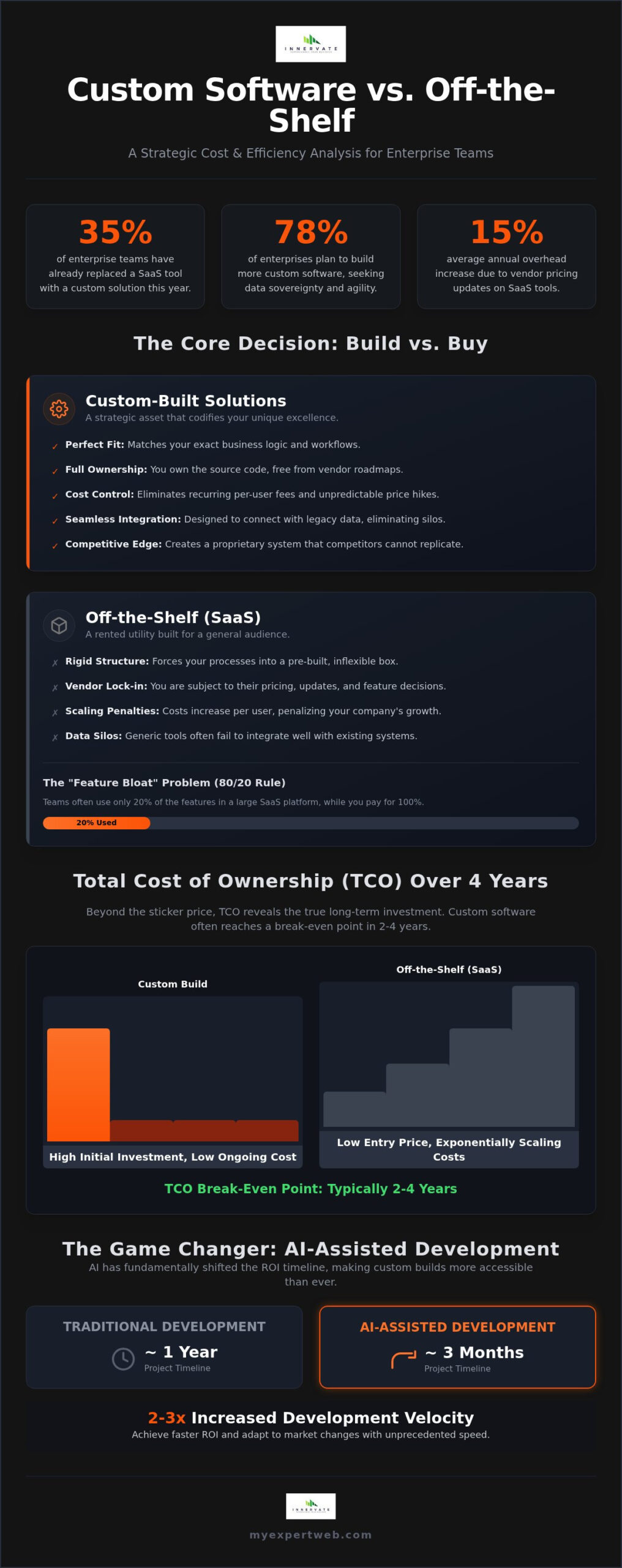
Thirty-five percent of enterprise teams have already replaced at least one SaaS tool with a custom-built solution this year. While the initial subscription fee for a ready-made app looks appealing, many leaders are realizing that the long-term cost of custom software vs off the shelf tells a different story. You’ve likely felt the frustration of paying for a massive platform where your team only uses 20% of the features. It’s even more taxing to watch your overhead climb by 15% every year simply because a vendor updated their pricing tiers or user seat limits.
It’s difficult to grow when your business processes are forced into a rigid, pre-built box that doesn’t quite fit. You deserve a solution that scales with you, not one that penalizes your success with disconnected data silos and manual workarounds. This guide provides a clear framework to calculate your total cost of ownership and determine if your unique workflows justify a tailored build. We’ll explore how AI-assisted development has shifted the ROI timeline and help you choose the path that secures your operational efficiency for years to come.
Key Takeaways
- Learn to calculate the Total Cost of Ownership (TCO) to move beyond simple sticker prices and understand the real impact on your balance sheet.
- Compare the long-term cost of custom software vs off the shelf to identify which investment model supports your growth without scaling penalties.
- Identify the “Efficiency Tax” and shadow processes that emerge when teams create manual workarounds for rigid, ready-made tools.
- Use the 80/20 rule to determine if missing features in your current software are creating data silos that hinder operational visibility.
- Discover how a methodical partnership with a dedicated development team provides the scalability and security your business requires.
Defining the Dilemma: Custom Software vs. Off-the-Shelf in 2026
The choice between building or buying software used to be a simple budget exercise. Today, it’s a strategic pivot that determines how fast a company can move. In 2026, the landscape has shifted because AI-assisted development has increased velocity by 2 to 3 times, making tailored builds more accessible than ever. This shift forces leadership to ask a fundamental question: is this software a utility expense like electricity, or is it a strategic asset that creates a competitive moat? Understanding the total cost of custom software vs off the shelf requires looking past the initial invoice to see how these tools impact your team’s daily output and long-term scalability.
We see many businesses treating software as a utility, only to realize later that they’ve outsourced their most critical workflows to a vendor that doesn’t understand their specific market. When you buy a subscription, you’re buying someone else’s vision of how your business should run. When you build, you’re codifying your own excellence. This distinction is why 78% of enterprises plan to build more custom software this year. They aren’t just looking for features; they’re looking for data sovereignty and the ability to pivot without waiting for a third-party update.
Custom Application Development: The Tailored Approach
This path involves creating a digital ecosystem from the ground up to match your exact business logic. Custom software ensures that your unique competitive advantages aren’t diluted by generic workflows. You own the source code entirely. This ownership means you aren’t at the mercy of a vendor’s roadmap or sudden 15% annual price hikes. Because the architecture is built for you, it integrates seamlessly with your existing legacy data, eliminating the silos that often plague ready-made apps. In the current market, a tool that once took a year to build can now be deployed in about three months, allowing you to see a return on investment much faster than in previous years.
Off-the-Shelf Software: The Ready-Made Solution
Off-the-shelf products are designed to solve common problems for the widest possible audience. The core promise is speed; you can often sign up and start working within minutes. However, this convenience comes with a trade-off in long-term flexibility. You’re essentially renting a utility. While the entry price is lower, the cost of custom software vs off the shelf often reaches a break-even point within two to four years. As your user count grows, you may find that the software you “bought” is actually holding you back with rigid structures. You might pay for 100% of a platform’s features but only use 20% of them, which creates a significant amount of “feature bloat” that confuses your staff and slows down operations.
The Architecture of Cost: Breaking Down Total Cost of Ownership (TCO)
Many business leaders mistake the monthly subscription fee for the total expense of a software solution. In reality, the true cost of custom software vs off the shelf is only revealed when you look beyond the sticker price to account for training, integrations, and scaling fees. Total Cost of Ownership (TCO) is the sum of all direct and indirect costs over the software’s lifecycle. By shifting your perspective from monthly operating expenses to long term asset value, you can make a choice that protects your margins as your company grows.
While off the shelf tools offer a low barrier to entry, they often carry hidden implementation costs. You might spend thousands on specialized consultants just to map your unique data into a vendor’s rigid fields. Custom software requires a higher initial commitment, but it functions as a strategic investment rather than a recurring debt. Research indicates that while SaaS deployment is faster, custom builds typically reach a break even point in TCO within two to four years. This is largely because custom solutions eliminate the per user tax that penalizes your success.
Upfront Costs vs. Long-Term Amortization
A custom build is a capital expenditure that provides lasting value to your balance sheet. For those exploring custom software development for small business australia, this investment typically amortizes over a three to five year period. Modern AI assisted development has changed the math here significantly. A tool that once required a $150,000 investment can now be built for a fraction of that cost in roughly three months. This reduced entry point makes it easier to justify the upfront build when compared to the $44,000 to $124,000 a mid market enterprise might spend on SaaS licenses over the same three year window.
Recurring Expenses: Subscriptions vs. Maintenance
The “Per User Trap” is a common pain point in the SaaS model. As your team expands, your software bill increases proportionally, even if your actual usage of the platform’s features remains static. Most enterprises pay for 100% of a SaaS platform’s capabilities but only utilize 20% to 50% of them. You are effectively subsidizing features you don’t need. Furthermore, SaaS vendors commonly raise prices by 5% to 15% annually. In contrast, maintenance for a custom tool ensures the software evolves alongside your specific business logic. If you want to stop paying for unused features, you might consider how a dedicated development team can help you maintain a lean, high performance system that you own outright.
Strategic Comparison: Flexibility, Scalability, and Data Sovereignty
Choosing a software path involves more than just comparing invoices. It’s about deciding who controls the future of your operations. Many organizations find themselves trapped by the 80/20 Rule of off-the-shelf platforms. These tools often provide 80% of what you need, but the final 20% contains the specific workflows that differentiate your business. When those missing features force your team into manual workarounds, the actual cost of custom software vs off the shelf begins to shift in favor of the build. You aren’t just paying for code; you’re paying to eliminate the friction that slows down your most talented employees.
Scalability is another area where the SaaS model can become a liability. If your business volume increases by 200%, a per-user or per-transaction subscription often results in a 200% price hike. Custom business management software behaves differently. Once the infrastructure is built, you can often scale your operations significantly without a proportional increase in software expenses. This allows your margins to expand as you grow, rather than being eaten by vendor fees. It turns your software from a tax on growth into a lever for it.
Owning the Roadmap vs. Following the Vendor
Vendor lock-in is a silent growth killer. When you rely on a third-party platform, you’re tethered to their security standards and feature priorities. If they decide to sunset a feature you rely on, you have little recourse. Investing in secure web application development ensures that you hold the keys to your own digital fortress. This approach provides true data sovereignty. Your business intelligence remains your own, rather than being stored in a shared-tenant environment where vulnerabilities are communal and data migration is intentionally difficult.
Integration and Ecosystem Harmony
Off-the-shelf tools rarely talk to each other without expensive help. Businesses often end up paying for middleware or specialized connectors just to sync data between disconnected apps. These hidden integration costs can range from $20,000 to $100,000, quickly inflating the cost of custom software vs off the shelf. A custom build eliminates this redundancy by creating a unified ecosystem from day one. This harmony doesn’t just save money; it future-proofs your stack for upcoming AI and machine learning integrations. It ensures your data is clean, accessible, and ready for the next wave of innovation without requiring a complete system overhaul.
Identifying the ‘Efficiency Tax’: When Off-the-Shelf Costs You More
The Efficiency Tax isn’t a line item on your balance sheet, but it’s often the most expensive part of your tech stack. It represents the cumulative loss of productivity caused by software that forces your team to adapt to its limitations, rather than the software adapting to your business. While we previously discussed the cost of custom software vs off the shelf in terms of licensing, the Efficiency Tax manifests in the hours your staff spends fighting rigid interfaces or fixing data errors. When a tool only meets 80% of your needs, your team pays the remaining 20% in manual effort every single day.
This tax is most visible when “shadow processes” emerge. If your employees have developed complex Slack chains, sticky note reminders, or separate spreadsheets just to bridge the gaps between your official apps, your software has failed its primary purpose. These workarounds aren’t just annoying; they represent a significant opportunity cost. Every hour spent on manual data synchronization is an hour taken away from high value tasks like customer acquisition or strategic planning. Calculating the ROI of a custom solution often involves simply quantifying the cost of eliminating these friction points.
Workaround Labor: The Silent Profit Killer
Workaround labor is any manual task performed solely because the software cannot handle the required logic. If your team spends every Friday afternoon exporting CSV files from one platform to manually re-enter them into another, you are paying for software that doesn’t actually work for you. This manual re-entry is a breeding ground for human error, which can lead to missed shipments, incorrect billing, or damaged customer trust. In a competitive landscape, these errors are more than just a nuisance; they are risks to your brand’s long term viability. By investing in custom software development, you replace these fragile manual bridges with automated, reliable workflows.
The 5 Signs You’ve Outgrown Off-the-Shelf Software
Recognizing the transition point from a ready-made utility to a custom asset is crucial for maintaining operational health. Look for these five indicators that your current stack is holding you back:
- Tool Fragmentation: You are forced to run three or more disconnected tools to manage a single, core business process.
- Subscription Imbalance: Your monthly per-user fees have climbed so high they rival the cost of maintaining a dedicated developer.
- Data Paralysis: Critical business decisions are delayed because your data is trapped in silos that don’t talk to each other.
- Plugin Bloat: Your “standard” software requires a fragile web of third-party plugins just to perform basic, daily functions.
- Manual Verification: Your staff spends more time double-checking the software’s output than they do actually using the data.
If these signs look familiar, the cost of custom software vs off the shelf is likely already tipping in favor of a build. Eliminating the Efficiency Tax allows your team to focus on growth rather than maintenance, turning your technology from a hurdle into a competitive advantage.
Navigating Your Software Journey with a Reliable Strategic Partner
Transitioning from a generic subscription to a tailored system is a significant strategic move. It requires more than just a vendor; it demands a partner who understands that software is a living part of your business operations. When you evaluate the cost of custom software vs off the shelf, the most successful outcomes come from a phased approach. Rather than attempting a “big bang” launch that replaces every system at once, we recommend starting with a Minimum Viable Product (MVP). This strategy targets your highest friction processes first, allowing you to realize immediate efficiency gains while managing your capital expenditure effectively.
A common concern for businesses is the perceived risk of offshore development. We solve this by utilizing a hybrid model. You receive local strategic guidance and project management, ensuring your business logic is perfectly captured and understood. This is supported by our dedicated development teams in the Philippines, who provide the technical execution at a price point that makes the cost of custom software vs off the shelf much more competitive. It’s the balance of high level oversight and cost effective production that secures your long term growth.
The MyExpertWeb Method: Partnership Over Vendorism
With over 12 years of experience in custom business application development, MyExpertWeb acts as a methodical guide through this transition. We don’t just build tools; we act as an extension of your own team. Our track record includes building secure, mobile friendly applications that aren’t just functional but are designed to be strategic assets. By leveraging our dedicated teams, we ensure that your software evolves as your business goals shift, providing a level of adaptability that no SaaS vendor can match.
Starting with a Professional Software Audit
The first step in our partnership is always a thorough professional audit. We prioritize understanding your specific workflows and identifying where data silos are currently draining your resources. This isn’t just about code; it’s about business utility. We look at your security requirements, mobile accessibility, and how your software contributes to lead generation. Our goal is to ensure that every line of code written serves a practical purpose on your balance sheet. If you’re ready to stop paying the “efficiency tax” and start building a moat around your business, book a free consultation with MyExpertWeb to audit your current software stack.
Securing Your Operational Excellence for the Future
Choosing the right technology is about more than just checking features; it’s about ensuring your software acts as a foundation for growth rather than a ceiling. We’ve explored how the cost of custom software vs off the shelf often reaches a break-even point within just a few years, especially as SaaS subscription fees climb and manual workarounds accumulate. By shifting your perspective from a monthly utility expense to a long-term strategic asset, you can reclaim lost productivity and protect your business intelligence.
With over 12 years of experience, MyExpertWeb acts as a methodical guide for businesses ready to build secure, mobile-friendly applications that truly fit their unique workflows. Our hybrid model utilizes dedicated development teams in the Philippines to deliver high-quality code while providing you with the local strategic oversight you need to succeed. You don’t have to settle for rigid, pre-packaged tools that slow your team down.
Your business processes are your competitive advantage. Let’s build the digital infrastructure that honors and amplifies that excellence.
Frequently Asked Questions
Is custom software always more expensive than off-the-shelf options?
Not necessarily when you factor in the long-term cost of custom software vs off the shelf. While a custom build requires a higher initial investment, it eliminates recurring per-user fees and annual price increases associated with SaaS. Over a three to five-year period, the absence of these subscription costs often makes custom software the more economical choice for growing enterprises that need to scale without financial penalties.
How long does it typically take to build a custom business application?
A standard custom application typically takes between three and twelve months to reach full deployment. However, modern AI-assisted development has significantly accelerated this timeline. Many businesses now see their first functional MVP ready for use in approximately three months. This phased approach allows your team to begin gaining value from the tool while we continue to refine more complex features in the background.
What are the hidden costs of using SaaS or off-the-shelf software?
SaaS platforms often hide significant expenses behind their low monthly fees. You might face customization costs ranging from $50,000 to $200,000 just to make a generic tool fit your specific workflow. Additionally, integrating disconnected apps can cost between $20,000 and $100,000. When you add annual price hikes of 5% to 15%, the total cost of custom software vs off the shelf becomes much more comparable over time.
Can I migrate my data from my current off-the-shelf tool to a custom build?
Yes, migrating data from existing platforms is a core part of the development process. We utilize APIs or direct database exports to move your legacy information into the new system. This ensures continuity for your operations and prevents data loss. A methodical migration plan allows your team to transition to the new tool without losing years of valuable business intelligence or historical customer data.
Who owns the code when I hire a company for custom software development?
You should always own the source code for any custom application built for your business. At MyExpertWeb, we ensure that the intellectual property remains entirely with the client upon project completion. This ownership prevents vendor lock-in and gives you the freedom to maintain or expand the software as you see fit. It transforms your technology from a rented utility into a permanent, valuable business asset.
What happens if my business needs change after the custom software is built?
Custom software is designed to be modular and adaptable to your changing requirements. Unlike off-the-shelf tools that have a fixed roadmap, a custom build allows you to pivot your logic or add new features at any time. You don’t have to wait for a third-party vendor to approve a feature request. This flexibility ensures your digital infrastructure remains perfectly aligned with your operational goals as your market evolves.
Is custom software more secure than popular off-the-shelf platforms?
Custom software provides a higher level of security by eliminating the risks inherent in shared-tenant environments. Popular SaaS platforms are high-value targets for hackers because a single vulnerability can expose thousands of companies. A custom application allows you to implement specific security protocols tailored to your industry’s compliance needs. You retain full control over who accesses your data and how that data is stored or encrypted.
How do I calculate the ROI of switching to custom software?
To calculate ROI, compare your total SaaS expenses, including subscription fees and integration costs, against the one-time build cost and ongoing maintenance. You must also quantify the savings from eliminating the “efficiency tax” by estimating the hours your staff saves through automation. Most businesses find that the increased productivity and eliminated license fees result in a positive return on investment within two to four years of deployment.