


MyExpertWeb Team
August 11, 2026
Custom Business Management Software: The 2026 Strategic Trend Analysis
How much of your monthly revenue is currently disappearing into a “SaaS tax” for enterprise features your Australian team never actually touches? Many business owners find themselves paying for a dozen different tools that refuse to communicate, creating data silos that slow down every decision. It’s a common frustration to watch your overheads climb with every new hire due to rigid per-user pricing models. This is why custom business management software has moved from a high-end luxury to a vital strategic hedge against operational fragmentation in 2026.
You likely agree that software should adapt to your business, not the other way around. In this analysis, we’ll show you how to escape subscription fatigue by building a proprietary asset that stays within your control. We’ll break down the 2026 shift toward unified systems that mirror your exact workflows, providing the security and scalability needed to grow without the constant pressure of rising per-user fees. You’ll discover how a methodical approach to development can turn your internal processes into a genuine operational asset.
Key Takeaways
- Learn how to reclaim your profit margins by identifying the hidden costs of “per-user” SaaS pricing and moving toward a model of software ownership.
- Understand the 2026 shift toward Private AI and mobile-first management for coordinating a national Australian workforce with greater precision.
- Discover why investing in custom business management software creates a proprietary operational asset rather than just another recurring monthly expense.
- Explore the lifecycle of professional development, from strategic workflow mapping to UI/UX design that prioritizes your specific business processes.
- Find out how partnering with a dedicated development team provides the technical stability and cybersecurity needed for long-term scalability.
What is Custom Business Management Software in 2026?
Custom software is no longer just a technical choice; it’s a strategic foundation. In 2026, custom business management software represents a centralized digital ecosystem built specifically to align with an organization’s unique operational DNA. Unlike generic platforms that offer a thousand features you’ll never use, these systems are lean, purposeful, and designed to eliminate the friction caused by disjointed workflows. This shift marks a move away from “feature-heavy” bloat toward applications that do exactly what is required and nothing more.
Many Australian businesses are moving away from bloated, “all-in-one” subscriptions. They’ve realized that paying for unused enterprise modules is a drain on capital. This year marks the rise of the “Proprietary Operational Asset.” This means your software isn’t just a bill you pay every month; it’s a piece of intellectual property that stays on your balance sheet. By focusing on lean builds, companies can reduce technical debt and ensure their teams aren’t distracted by irrelevant tools.
The Core Philosophy: Software as a Capital Asset
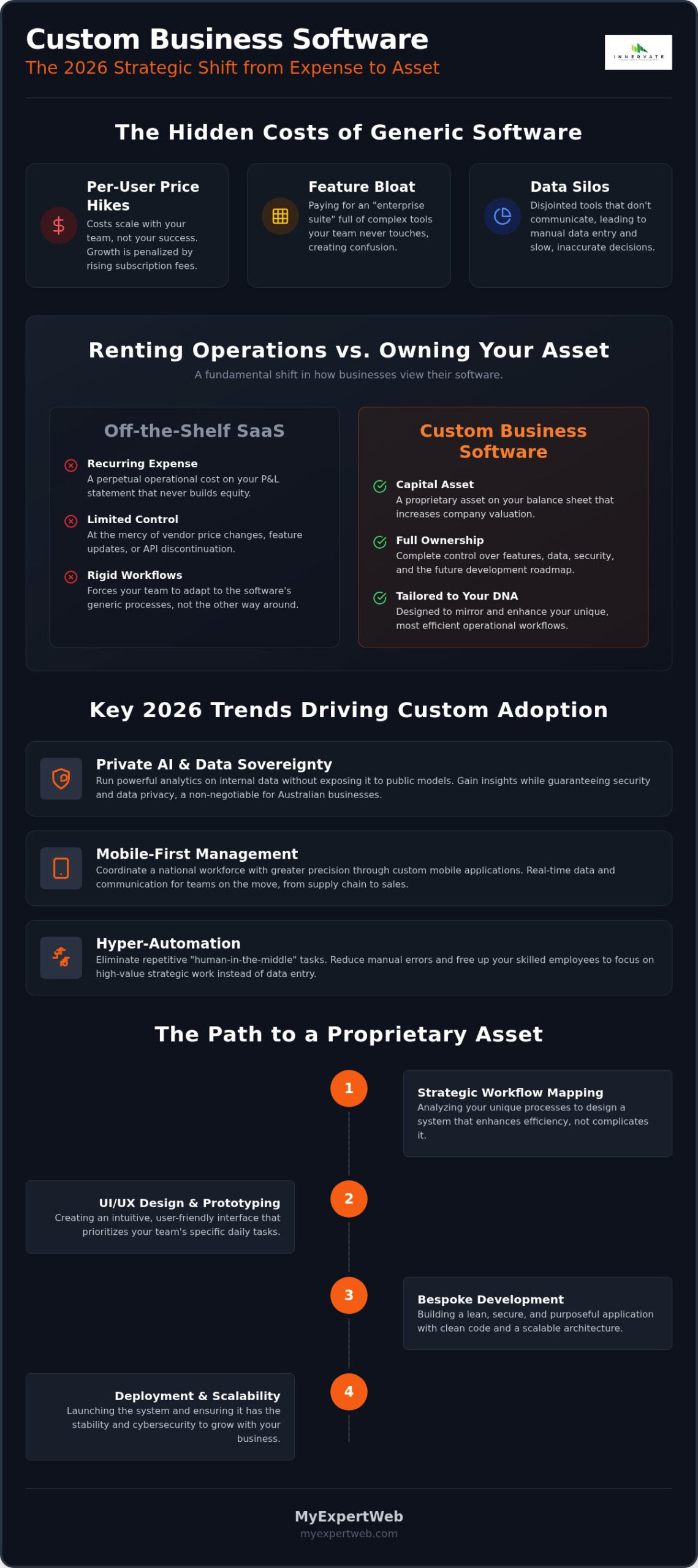
Think of the difference between renting a warehouse and owning your headquarters. When you rely on SaaS, you’re essentially renting your operational logic from a third party. If they raise prices or change their API, your business is at their mercy. By investing in custom business management software, you’re building a proprietary business engine that captures your unique operational logic and turns it into a scalable digital asset. This approach increases your company’s overall valuation. It transforms a recurring expense into a long-term capital asset that scales alongside your team without the penalty of per-user fee hikes.
Key Examples of Custom Management Tools
Effective systems focus on specific utility rather than generic functionality. Here are a few ways this manifests in modern Australian enterprises:
- Unified Client and Partner Portals: Secure hubs where stakeholders interact directly with your data, reducing email clutter and improving transparency.
- Real-Time Inventory and Supply Chain Systems: Applications that sync across multiple locations to prevent stockouts and manage logistics with precision.
- Bespoke CRMs: Systems that prioritize your specific sales cycle and lead nurturing process rather than forcing you into a standard sales funnel.
Success in these areas often starts with professional custom business application development to ensure the architecture supports future growth and remains secure against evolving threats.
Security and data sovereignty have become non-negotiable. Modern builds now integrate Private AI, allowing you to run powerful analytics on your internal data without ever exposing sensitive information to public models. This ensures your data remains your own while providing the insights needed to stay competitive. In a market where data is the most valuable currency, owning the system that processes it is the only way to guarantee long-term security.
The 2026 Trends Driving Custom Application Adoption
The landscape of corporate operations is shifting as leaders prepare for 2026 business trends. It’s no longer enough to have a digital version of a paper process. Modern custom business management software must act as an intelligent partner that anticipates needs rather than just recording entries. While no-code platforms offer a quick start for simple tasks, they often hit a ceiling when faced with complex Australian regulatory requirements or intricate business logic. This is why high-performance, bespoke builds are becoming the standard for growing enterprises.
Generic tools often struggle to keep pace with the rapid evolution of hyper-automation. By removing the “human-in-the-middle” for repetitive data entry, businesses can redirect their talent toward higher-value strategic work. This transition isn’t just about speed. It’s about accuracy. When your system handles the heavy lifting of data synchronization, the risk of manual error drops significantly, allowing for a more resilient operation.
Private AI and Data Intelligence
Data privacy has become a top priority for Australian directors. Businesses are moving away from public AI tools for sensitive internal analysis because the risk of data leakage is too high. By building internal Large Language Models (LLMs) directly into their management suites, companies can extract deep insights from proprietary records without risking intellectual property on public servers. This predictive analytics capability allows for better resource allocation, helping you forecast demand or identify supply chain bottlenecks before they impact your bottom line.
The “Single Source of Truth” Architecture
Fragmentation is the enemy of efficiency. Most organizations suffer from data silos where sales, finance, and operations teams work from different versions of the truth. An API-first design ensures that your custom tool communicates seamlessly with every other part of your tech stack. This creates real-time dashboards that provide the C-suite with a clear, unified view of the entire organization. When every department looks at the same data, decision-making becomes faster and more collaborative.
Managing a national workforce also requires a mobile-first approach. Whether your team is operating from a regional facility or a corporate headquarters, they need full access to management tools from any device. This necessity has led to a convergence of secure web application development and internal operational tools. If you’re ready to move beyond fragmented systems, our team at MyExpertWeb can help you map out a strategy with a free strategic consultation to ensure your software is ready for the challenges of the coming year.
Custom vs. Off-the-Shelf: Navigating Subscription Fatigue
Subscription fatigue has become a significant operational hurdle for Australian enterprises in 2026. Many business owners find themselves trapped in a cycle of “per-user” SaaS pricing that penalizes growth rather than supporting it. When every new hire adds hundreds of dollars to your monthly overheads, software stops being a tool and starts being a tax. Transitioning to custom business management software allows you to break this cycle by owning the underlying technology rather than renting it indefinitely.
Generic ERP systems often force your business to adapt to their rigid structures. Instead of the software serving your unique competitive advantages, your team spends hours finding workarounds for features that don’t quite fit. For a deeper breakdown of these dynamics, you can explore our analysis on the cost of custom software vs off the shelf solutions. Relying on multiple disconnected tools creates a fragmented environment where data silos thrive and operational clarity disappears.
When Off-the-Shelf Becomes a Bottleneck
There are clear signs that a company has outgrown its current SaaS stack. If your team spends more time manually transferring data between tools than performing their actual roles, you’ve hit a bottleneck. These “workarounds” carry a hidden cost in lost productivity and increased human error. Security risks also multiply as you manage dozens of different logins across various platforms. A centralized, bespoke system eliminates these vulnerabilities by providing a single, secure point of entry for your entire operation.
The Long-Term Financial Argument
Calculating the five-year ROI reveals the true value of ownership. While off-the-shelf tools seem cheaper initially, the cumulative cost of perpetual subscriptions often exceeds the investment of a custom build within the first few years. Custom software is a one-time build for a lifetime of utility. Beyond the direct savings on monthly operational expenditure (OPEX), there are significant tax advantages to consider. In Australia, certain aspects of custom business management software development may qualify for Research and Development (R&D) tax incentives, allowing you to reclaim a portion of the investment through the ATO. This transforms your software from a recurring bill into a strategic capital asset that strengthens your balance sheet.
Choosing to build your own tools isn’t just about saving money; it’s about gaining total control over your data and your future. When you own the code, you decide when to update, when to scale, and how to integrate new technologies like Private AI. This level of autonomy is essential for any business looking to maintain a competitive edge in a rapidly evolving digital economy.
The Lifecycle of Professional Custom Software Development
Building custom business management software is a methodical journey that requires more than just technical coding skills. It’s a strategic process designed to ensure the final product actually solves the operational hurdles your team faces every day. Rather than a rigid, one-size-fits-all approach, a professional development lifecycle moves through distinct phases that prioritize clarity, security, and long-term viability. This structured path transforms a complex business need into a high-performance digital asset.
A typical professional lifecycle includes five essential stages:
- Phase 1: Strategic Discovery and Workflow Mapping to align the software with your business goals.
- Phase 2: UI/UX Design focused on operational efficiency and ease of use for your staff.
- Phase 3: Iterative Development using agile sprints to allow for feedback and adjustments.
- Phase 4: Rigorous Testing and cyber security hardening to protect your proprietary data.
- Phase 5: Deployment and continuous evolution to keep the system relevant as you scale.
Discovery: Beyond Technical Requirements
The success of any custom build depends on the depth of the initial discovery phase. We move beyond simple technical specifications to map the actual “User Journey” of your employees. If a system is difficult to navigate, your team will find workarounds that lead back to the very data silos you’re trying to eliminate. Identifying the specific “Pain Points” that slow down your daily operations is critical. Whether it’s a bottleneck in the approval process or a lack of visibility in the supply chain, these insights form the blueprint of the build. Defining success metrics early, such as reducing manual data entry time by a specific percentage, ensures the project remains focused on delivering a high return on investment.
Maintenance and Cyber Security
In 2026, a “set it and forget it” mentality is a dangerous liability. Cyber threats are constantly evolving, and your custom business management software must be hardened to withstand them. Regular security audits and software updates are not optional; they’re a fundamental part of protecting your company’s valuation. This is particularly important when your system includes mobile access for a field-based workforce. Understanding how a professional mobile app development company handles updates across different platforms can provide a benchmark for your own internal tools. This ensures that security patches and functional improvements reach every device in your network simultaneously, maintaining a consistent and secure environment for all users.
If you’re ready to move from fragmented tools to a unified system, our team is here to guide you through every phase of the process. You can start by scheduling a free strategic planning session to map out your operational future.
Executing Your Vision with MyExpertWeb
Moving from a strategic plan to a functional digital ecosystem requires more than just technical proficiency. It demands a deep understanding of your specific operational challenges. In a market where many promote “do-it-yourself” AI builders, these tools often fail when faced with the complex business logic required for a truly integrated custom business management software solution. We bridge the gap between your high-level vision and the technical execution needed to turn that vision into a high-performance asset.
A successful transition relies on a partner who prioritizes your long-term stability over a quick delivery. By choosing a specialist in custom business application development, you gain access to a team that views your software as an evolving engine. We focus on creating secure, mobile-friendly systems that don’t just solve today’s bottlenecks but provide a foundation for whatever your business becomes in the next decade.
A Partner, Not Just a Vendor
With 12 years of industry experience, we’ve seen how fragmented systems can stifle even the most ambitious Australian companies. We don’t just build a tool and walk away; we act as an extension of your own team. This relationship is built on a methodical approach to complex logic that no-code platforms simply cannot replicate. One of the greatest advantages of our model is the use of dedicated development teams. Having the same experts who wrote your initial code continue to manage and scale it ensures that your system remains efficient and free of technical debt as your user base grows.
Pragmatic leaders also recognize the need to balance high-quality output with financial sustainability. We help you achieve this by combining local strategic oversight with the competitive cost of hiring developers in the Philippines. This hybrid approach allows you to deploy a full-scale development team that would otherwise be cost-prohibitive, ensuring you get the most value for every A$ invested in your proprietary infrastructure.
Next Steps: Your Free Strategic Consultation
The first step toward operational clarity is a discovery call focused on your unique requirements. During this session, we’ll evaluate your current tech stack to identify where data silos are costing you time and money. We won’t just talk about features; we’ll discuss how a unified system can mirror your exact processes to drive efficiency. You’ll walk away with a clearer understanding of how to optimize your operations and what the path to ownership looks like. If you’re ready to escape the cycle of subscription fatigue and build a lasting asset, schedule your free consultation with MyExpertWeb today.
Securing Your Operational Future in 2026
The transition from renting generic tools to owning a proprietary digital engine is the most significant strategic shift for Australian businesses this year. By choosing custom business management software, you move beyond the limitations of subscription fatigue and data fragmentation. This investment ensures your technology remains an asset on your balance sheet rather than a recurring operational tax. You’ve seen how a unified architecture supports real-time decision-making and protects your data sovereignty through Private AI integration.
MyExpertWeb brings 12+ years of custom development expertise to help you bridge the gap between operational vision and technical reality. We’re specialists in building secure, scalable business applications and have a proven track record with national Australian clients. It’s time to take control of your workflows and build a system that mirrors your exact business logic. Book a Free Strategic Consultation with MyExpertWeb to evaluate your current tech stack and map out a path to software ownership. Your operations deserve a platform that grows as fast as your ambitions.
Frequently Asked Questions
Is custom business management software more expensive than SaaS?
Custom software typically requires a higher upfront investment but offers a lower total cost of ownership over a five-year period. While SaaS platforms charge per-user fees that climb as your team grows, a custom build is a one-time capital expenditure. This allows you to scale without the penalty of rising monthly overheads. Most Australian enterprises find that the break-even point occurs quickly when compared to premium enterprise SaaS subscriptions.
How long does it typically take to build a custom management system?
The timeline for development depends on the complexity of your workflows and the number of integrations required. A streamlined application might take three to four months to deploy, while a comprehensive enterprise system can take six to twelve months. We use an agile approach to deliver functional modules in stages. This allows your team to start using core features while the rest of the system is being finalized.
Can I integrate my existing tools with new custom software?
Yes, modern systems are designed with an API-first architecture to ensure they talk to your existing tech stack. You can integrate your new custom business management software with common Australian tools like Xero for accounting or legacy databases that still hold vital information. This prevents data fragmentation and ensures that your new application acts as a central hub for all your operational data without requiring manual data entry.
What happens if my business processes change after the software is built?
Custom systems are inherently more adaptable than off-the-shelf products because you own the underlying code. As your Australian business evolves or regulatory requirements change, your software can be updated through iterative development cycles. This flexibility ensures the tool continues to mirror your exact processes. You don’t have to wait for a third-party vendor to release a feature that might not even fit your new operational model.
How do I ensure my custom business application is secure?
Security is integrated into every phase of the development lifecycle through encryption, secure authentication, and regular vulnerability testing. In 2026, we focus on data sovereignty by ensuring your sensitive information stays within your controlled environment. This often involves using Private AI models that process data internally. Regular security audits help protect your proprietary assets against evolving cyber threats and ensure compliance with local data protection regulations.
Do I need a technical team to manage custom software?
You don’t need an in-house technical team if you partner with a provider that offers ongoing maintenance and support. Many businesses choose to leverage a dedicated offshore development team to handle updates and security patches. This provides the expertise of a full IT department without the high costs of local full-time salaries. Your partner acts as an extension of your team, managing the technical health of your software.
Can custom management software be used on mobile devices?
Yes, mobile-first design is a core requirement for managing a modern, distributed workforce. Your custom business management software can be accessed via secure web portals or dedicated mobile apps, allowing your team to update inventory or sign off on approvals from any location. This is essential for Australian companies with field staff or multiple sites. It ensures that everyone has access to the same information regardless of their device.
What are the ownership rights for the code in a custom project?
In a professional custom project, you typically retain full ownership of the intellectual property and the source code upon final payment. This transforms the software from a monthly expense into a proprietary asset that adds tangible value to your company’s valuation. Unlike SaaS, where you lose access if you stop paying, you have the right to host, modify, and scale your custom system independently for the life of the business.