


MyExpertWeb Team
August 26, 2026
Cyber Security 2026: Strategic Guide for Modern Business
Did you know that 46% of small businesses across Australia faced a cyberattack in 2025? It is a sobering reality that highlights why cyber security is no longer just an IT concern but a fundamental business pillar. You might feel overwhelmed by technical jargon or worried that a single data breach could cost your company millions. It’s natural to feel uncertain as the Australian Signals Directorate begins retiring the Essential Eight framework in favour of the new “Essentials” series guidelines.
We understand these pressures and believe that digital protection should provide peace of mind rather than constant anxiety. This guide will show you how to protect your digital assets and build resilient business applications using industry-leading frameworks and proactive development strategies. We’ll outline a clear roadmap for 2026, covering everything from the new security rules for smart devices to vetting offshore development teams. By the end, you’ll have the confidence to manage technical complexity and secure your software for the long term.
Key Takeaways
- Learn how to transition your strategy from reactive defense to a proactive model where cyber security is integrated into every stage of your digital growth.
- Understand the practical steps for navigating the latest Australian security frameworks to ensure your business remains compliant and resilient.
- Discover how to implement ‘Security by Design’ to protect custom business applications from increasingly sophisticated digital threats.
- Gain a clear checklist for evaluating the security protocols of your third-party infrastructure and cloud hosting providers.
What is Cyber Security in the 2026 Business Context?
At its foundation, cyber security involves the comprehensive protection of systems, data, and networks from digital attacks. While this definition remains constant, the environment of 2026 has shifted dramatically. Business owners can no longer view security as a simple “set and forget” task. Instead, it’s a core operational discipline. We see a landscape where attackers use agentic AI to automate breaches and create hyper-personalized phishing campaigns that bypass traditional filters.
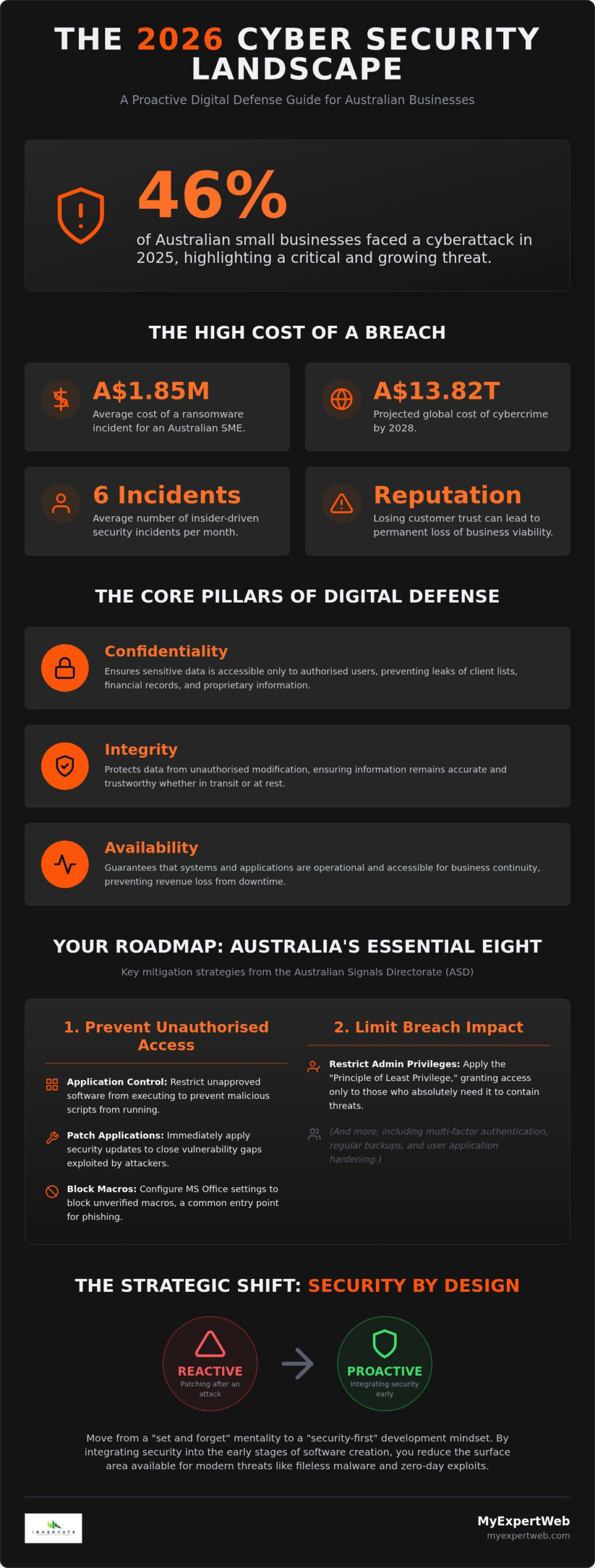
The global cost of cybercrime is projected to hit A$13.82 trillion by 2028. For an Australian SME, a breach isn’t just a technical glitch; it’s a financial catastrophe. In 2025, 46% of small businesses experienced an attack, with ransomware incidents costing an average of A$1.85 million per incident. Beyond the immediate loss of funds, the reputational damage can be permanent. Many organisations experience an average of six insider-driven incidents per month. Customers expect their data to be safe, and losing that trust often leads to a total loss of business viability.
The Core Pillars of Digital Defense
To build a resilient business, you must focus on three fundamental principles often called the CIA triad. These pillars ensure your operations remain stable even under pressure.
- Confidentiality: This ensures that sensitive business data is only accessible to authorised users. It prevents leaks of client lists, financial records, and proprietary code.
- Integrity: You must protect data from unauthorised modification. Whether the information is in transit or stored on a server, it must remain accurate and trustworthy.
- Availability: System uptime is critical for operational continuity. If your customers can’t access your application, your revenue stops immediately.
Why Traditional Antivirus is No Longer Sufficient
The tools that worked five years ago aren’t enough to stop modern threats like fileless malware or zero-day exploits. In 2026, hackers don’t always need to install a visible file on your computer. They can exploit vulnerabilities directly in system memory. This shift means that network-level protection must be paired with deep application-level security.
Human error also remains a significant vulnerability in modern cyber security incidents. Even the most advanced firewall can’t stop a breach if an employee inadvertently grants access to a malicious actor. This is why we move away from reactive patching and toward a “security-first” development mindset. By integrating security checks into the early stages of software creation, we reduce the surface area available for attack.
The Essential Eight: A Framework for Australian Business
The Australian Signals Directorate (ASD) developed a set of baseline mitigation strategies known as The Essential Eight to help organisations protect themselves against various threats. While the ASD has begun a transition toward the new “Essentials” series guidelines, this framework remains the gold standard for Australian businesses in 2026. It provides a methodical way to assess your maturity and prioritise your efforts based on your specific business risk profile. Not every company needs the highest level of lockdown immediately, but every company needs a starting point.
We work with our partners to ensure their digital presence isn’t just functional but also resilient. By aligning our custom development processes with these government standards, we help you build a foundation that can withstand modern pressures. It is about moving from a state of uncertainty to one of quiet confidence. Implementing these strategies is not just a compliance task; it is a vital part of maintaining your operational efficiency and protecting your brand’s reputation in a competitive market.
Preventing Unauthorised Access
The first goal is to stop attackers before they can gain a foothold. Application control is a critical component here. It involves restricting unapproved software from executing on your systems. If a malicious script isn’t on your “allowed” list, it simply won’t run. This is paired with rigorous patching of applications. In 2026, the window between a vulnerability being discovered and an attacker exploiting it has shrunk to hours. Security by design requires immediate updates to close these gaps. Additionally, configuring Microsoft Office macro settings to block unverified code remains a simple yet highly effective way to stop common phishing entry points.
Limiting the Impact of a Breach
If an attacker manages to bypass your first line of defense, your goal shifts to containment. You can do this by restricting administrative privileges to only those who absolutely need them. This “least privilege” model ensures that a compromised standard user account cannot be used to rewrite your entire database. We also focus on patching operating systems to ensure the very foundation of your software is secure. Perhaps most importantly, multi-factor authentication (MFA) remains the single most effective way to stop credential theft. Even if a password is stolen, the second layer of verification keeps the door locked. If you’re ready to strengthen your digital infrastructure, our team can help you implement a tailored cyber security strategy that protects your long term viability.
Security by Design: Protecting Your Custom Business Applications
In 2026, it is no longer enough to wrap a secure perimeter around a vulnerable application. We must treat secure web application development as a core discipline rather than an afterthought. This philosophy, often called Security by Design, ensures that every line of code is written with protection in mind. It moves the focus from fixing bugs after deployment to preventing them during the architectural phase. When you integrate security checks into the earliest stages of custom business application development, you create a product that is resilient from the inside out and ready for the modern threat landscape.
A major part of this resilience is how your software handles sensitive information. Data encryption must be applied both at rest and in transit. This means that even if a hacker intercepts a data stream or gains access to a database, the information remains unreadable and useless to them. As your business grows, your security must scale alongside it. A well-designed application maintains its protective integrity whether it is serving ten users or ten thousand across the nation. We focus on building systems that expand without creating new vulnerabilities, ensuring your growth is never hindered by technical debt or security lapses.
Secure Coding Practices and Frameworks
Our development process strictly adheres to the OWASP Top 10 standards. These guidelines help us prevent common web vulnerabilities like SQL injection and cross-site scripting. By implementing strict input validation and sanitisation, we ensure that malicious code cannot be “injected” into your system through user forms or search bars. Clean code is inherently more secure. It’s easier to audit, simpler to maintain, and less likely to contain hidden backdoors. When code is methodical and well-structured, potential cyber security risks become much easier to identify and resolve.
The Role of Regular Security Maintenance
Security is a continuous process, not a one-time event. Even the most robust custom software requires ongoing monitoring for suspicious activity. We recommend scheduled security audits and vulnerability scanning to catch new threats as they emerge. In 2026, managing third-party libraries and dependencies is critical. Attackers often target these smaller components to gain entry into larger systems. By keeping every piece of your software ecosystem updated, you significantly reduce your exposure to supply chain risks. This proactive approach ensures your cyber security posture remains strong and your application remains a stable, reliable asset for your business.
Vetting Your Infrastructure: A Practical Security Checklist
Securing your business requires more than just robust software; it demands a thorough examination of your underlying infrastructure. We recommend starting with a baseline risk assessment to identify which digital assets are mission-critical and where your greatest vulnerabilities lie. This isn’t a one-off task but a recurring process that evolves with your company. By understanding your digital footprint, you can allocate resources where they’ll have the most significant impact on your overall cyber security posture.
Evaluating the security protocols of your web hosting and cloud providers is equally vital. You shouldn’t assume that a provider’s default settings meet Australian standards or your specific business needs. Ask for their compliance certifications and understand their shared responsibility model. Alongside this, a robust backup and disaster recovery plan is your final line of defence. If a breach occurs, you need to know exactly how to restore operations without paying a ransom. Finally, don’t overlook the human element. Training employees to recognise AI-generated phishing and social engineering attempts is a non-negotiable part of modern resilience.
Step 1: Identity and Access Management
Controlling who has access to your systems is one of the most effective ways to prevent a breach. We suggest a methodical approach to managing user identities:
- Account Audits: Review all current user accounts and remove inactive ones immediately to close potential “ghost” entry points.
- Passphrase Policies: Enforce strong, unique passphrase policies across the entire organisation rather than simple passwords.
- Least Privilege: Implement ‘Least Privilege’ access, ensuring staff only have the permissions necessary for their specific roles.
Step 2: Network and Device Security
With the rise of remote work, the traditional office perimeter has disappeared. You must secure every device that connects to your business applications. Ensure all company laptops and mobile devices are encrypted and equipped with remote-wipe capabilities. This protects your data if hardware is lost or stolen. Use secure VPNs for all remote access to internal systems to keep data traffic private. Under the new Cyber Security Rules 2025, it is also critical to regularly update firmware on all networking hardware to patch vulnerabilities that attackers frequently exploit. If you need a partner to help manage these technical complexities, our cyber security services provide the expert oversight required to keep your infrastructure secure.
Why a Strategic Partner is Your Best Defense
The sophistication of attacks in 2026 makes it clear that managing protection in-house is increasingly difficult for most businesses. You need a partner who understands that cyber security is a living process rather than a static goal. This is where integrated web development and SEO services become invaluable. By weaving security into your digital marketing and development from the start, we ensure your site’s visibility isn’t compromised by technical vulnerabilities or sudden downtime.
A dedicated development team provides the continuity required to stay ahead of emerging threats. When you have an offshore team that acts as an extension of your own office, you gain the benefit of constant vigilance. They don’t just build a product and walk away; they maintain the infrastructure, update dependencies, and monitor for anomalies. This shift from a simple vendor-client relationship to a long-term strategic partnership is what separates resilient companies from those that remain vulnerable. It allows you to focus on your core business while experts handle the technical complexity.
Leveraging 12 Years of Security Experience
Our team brings over 12 years of experience in custom software to every project we undertake. We’ve seen the evolution of threats from basic malware to the agentic AI attacks of 2026. This history allows us to build security into every custom application we deliver. We believe that professional aesthetics should never come at the expense of functional, secure excellence. Your users deserve a clean, mobile-friendly interface that they can trust with their most sensitive data. Our pragmatic approach focuses on protection that supports your business growth rather than creating roadblocks.
Next Steps for Your Business
Protecting your digital assets shouldn’t feel like a burden. We recommend starting with a free consultation to evaluate your current security posture and identify any immediate gaps. From there, we can define a clear roadmap for your next secure business application, ensuring it meets both your operational goals and Australian regulatory standards. Our goal is to provide you with the technical expertise needed to operate with confidence in a complex digital world. Contact MyExpertWeb today for a dedicated development team that prioritises your security.
Securing Your Competitive Edge in 2026
The digital landscape of 2026 demands a shift from simple defense to a comprehensive, security-first strategy. By integrating protection into the early stages of development and maintaining a rigorous infrastructure checklist, you move beyond reactive patching toward true operational resilience. Navigating the transition from the Essential Eight to the new Australian “Essentials” framework doesn’t have to be a solo journey. It’s about finding a steady hand to guide you through technical complexity while you focus on your core operations.
With over 12 years of digital agency expertise, MyExpertWeb specializes in building secure, mobile-friendly custom software that protects your assets while supporting your growth. Our dedicated outsourcing teams act as an extension of your staff, providing the scalable cyber security oversight needed to face sophisticated modern threats with confidence. You deserve a partner who values your long-term viability as much as you do. Secure your business future with a free expert consultation at MyExpertWeb. It is time to build a digital foundation that is as ambitious as your business goals.
Frequently Asked Questions
What is the most common cyber security threat for businesses in 2026?
AI-powered phishing and automated ransomware attacks are the most prevalent threats facing businesses today. Attackers now use agentic AI to create hyper-personalised messages that are nearly impossible to distinguish from legitimate communication. These tools allow hackers to scan for vulnerabilities across your network at a scale previously unseen. Maintaining a proactive defense is essential to prevent these automated systems from gaining a foothold in your business applications.
How often should my business conduct a cyber security audit?
We recommend conducting a full cyber security audit at least once per year, with smaller quarterly reviews of your access logs and user privileges. You should also perform an immediate assessment whenever you implement major software updates or change your cloud infrastructure. Regular checks ensure that your defences evolve alongside new threats. This methodical approach helps you identify gaps before they can be exploited by malicious actors.
Is multi-factor authentication (MFA) really necessary for small businesses?
MFA is absolutely essential for every organisation regardless of its size. It remains the single most effective way to prevent unauthorised access resulting from credential theft. Even if an employee’s password is compromised in a data breach, the second layer of verification stops the attacker from entering your system. We consider MFA a baseline requirement for any secure business application or remote access setup in the current threat landscape.
Can custom software be more secure than off-the-shelf solutions?
Yes, custom software can offer superior security because it isn’t a target for the mass-market exploits that plague popular off-the-shelf platforms. When you use a “security by design” approach, protection is baked into the code specifically for your business logic. This reduces your attack surface and removes unnecessary features that often contain hidden vulnerabilities. Custom solutions also allow for faster, more targeted patching when new threats are identified by your development team.
What should I do immediately after discovering a data breach?
Your first priority is to contain the breach by isolating affected systems and changing compromised credentials. Once the threat is neutralised, you must assess the extent of the data loss and determine if it meets the criteria for mandatory notification under the Australian Notifiable Data Breaches scheme. Document every step of your response for regulatory purposes. Finally, work with your technical partner to restore systems from clean backups and patch the entry point.
How do I ensure my offshore development team follows secure coding practices?
You ensure compliance by choosing a partner with a proven track record and established security protocols. At MyExpertWeb, we leverage over 12 years of experience to integrate security checks into every stage of the development lifecycle. This includes adhering to OWASP standards, performing regular code reviews, and maintaining strict access controls. Clear communication and a shared commitment to functional excellence are the foundations of a secure and successful long-term partnership.
What is the Essential Eight and why does it matter to me?
The Essential Eight is a series of baseline mitigation strategies developed by the Australian Signals Directorate (ASD). It matters because it provides a clear, prioritised roadmap for building national cyber resilience. By following these eight strategies, you significantly reduce the risk of a successful attack. While the ASD is transitioning toward a new “Essentials” series, these core principles remain the standard for protecting Australian businesses from common digital threats.
How much does it cost to implement a basic cyber security strategy?
The cost of implementing a cyber security strategy varies based on the technical complexity of your business and the scale of your digital assets. Most professional agencies use a combination of project-based fees for initial setup and monthly retainers for ongoing monitoring and maintenance. Rather than a fixed price, we focus on providing a tailored solution that fits your specific risk profile. Contacting us for a free consultation is the best way to define a budget that aligns with your operational goals.