


MyExpertWeb Team
September 18, 2026
Hire Offshore Software Developers: The 2026 Strategic Partner Guide
The most expensive mistake a growing company can make isn’t hiring the wrong developer; it’s treating a technical partnership like a simple transaction. You’ve likely felt the frustration of high-pressure sales pitches that promise the world, only to leave you with unmaintainable “spaghetti code” and a mounting pile of technical debt. It’s natural to feel anxious about intellectual property security or the friction of different timezones when you decide to hire offshore software developers. You need more than just a vendor who fills seats. You need a reliable ally who understands that your software is the backbone of your business growth.
This guide will show you how to move beyond basic outsourcing and build a high-performance extension of your internal team. We’ll explore a strategic partnership model that prioritizes security, senior-level talent, and long-term performance. By the end of this article, you’ll know exactly how to scale your technical capacity without sacrificing quality or control. Drawing on over 12 years of experience bridging the gap between Australia and talent hubs like the Philippines, we’ll examine the specific infrastructure needed for 2026 and the proven methods for ensuring seamless communication across borders.
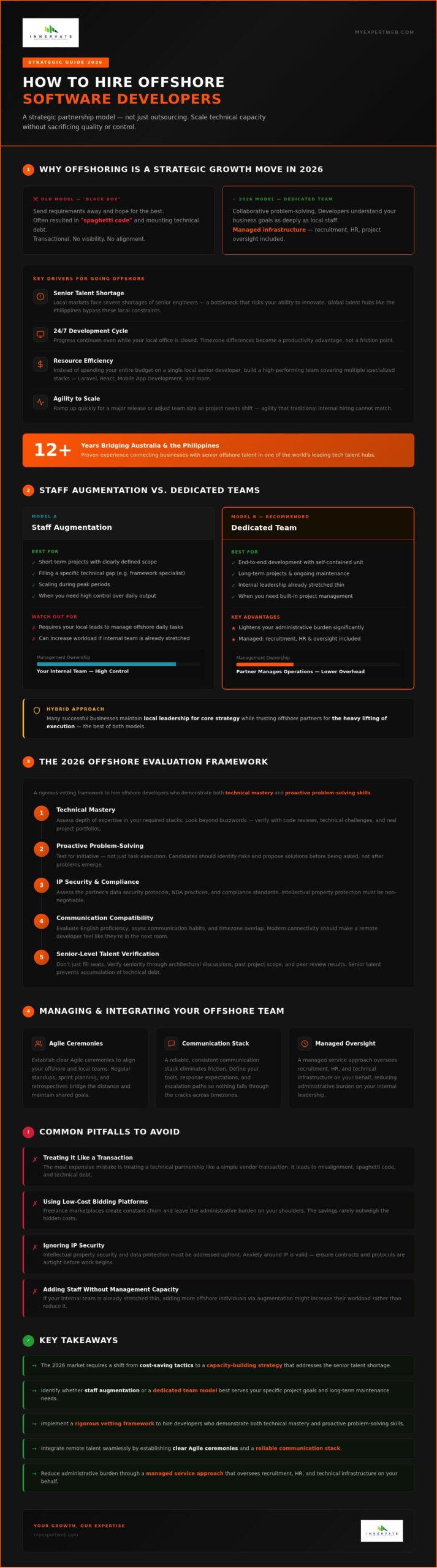
Key Takeaways
- Understand why the 2026 market requires a shift from cost-saving tactics to a capacity-building strategy that addresses the senior talent shortage.
- Identify whether staff augmentation or a dedicated team model best serves your specific project goals and long-term maintenance needs.
- Implement a rigorous vetting framework to hire offshore software developers who demonstrate both technical mastery and proactive problem-solving skills.
- Integrate your remote talent seamlessly by establishing clear Agile ceremonies and a reliable communication stack.
- Reduce your administrative burden through a managed service approach that oversees recruitment, HR, and technical infrastructure on your behalf.
Beyond the Talent Gap: Why Offshoring is a Strategic Growth Move in 2026
In 2026, the decision to hire offshore software developers has evolved from a simple budget reduction exercise into a sophisticated growth strategy. Local talent markets often face severe shortages of senior engineers, which creates a bottleneck for companies trying to scale. This scarcity isn’t just a minor hurdle; it’s a risk to your business’s ability to innovate. By looking toward global talent hubs, particularly in regions like the Philippines, businesses can bypass these local constraints. This isn’t about replacing your team. It’s about extending your capacity to meet ambitious product milestones without the friction of a months-long local recruitment cycle.
A managed offshore model outperforms freelance marketplaces because it addresses the administrative burden that usually falls on your shoulders. When you choose to hire offshore software developers through a strategic partner, you’re not just getting code; you’re getting a managed infrastructure. This includes recruitment, HR, and project oversight. It allows your internal leadership to focus on high-level strategy rather than daily micro-management or the constant churn often found on low-cost bidding platforms. This stability is the foundation of a 24/7 development cycle, where progress continues even while your local office is closed.
The Evolution of the Offshore Model
The early days of offshore outsourcing were often defined by a “black box” approach. You would send requirements away and hope for the best, often receiving “spaghetti code” in return. Today, the model has matured into the “Dedicated Team” standard. Modern connectivity tools have bridged the distance, making a developer in another country feel like they’re sitting in the next room. This integration ensures that your offshore team understands your business goals as deeply as your local staff does, moving away from transactional tasks toward collaborative problem-solving.
Economic and Operational Advantages
The real value lies in how you use your resources. Instead of spending your entire budget on a single local senior developer, you can build a high-performing team that covers multiple specialized stacks. Whether you need expertise in Laravel, React, or Mobile App Development, the global market offers a depth of talent that is often rare in domestic pools. This model allows you to reinvest your operational savings into product innovation. You can ramp up quickly for a major release or adjust your team size as project needs shift. This provides a level of agility that traditional internal hiring simply cannot match.
Identifying the Right Model: Staff Augmentation vs. Dedicated Teams
Choosing the right engagement model is a critical step when you decide to hire offshore software developers. It isn’t a one-size-fits-all decision. Your choice should depend on your current project stage and the strength of your internal management. Staff augmentation allows you to add specific expertise to an existing team, while a dedicated team provides a self-contained unit capable of handling end-to-end development. Given the growing demand for software developers worldwide, understanding these distinctions helps you secure the right talent without overextending your internal resources.
Before committing to a model, assess your internal capacity for management. Staff augmentation requires your local leads to manage the offshore developers’ daily tasks. If your internal team is already stretched thin, adding more individuals might increase their workload rather than reduce it. In contrast, a dedicated team often comes with its own project management, which lightens your administrative burden. Many successful businesses now use a hybrid approach. They maintain local leadership for core strategy while trusting offshore partners for the heavy lifting of execution.
When to Choose Staff Augmentation
This model is ideal for short-term projects where you have a clearly defined scope and need to fill a specific technical gap. It’s particularly effective when you’re working on secure web application development and need a specialist in a particular framework for a few months. Because these developers integrate directly into your existing processes, you maintain high levels of control over the daily output. It’s a pragmatic way to scale during peak periods without the long-term commitment of a permanent hire.
The Power of the Dedicated Development Team
For long-term product development and maintenance, a dedicated team is often the superior choice. This model fosters institutional knowledge; the developers stay with your project for years, learning the nuances of your business and code. This continuity leads to higher retention rates and a team that aligns closely with your company culture. The Philippines remains a premier destination for an offshore dedicated development team philippines due to its strong cultural compatibility and technical proficiency. If you’re looking to build a sustainable technical infrastructure, you might consider how a managed development team can act as a seamless extension of your business.
Vetting for Quality: The 2026 Offshore Evaluation Framework
Finding the right talent requires looking beyond a polished resume. When you hire offshore software developers, you’re looking for an extension of your own culture and technical standards. A resume might list “React” or “Laravel,” but it doesn’t show how a developer handles a logic error or how they communicate a delay. The 2026 evaluation framework focuses on behavioral and technical integration. This ensures your partner is a strategic asset rather than a management headache. You need a team that understands your market nuances and business goals as clearly as your local staff.
Effective vetting moves away from theoretical quizzes and into live, collaborative coding environments. This allows you to see if a candidate prioritizes security and performance in their logic. It also reveals their ability to explain their decisions. If a developer can’t articulate why they chose a specific architectural path, they’ll likely struggle to integrate with your senior internal team. You need experts who contribute to your scalability, not just those who follow instructions without question. Proactive problem-solving is the trait that separates high-quality developers from those who simply produce code.
Technical and Soft Skill Assessment
Real-world problem-solving tests are essential for a modern evaluation. Instead of asking generic questions, provide a small piece of your own non-sensitive code and ask for improvements. This tests initiative and curiosity. You should also evaluate transparency. A developer who admits when they don’t know something but shows a methodical way to find the answer is far more valuable than one who guesses. Always verify past project delivery history by speaking with previous clients. This confirms their ability to meet deadlines and maintain code quality over long periods.
IP Security and Legal Protections
Anxiety over intellectual property is a common pain point, but it’s manageable with the right legal framework. Ensure your partner provides enforceable NDAs and clear IP assignment clauses that transfer all rights to your company upon payment. Beyond the paperwork, review the provider’s digital security infrastructure. This includes verifying the use of secure code repositories and multi-factor authentication for all access points. A reliable partner will have documented protocols for data protection and physical office security. These measures ensure your proprietary information remains confidential and safe from breaches, protecting your business as it grows.
How to Manage and Integrate Your Offshore Developers
Scaling your technical capacity is only half the challenge. Once you hire offshore software developers, the focus must shift immediately to operational rhythm. Without a clear structure, even the most talented engineers will struggle to deliver consistent value. Integration requires more than just granting access to your codebase; it requires a shared language of progress and accountability. You’re building a bridge, not just a team, and that bridge stays strong through consistent, predictable interactions. Rhythm matters more than proximity when it comes to shipping high-quality code.
Successful management starts with your communication stack. Slack, Jira, and video conferencing aren’t just tools; they’re the digital office where your team lives. However, tools alone don’t solve the timezone hurdle. You need to establish overlap hours for critical meetings while relying on asynchronous workflows for deep work. Asynchronous communication is the practice of sharing information and updates without requiring an immediate response, allowing work to continue across different timezones without constant interruptions. This approach ensures that your local team can hand off tasks at the end of their day, and the work continues while they sleep.
Effective Communication Protocols
Clear documentation is the antidote to the friction of remote work. When every task has a well-defined brief in Jira, you reduce the need for constant back-and-forth. A local project manager often acts as a vital bridge, ensuring that business requirements are translated accurately into technical tasks. This role prevents “us vs. them” mentalities by acting as a unified voice for the project. By treating your offshore developers as a true extension of your team, you foster a culture of shared ownership. This sense of belonging is what keeps developers engaged and committed to your long-term success.
Performance Tracking and Accountability
Agile ceremonies provide the heartbeat of your development cycle. Daily stand-ups keep everyone aligned, while sprint planning and retrospectives ensure that you’re constantly improving. Don’t just track hours; track outcomes. Use data-driven metrics like velocity and code quality to measure success over time. Regular feedback loops are essential for identifying roadblocks before they derail a sprint. Consistent performance reviews help developers grow and stay aligned with your evolving technical standards. If you’re ready to see how a structured approach can transform your output, you can explore our managed outsourcing development team solutions today.
Scaling with Confidence: The MyExpertWeb Approach to Offshore Excellence
MyExpertWeb doesn’t just provide talent; we build the foundations for your long-term technical success. With over 12 years of cross-market experience, we’ve refined a model that treats your business goals as our primary directive. We specialize in custom business application development, ensuring that every project is built for security and scalability. When you choose to hire offshore software developers through us, you’re opting for a managed ecosystem. We handle the recruitment, HR, and technical infrastructure, which removes the administrative friction that often stalls growth. This allows your leadership to focus on strategy while we manage the daily operations of your remote team.
Our approach ensures a deep cultural and technical fit for our national clients. We understand that software doesn’t exist in a vacuum. That’s why we integrate local seo services and marketing insights into the development lifecycle. This ensures your application isn’t just functional, but also visible and viable in your target market. By bridging the gap between technical execution and business utility, we act as a methodical guide through the complexities of global scaling.
Why Our Philippines Hub Outperforms
The Philippines remains a cornerstone of our strategy because of its deep pool of English-proficient, Western-aligned talent. This alignment reduces communication friction and ensures that your team understands the nuances of your user base. We have a proven track record in providing mobile app development company services that meet rigorous global standards. The decision to hire offshore software developers in this region often leads to high retention rates, meaning your dedicated team builds long-term institutional knowledge. This continuity makes your development cycle more efficient with every sprint.
Your Next Steps to Scaling
Moving from a talent gap to a scalable team doesn’t have to be overwhelming. It starts with a clear roadmap. We begin with a free consultation to map your specific technical needs and identify the right engagement model for your goals. From the initial hire to full team integration, we guide you through every step of the process. We prioritize transparency and consistent delivery, ensuring that your offshore team feels like a natural part of your company. If you’re ready to build a high-performance extension of your team, you can schedule your free offshore strategy session with MyExpertWeb to begin your transition toward a more sustainable development model.
Building Your Technical Future with a Strategic Partner
The transition to a global development model is no longer just about reducing overhead; it’s about securing the specialized talent necessary for innovation. We’ve seen how the right framework allows you to hire offshore software developers who integrate seamlessly into your existing workflows. Success in 2026 depends on moving away from fragmented, transactional hiring and embracing a dedicated team model that values institutional knowledge and security. By prioritizing cultural alignment and proactive communication, you transform a remote workforce into a high-performance extension of your own office.
MyExpertWeb provides the stability and expertise needed to manage this transition. With over 12 years of experience and a specialized Philippines-based talent hub, we offer dedicated project management that handles the administrative weight for you. This ensures your technical infrastructure remains secure and scalable as your business grows. If you’re ready to bridge the talent gap with a reliable ally, Book a Free Consultation for Your Offshore Team today. We look forward to helping you achieve your development milestones with clarity and confidence.
Frequently Asked Questions
How do I protect my intellectual property when hiring offshore developers?
Protecting your intellectual property requires a combination of legal contracts and technical security. You should ensure your partner provides enforceable NDAs and clear IP assignment clauses that transfer all rights to your business. We prioritize these protections alongside digital security measures like multi-factor authentication and secure code repositories. This ensures your proprietary information stays confidential while you hire offshore software developers to scale your technical capacity safely.
What are the most popular countries for hiring offshore software developers in 2026?
The Philippines remains a premier destination for technical talent due to its strong English proficiency and Western cultural alignment. Other significant hubs include Vietnam and various Eastern European countries that offer specialized engineering skills. We focus our operations in the Philippines because it provides a reliable pool of senior developers who integrate easily into Australian and American business cultures, ensuring a smoother collaborative experience for our clients.
How much can I save by hiring offshore developers compared to local hires?
While specific figures vary based on project complexity, businesses typically see substantial operational savings by looking beyond their local talent market. These savings allow you to reinvest in product innovation or expand your marketing efforts. Instead of struggling to find a single local senior developer, you can often build a high-performing team that covers multiple technical stacks for a more sustainable long-term cost.
What is the difference between offshoring and outsourcing?
Offshoring refers to the geographic location of your team, while outsourcing describes the business arrangement where a third party manages the work. You can choose to hire offshore software developers as a dedicated team through a partner who handles the recruitment and HR. This hybrid approach gives you the geographic benefits of a global talent pool alongside the managed support of a professional agency.
How do I handle the timezone difference with an offshore team?
Managing timezone differences effectively relies on a mix of overlap hours and asynchronous workflows. We establish specific times during the day when both teams are online for live meetings and stand-ups. Outside of those hours, work continues through detailed documentation and hand-off protocols. This ensures that your project moves forward 24/7, as your offshore team makes progress while your local office is closed for the evening.
Can offshore developers work with my existing in-house team?
Offshore developers are frequently used as a seamless extension of an existing in-house team. This staff augmentation model allows you to fill specific skill gaps without the overhead of permanent local hiring. Your remote developers participate in your daily stand-ups and use your standard communication tools like Slack and Jira. They follow your internal coding standards and contribute directly to your existing development pipeline.
How long does it typically take to hire and onboard an offshore developer?
The timeline for onboarding depends on whether you’re filling a specific role or building a full team. Working with a managed partner is generally faster than traditional local recruitment because they maintain a pre-vetted pool of senior talent. This streamlined process focuses on finding a precise cultural and technical fit, allowing you to scale your capacity in weeks rather than the months it often takes locally.
What tech stacks are best suited for offshore development?
Modern web and mobile stacks are exceptionally well-suited for remote collaboration. We see high success rates with frameworks like Laravel for business applications and React for front-end development. Mobile app development is also a popular choice for offshore teams. These technologies have robust global communities and standardized documentation, which makes it easier for remote developers to maintain high code quality and security standards.