


MyExpertWeb Team
September 7, 2026
Tech Outsourcing in the Philippines: The 2026 Strategic Guide for Growing Businesses
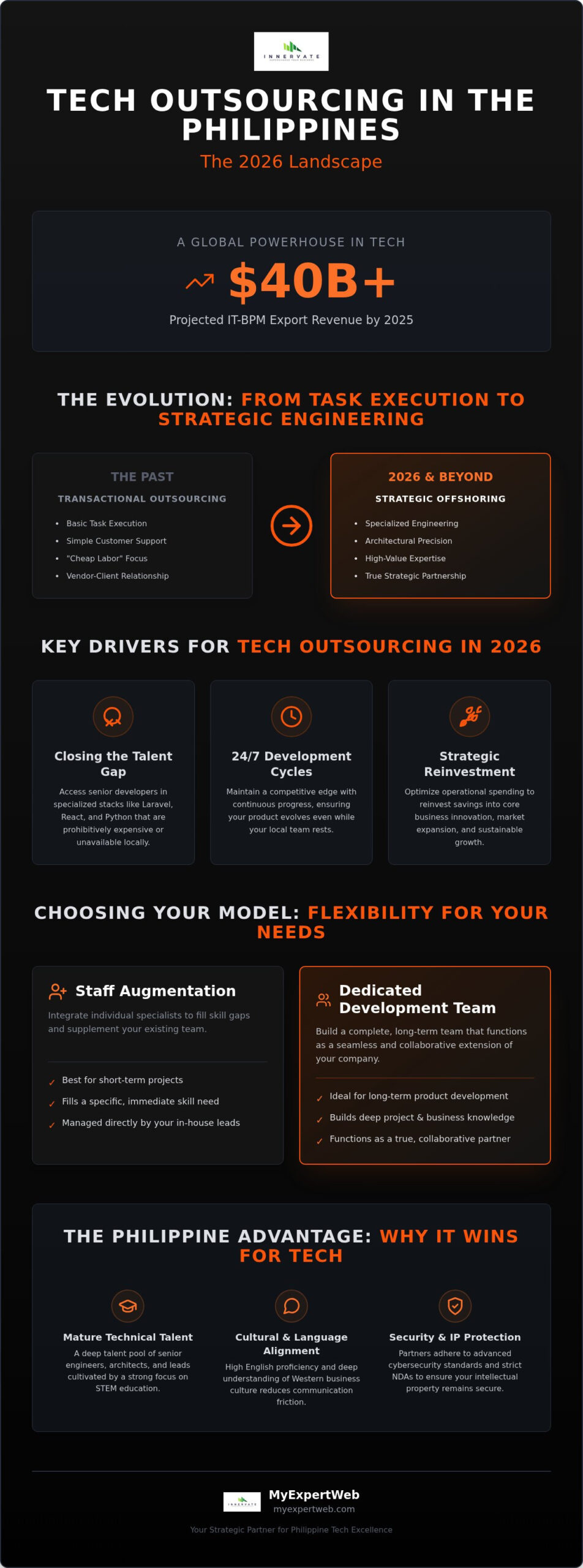
With the Philippine IT-BPM sector’s export revenue surpassing $40 billion in 2025, the region has officially moved beyond simple task execution into a global powerhouse for high-value engineering. If you’re struggling with the high cost of local developers or the persistent difficulty of finding specialized tech stacks, you’re not alone. Many growing businesses feel the pressure of scaling their digital operations while maintaining strict code quality and intellectual property security. The landscape of tech outsourcing philippines in 2026 offers a pragmatic solution that balances operational efficiency with high-level technical expertise.
Finding a reliable partner who understands your business goals is more critical than ever. This guide explores how you can leverage the Philippines’ technical ecosystem to build a scalable, dedicated development team that functions as a seamless extension of your internal staff. We’ll examine the latest 2026 trends, including the impact of the CREATE MORE Act and the integration of AI to enhance developer capabilities. By the end of this article, you’ll have a clear roadmap for achieving significant cost reductions without sacrificing the precision or security your software projects demand.
Key Takeaways
- Understand the 2026 transition from basic task execution to specialized engineering and how this shift supports your long-term business goals.
- Learn how tech outsourcing philippines offers a rare combination of cultural alignment and technical expertise to help you scale without sacrificing precision.
- Compare the advantages of staff augmentation versus dedicated development teams to determine which model best fits your current project requirements.
- Gain a practical framework for vetting offshore talent and ensuring your intellectual property remains secure through advanced cyber security standards.
- Discover how to move beyond a vendor-client relationship and establish a collaborative partnership that treats your offshore team as a true extension of your business.
What is Tech Outsourcing in the Philippines and Why It Matters in 2026
Tech outsourcing in the Philippines represents the strategic integration of offshore technical talent into your core software and IT functions. While the history of tech outsourcing in the Philippines began with basic customer support, the 2026 environment has matured into a hub for sophisticated engineering. We’ve seen a decisive move from generic Business Process Outsourcing (BPO) toward specialized technical development. This shift allows growing businesses to access high-level expertise that functions as a true extension of their internal team rather than a distant vendor.
Choosing a partner today requires a focus on “Strategic Offshoring” rather than “Transactional Outsourcing.” In a transactional model, you simply buy hours to complete tasks. Strategic offshoring involves finding a partner who understands your long-term business goals and provides the architectural precision needed for scale. The Philippines has emerged as a global tech hub because it offers this higher level of engagement, combining technical skill with a professional culture that aligns closely with Western business standards.
The Evolution of the Philippine Tech Ecosystem
The local ecosystem has undergone a significant transformation. Government initiatives focusing on STEM education and advanced technical training have cultivated a workforce that excels in senior-level engineering roles. This isn’t just about volume; it’s about depth. The talent pool has matured to include architects and lead developers who can take ownership of complex product roadmaps. High English proficiency remains a cornerstone, ensuring that technical documentation and architectural discussions remain clear and precise. This cultural alignment reduces the communication friction often found in other offshore markets, making tech outsourcing philippines a reliable choice for complex projects.
Key Drivers for Tech Outsourcing in 2026
Several factors drive the demand for Philippine tech talent today. First, the global talent gap for specialized stacks like Laravel, React, and Python continues to widen. Finding local senior developers in these areas is often prohibitively expensive or simply impossible. Second, the modern digital market demands 24/7 development cycles to maintain a competitive edge. A dedicated offshore team allows for continuous progress, ensuring your product evolves while your local team rests. Finally, cost-efficiency serves as a strategic tool. By optimizing operational spend through a partner-led model, companies can reinvest those savings into core business innovation and market expansion. It’s about building a sustainable engine for growth.
Analyzing the Benefits: Why the Philippines Wins for Tech
The Philippine tech sector has evolved into a powerhouse by offering more than just financial savings. While cost reduction is a clear driver, the real victory lies in the alignment of professional standards and technical maturity. The IT-BPM industry roadmap highlights a transition toward high-complexity tasks, moving away from the “cheap labor” reputation of the past. With the industry projected to generate $42 billion in revenue by the end of 2026, businesses today look for value, and the Philippines delivers this through a young, educated workforce that understands Western business logic.
Scalability remains a major advantage for growing firms. Local hiring in Western markets often involves months of vetting and high recruitment fees that drain resources. In contrast, tech outsourcing philippines allows you to scale a dedicated team in weeks. This speed doesn’t come at the cost of reliability. The country’s infrastructure has kept pace with global demands, ensuring high-uptime remote work environments that support seamless collaboration. If you’re looking to expand, establishing an outsourced development team provides the flexibility to grow without the traditional overhead of physical office space and local payroll taxes.
Unrivalled Cultural and Language Alignment
Communication is the primary failure point in most global partnerships. The Philippines mitigates this risk through an education system and professional culture deeply rooted in Western standards. It’s not just about speaking English; it’s about understanding nuance, deadlines, and proactive problem-solving. This shared work ethic makes it significantly easier to integrate offshore staff into your existing internal teams. They don’t just follow instructions; they contribute to the conversation, identify potential roadblocks, and suggest improvements. This level of cultural synergy ensures that your business goals aren’t lost in translation.
Technical Specialization and Skill Diversity
The talent pool is increasingly diverse, covering everything from Business Application Development to mobile apps and robust cyber security. We’ve seen a surge in niche developers who specialize in maintaining legacy systems while simultaneously building modern, cloud-native solutions. A defining trend in 2026 is the rapid adoption of AI-augmented development tools. Philippine developers are using these technologies to accelerate code production and improve accuracy, ensuring they remain at the cutting edge of global software standards. This technical agility allows them to handle complex stacks including Laravel, React, and Python with the same precision as a local senior hire.
Outsourcing Models: Staff Augmentation vs. Dedicated Teams
Choosing the right engagement model is the difference between a successful product launch and a fragmented development cycle. In the context of tech outsourcing philippines, businesses typically choose between two primary paths. One path offers immediate relief for specific gaps, while the other builds a long-term foundation for growth. Strategic agencies often utilize a Monthly Service Retainer model to provide this stability. This approach ensures that resources are locked in and ready to respond to evolving roadmap requirements without the friction of constant renegotiation.
While project-based fees might seem attractive for one-time builds, they often lack the continuity required for complex tech projects. Once the specific build is finished, the developers move on to other clients, which can leave you with a maintenance burden. A retainer model ensures that the same minds who built your system are available to scale it. This continuity reduces technical debt and ensures that your technical ecosystem remains robust as your user base grows. It’s a pragmatic choice for businesses that value consistency over short-term savings.
Staff Augmentation: Scaling on Demand
Staff augmentation serves as a tactical tool for scaling on demand. It’s ideal when you have an existing team but lack a specific skill set for a finite period. For instance, you might need specialized expertise in mobile app development to bring a new interface to market or handle a sudden surge in feature requests. This model offers an excellent cost-to-flexibility ratio. You can add or remove specialized talent without the commitment of a full-time hire. However, you must manage these individuals closely to ensure they align with your internal coding standards and documentation practices.
Dedicated Development Teams: The Long-Term Play
Dedicated development teams represent the strategic play for businesses focused on sustainable innovation. This model is particularly effective for secure web application development, where deep domain knowledge and consistent security protocols are non-negotiable. Unlike project-based builds, a dedicated team develops brand loyalty and an intimate understanding of your business logic. They act as a true extension of your business. They don’t just write code; they understand why the code matters to your customers. This deep integration leads to better architectural decisions and a more reliable product over the long term.
Vetting and Managing Your Offshore Tech Team
Establishing a partnership through tech outsourcing philippines requires a methodical approach to vetting. You aren’t just hiring a developer; you’re integrating a professional into your business architecture. While a CV provides a baseline, it rarely reveals how a developer handles pressure or complex logic. Effective management starts with setting clear expectations and establishing a culture of accountability from day one. By prioritizing transparency, you ensure that your remote team remains focused on long-term business utility rather than just completing tickets.
The Vetting Process: Beyond the Technical Test
Assessing soft skills is vital for remote collaboration. You need to know if a developer can explain technical debt to a non-technical stakeholder or if they proactively suggest better architectural paths. Checking past project portfolios and client testimonials provides a window into their reliability and historical performance. Technical Vetting is a multi-stage process involving code reviews and logic testing.
Security and Intellectual Property Frameworks
Security is a primary concern for any digital operation, especially when sensitive data is involved. You must ensure that your partner adheres to strict cyber security and IP protection protocols. This includes the use of non-disclosure agreements (NDAs) and secure, isolated development environments that prevent unauthorized access. Compliance with ISO 27001 standards offers an additional layer of assurance that the offshore operation handles data with the highest level of integrity. The Data Privacy Act of 2012 in the Philippines mandates strict breach notification and processing rules that align with international standards, ensuring your data remains protected across borders.
Managing a remote team requires a shift from monitoring hours to measuring outcomes. Setting clear KPIs is essential to maintain momentum and ensure quality. Focus on metrics like code churn, sprint velocity, and bug-to-feature ratios to get an accurate picture of performance. Regular stand-ups and transparent project management tools keep everyone aligned with your core business goals. This structured approach to tech outsourcing philippines transforms a distant vendor into a reliable strategic ally that values consistency and professional excellence. If you’re ready to build a team backed by 12 years of cross-border experience, explore how we can support your outsourcing development team needs.
MyExpertWeb: Your Strategic Partner for Philippine Tech Excellence
Choosing a partner for tech outsourcing philippines requires more than a simple recruitment agency. It demands a guide who understands the technical nuances of the local market and the strategic goals of international businesses. At MyExpertWeb, we position ourselves as a Methodical Guide, leveraging over 12 years of experience to transform complex technical requirements into functional excellence. We don’t just provide staff; we provide a collaborative framework that ensures your digital products are secure, scalable, and built for long-term viability. Our quiet confidence comes from having seen a wide variety of scenarios and remaining unfazed by technical complexity.
A Partnership Built on 12 Years of Experience
Our end-to-end service model covers the entire digital lifecycle. Whether you need custom software development or integrated web development and SEO services, our team ensures that every line of code serves a specific business purpose. We prioritize clean, mobile-responsive designs that perform across all devices and platforms. This versatility allows us to handle one-time builds with precision while offering the stability of monthly retainers for ongoing growth. By focusing on professional aesthetics and functional excellence, we help you maintain a competitive edge without the high-pressure sales tactics common in the agency space.
Bridging the Gap Between Business Goals and Technical Execution
We believe that technical execution should never be detached from business logic. Our “Extension of Your Team” philosophy means our developers work alongside your internal staff, adopting your standards and advocating for your goals. This managed approach simplifies the cost of hiring developers in the Philippines. Instead of navigating the complexities of local payroll, infrastructure, and vetting alone, you gain a streamlined partner who handles the operational heavy lifting. This allows you to focus on core innovation while we ensure your software remains robust, secure, and user-friendly.
Your technical roadmap doesn’t have to be a source of friction or uncertainty. We invite you to schedule a free consultation to discuss your specific challenges and map out a strategic path for your next project. Let’s explore how a dedicated Philippine development team can become your most reliable asset for scaling in 2026 and beyond. We’re here to listen, adapt, and help you build a digital presence that reflects the quality of your brand.
Building a Sustainable Engine for Technical Growth
The landscape of tech outsourcing philippines has matured into a sophisticated ecosystem where technical precision meets cultural alignment. By choosing a dedicated development model and prioritizing rigorous vetting, your business can overcome the local talent gap while maintaining full control over code quality and security. This isn’t just about reducing costs; it’s about building a sustainable engine for innovation that functions as a true extension of your internal team. Success in 2026 depends on finding a partner who values long-term viability over short-term task execution.
MyExpertWeb brings over 12 years of industry expertise to this partnership. We specialize in secure, scalable custom software and provide dedicated support for Australian SMEs looking for methodical guidance. We understand that your digital presence is the backbone of your business, and we’re committed to delivering excellence through transparency and hard work. Ready to map your technical roadmap with a reliable strategic ally? Book Your Free Technical Outsourcing Consultation with MyExpertWeb today. Your growth journey deserves a partner who is ready to listen and adapt to your unique needs.
Frequently Asked Questions
Why is the Philippines the top choice for tech outsourcing in 2026?
The Philippines remains a top choice due to its unique blend of cultural alignment and technical maturity. In 2026, the IT-BPM sector is projected to reach $42 billion in revenue, reflecting a decisive shift from basic support to specialized software engineering. High English proficiency and an education system focused on STEM ensure that developers don’t just follow tasks but understand the business logic behind the code. This creates a reliable environment for long-term technical partnerships.
How do I protect my intellectual property when outsourcing to the Philippines?
Protecting your intellectual property involves a combination of legal frameworks and technical safeguards. You should ensure your partner adheres to the Data Privacy Act of 2012, which mandates strict data handling and breach notification protocols. We recommend using non-disclosure agreements and isolated development environments to prevent unauthorized access. Implementing ISO 27001 standards within the offshore operation adds a layer of verified security that protects your proprietary code and sensitive user data.
What is the average cost savings when hiring a dedicated developer in the Philippines?
While specific figures vary based on technical complexity, businesses typically see a substantial reduction in operational overhead compared to local hiring. These savings come from reduced payroll taxes, lower office infrastructure costs, and a lack of recruitment fees. This efficiency allows you to reinvest capital into core innovation and market expansion. By leveraging tech outsourcing philippines, you can scale your development capacity without the financial strain of maintaining a large, in-house technical department.
Can I manage my offshore team directly, or do I need a middleman?
You can manage your offshore team directly, but a managed service model often provides better results. A strategic partner handles the recruitment, HR, and infrastructure, allowing you to focus on the product roadmap. This approach removes the administrative burden while maintaining your direct influence over the development process. It creates a collaborative environment where the remote team acts as a true extension of your business rather than a disconnected third-party vendor.
How does the time zone difference affect development cycles?
Time zone differences can be turned into a strategic advantage by creating 24/7 development cycles. Many Philippine teams offer flexible shifts to provide several hours of overlap with Western business days, ensuring seamless communication. While your local team rests, the offshore team continues progress on sprints and bug fixes. This “follow-the-sun” model accelerates your time-to-market and ensures that critical digital operations are monitored around the clock for maximum uptime.
What technical stacks are most commonly available in the Philippine talent pool?
The Philippine talent pool is diverse, with high availability in modern stacks like Laravel, React, and Python. You’ll also find significant expertise in mobile app development for both iOS and Android platforms. As the ecosystem has matured, there’s an increasing number of developers specializing in cyber security and AI-augmented coding tools. This variety allows you to find niche skills for legacy system maintenance or build cutting-edge, cloud-native applications from the ground up.
Is tech outsourcing suitable for small businesses or only large enterprises?
Tech outsourcing is highly suitable for small businesses and SMEs, not just large enterprises. In fact, smaller firms often benefit more from the flexibility and cost-efficiency of offshore teams. It allows you to access senior-level talent that might be unaffordable in a local market. Whether you need a single developer for a landing page or a dedicated team for a custom business application, the model scales to match your specific growth stage.
How do I ensure the code quality of an offshore development team?
Ensuring quality requires a structured approach involving technical vetting and regular code reviews. You should set clear KPIs such as sprint velocity and bug-to-feature ratios to monitor performance objectively. Utilizing transparent project management tools allows you to track progress in real-time. A reliable partner will have their own internal QA processes to catch issues before they reach production, ensuring that the final output meets your professional aesthetics and functional standards.