


MyExpertWeb Team
September 11, 2026
The Strategic Guide to Secure Software Development Practices in 2026
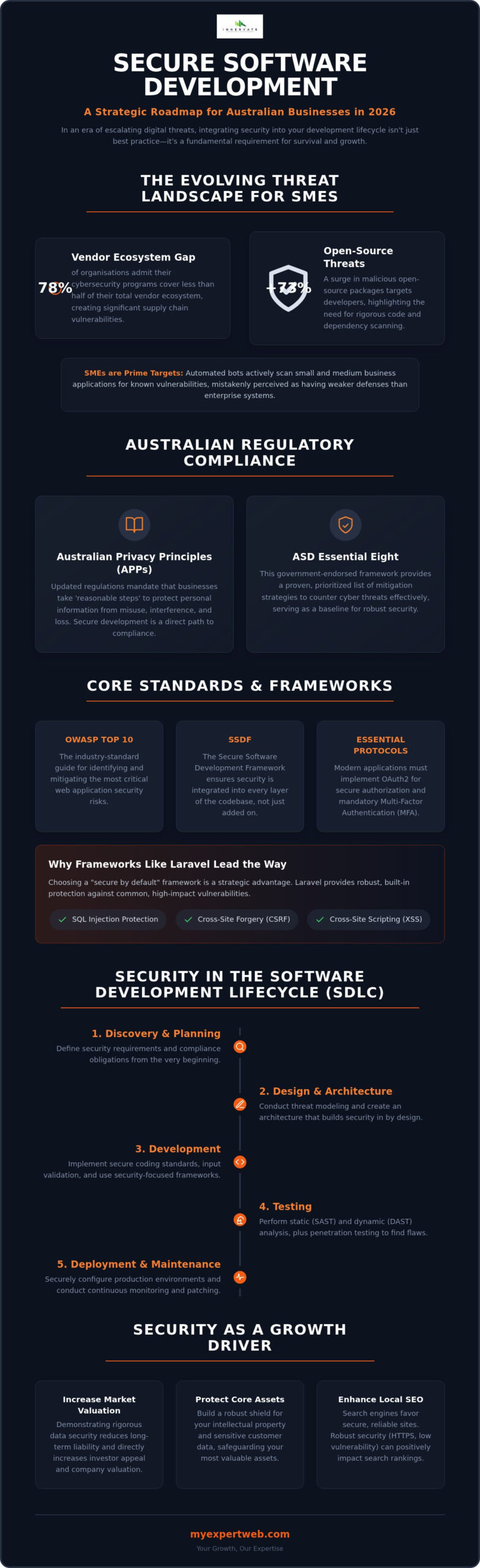
Did you know that 78% of organisations admit their internal cybersecurity programmes cover less than half of their total vendor ecosystem? For Australian business owners, this gap represents a significant risk to both intellectual property and brand reputation. It’s understandable to feel overwhelmed by the complexity of the Australian Privacy Principles or to worry that integrating secure software development practices will significantly delay your project timelines.
You want a digital asset that performs at a high level without leaving your data vulnerable to the 73% surge in malicious open-source packages seen in the last year. This article promises to show you how to implement industry-leading security protocols that protect your intellectual property and drive long-term business scalability. We will explore the 2026 security landscape, from the latest OWASP standards to the practical application of the ASD Essential Eight, providing a methodical roadmap for your next development project.
Key Takeaways
- Understand how 2026 Australian security regulations like the updated Privacy Act make proactive security a mandatory business requirement.
- Learn how to implement secure software development practices using industry-standard frameworks like Laravel and the OWASP Top 10 to mitigate risks.
- Discover a methodical approach to the Software Development Life Cycle (SDLC) that integrates security from the discovery phase through to final deployment.
- See how a dedicated development team model prevents long-term security debt and ensures your digital assets remain protected as your business scales.
- Explore the direct link between robust site security and improved local SEO performance, transforming your security measures into a competitive growth driver.
What are Secure Software Development Practices and Why Do They Matter in 2026?
Secure software development practices represent a proactive philosophy where security isn’t treated as a final checkbox, but as a foundational element of the build. This involves integrating security into the SDLC from the very first line of code. In 2026, the traditional perimeter security model, which relied heavily on firewalls and external barriers, has become insufficient. Modern application architecture now demands security by design, ensuring that vulnerabilities are identified and mitigated before they ever reach a production environment. This shift is essential for protecting the core value of your business.
By embedding these protocols into your workflow, you create a robust shield for your intellectual property and sensitive customer data. This methodical approach ensures that your digital assets remain high-performing and resilient. It transforms security from a technical hurdle into a core business strength that supports long-term scalability. When you build with security at the centre, you’re investing in the future stability of your digital presence.
The Evolving Threat Landscape for SMEs
Small to medium businesses in Australia are no longer flying under the radar. In fact, they’ve become primary targets for automated bot attacks because their defences are often perceived as less sophisticated than enterprise rivals. These bots scan for known vulnerabilities in common frameworks and outdated plugins at a scale that was impossible just a few years ago. While a mid-size business application might cost between A$75,000 and A$300,000 to develop, the financial and reputational cost of a single data breach can far exceed the initial investment. A company’s commitment to rigorous data security directly increases its overall market valuation and investor appeal by reducing long-term liability.
Regulatory Compliance in the Australian Market
Compliance is no longer optional for Australian firms. The 2026 updates to the Privacy Act have introduced stricter penalties and clearer expectations for how businesses handle personal information. Implementing secure software development practices is the most reliable way to satisfy the Australian Privacy Principles (APPs). These principles require businesses to take reasonable steps to protect the information they hold from misuse, interference, and loss. Additionally, aligning your custom applications with the ASD Essential Eight provides a proven framework for mitigating cyber threats. When you prioritise secure web application development, you aren’t just ticking a box; you’re building a foundation of trust with your Australian clients. It shows that you value their privacy as much as your own operational integrity.
Core Secure Coding Standards and Frameworks for 2026
Establishing a baseline for security starts with the OWASP Top 10. It remains the industry standard for identifying the most critical web application security risks, from broken access control to cryptographic failures. However, a truly robust strategy looks beyond simple checklists. It incorporates the Secure Software Development Framework (SSDF) to ensure secure software development practices are baked into every layer of the codebase. Adopting these standards ensures your business stays ahead of emerging threats while maintaining high-speed delivery.
To prevent injection attacks, developers must implement strict input validation and output encoding. This ensures that user-provided data can’t be executed as malicious code by the server. In 2026, relying on simple passwords is a liability. Modern applications require OAuth2 for secure authorisation and mandatory Multi-Factor Authentication (MFA) to verify user identities. These protocols protect your data even if primary credentials are compromised.
Why Frameworks Like Laravel Lead the Way
Choosing the right framework is a strategic decision that dictates your application’s vulnerability profile. We prioritise Laravel for its “secure by default” philosophy. It provides built-in protection against SQL injection, cross-site request forgery (CSRF), and cross-site scripting (XSS). Laravel’s Eloquent ORM ensures that database interactions are handled securely, preventing attackers from manipulating your data. This level of protection is vital for custom business application development, where complex data structures are common. You should review how your current tech stack handles these core risks to avoid building technical debt.
Front-End Security and Mobile-First Integrity
Security must extend to the front-end, especially as Australian businesses move toward headless architectures. Secure data transmission between user interfaces and back-end APIs is non-negotiable. This involves using encrypted channels and ensuring that sensitive tokens are never exposed in the browser or device storage. High-integrity secure software development practices directly impact mobile app performance and user trust. Users are savvy. They can tell when an app feels flimsy. Partnering with a reliable mobile app development company ensures these front-end protections are implemented without compromising speed. If you’re unsure about your current posture, a methodical security audit can reveal where your defences need strengthening.
The Methodical Guide to Integrating Security into the SDLC
Effective secure software development practices require a transition from seeing security as a final hurdle to treating it as a continuous process. By embedding security into every stage of the Software Development Life Cycle (SDLC), you reduce the likelihood of expensive late-stage rework and ensure your application remains resilient against evolving threats. This methodical approach is broken down into five distinct phases:
- Phase 1: Security Requirements during Discovery — We align technical specifications with your business risk profile, identifying which data points require the highest level of protection.
- Phase 2: Secure Architecture and Design — Implementing the “Principle of Least Privilege” ensures that every module and user has only the minimum level of access required to function.
- Phase 3: Iterative Testing — During the coding phase, developers should consult resources like the OWASP Developer Guide to ensure every module meets global standards while using Static and Dynamic Analysis (SAST/DAST) to catch flaws early.
- Phase 4: Secure Deployment — CI/CD pipelines are configured with automated security checks that prevent vulnerable code from reaching the production environment.
- Phase 5: Post-Launch Maintenance — Real-world security involves recurring patches, dependency updates, and vulnerability scanning to defend against newly discovered exploits.
The Discovery Phase: Identifying Risks Early
A successful project starts with a clear map of how business workflows translate into technical vulnerabilities. During discovery, we define user roles and granular access controls before a single line of code is written. This proactive planning prevents the “security debt” that often occurs when features are rushed into production without a clear permission hierarchy. Taking the role of a methodical guide, we help you navigate these complex decisions, ensuring that your application’s architecture is both functional and inherently safe.
Automated vs. Manual Security Audits
While automated tools like SAST and DAST are essential for scanning thousands of lines of code quickly, they aren’t sufficient on their own. Automated scanners often miss sophisticated logic flaws that a human reviewer can spot. Manual code reviews allow a senior engineer to understand the context of a function and identify where business logic might be exploited. This holistic approach is often part of our broader integrated web development and SEO services, where we balance digital visibility with the technical resilience required to protect your users. Combining automated speed with manual precision is the most reliable way to maintain high-integrity secure software development practices over the long term.
Scaling Security with the Dedicated Development Team Model
Many businesses find that project-based development creates a “security vacuum” once the initial build is complete. When a vendor hands over a product and moves on, the intimate knowledge of the codebase goes with them. This often leads to “security debt,” where minor vulnerabilities are ignored because there’s no one tasked with long-term oversight. To maintain high-integrity secure software development practices, you need a team that lives and breathes your application’s architecture every day.
A dedicated development team provides the consistency required for ongoing threat monitoring and patching. By leveraging talent in the Philippines, Australian businesses can achieve 24/7 security oversight that would be cost-prohibitive to maintain purely with local staff. This model isn’t just about saving money; it’s about strategic resilience. It allows for a follow-the-sun approach where security updates can be tested and deployed while your local team is offline, ensuring your asset is always protected.
Culture and communication alignment are just as important as technical skill. A team that understands your business goals is more likely to spot logic flaws that could lead to a breach. Regular syncs and shared documentation ensure that every developer, regardless of location, adheres to the same high coding standards you expect in the Australian market.
Security Continuity and Dedicated Staffing
Having the same developers manage your code over several years significantly reduces the risk of human error. They understand the logic behind every security configuration and can anticipate how new features might impact the existing risk profile. These teams act as a seamless extension of your internal Australian operations, following your specific protocols and compliance requirements. If you’re considering this model, understanding the cost of hiring developers in philippines can help you budget for a team that prioritises security over short-term speed.
Vetting Your Outsourcing Partner for Security
Trust is the foundation of any outsourcing relationship, but it must be verified. When evaluating a partner, look for those who operate under local Australian management. This ensures they are fully accountable to Australian data laws and understand the nuances of the Privacy Act. Your partner should also implement rigorous remote access protocols, such as hardware-based MFA and encrypted VPNs, to protect your intellectual property. A methodical guide will always prioritise these operational details over flashy marketing claims. To see how we can secure your next project, you can consult our dedicated team specialists today to discuss your specific needs.
Security as a Growth Driver: ROI and Local SEO Impact
Many business owners view security as a defensive expense, yet it serves as a powerful driver for growth and market positioning. When you implement secure software development practices, you’re doing more than just closing backdoors. You are building a high-performance asset that search engines and users can trust. A secure foundation allows your business to scale 5-10x without the crippling weight of technical debt that often plagues rushed, insecure builds. This scalability is essential for maintaining operational efficiency as your user base expands.
Fast, secure code directly influences user experience (UX) trust signals. If a site feels sluggish or triggers browser warnings, users won’t hesitate to leave. This immediate churn impacts your bottom line and your recurring revenue. By contrast, a secure environment fosters long-term customer loyalty, as clients feel confident that their personal data is handled with the highest level of care. Investing in security is, at its core, an investment in the longevity of your customer relationships.
Security and SEO: The Technical Connection
Search engines have a vested interest in directing users to safe destinations. This is why technical factors like HTTPS, clean security headers, and the absence of malware are core ranking components. If your application uses outdated libraries with known vulnerabilities, search engines may penalise your visibility to protect their users. These technical signals are a vital part of local seo services, where national visibility depends on a flawless technical reputation.
Secure landing pages also improve PPC conversion rates and lead quality. High-quality leads are more likely to convert when they see professional security credentials and feel their information is safe. When your secure software development practices are visible to the user, you reduce friction in the sales funnel. This technical integrity ensures that every dollar spent on marketing delivers a better return on investment.
Choosing a Partner for Long-Term Viability
Choosing the right digital agency requires looking beyond mere coding ability. You need a partner that understands the deep intersection of code, security, and commercial growth. MyExpertWeb brings 12+ years of experience in the Australian SME market, acting as a methodical guide through the complexities of modern development. We don’t just build software; we build secure, scalable business tools that respect your intellectual property and your customers’ privacy. A secure digital future starts with a partner who prioritises long-term viability over short-term shortcuts. Reach out to a team that values your growth as much as you do.
Securing Your Path to Scalable Growth
Securing an application isn’t just a technical requirement; it’s a strategic business move that protects your reputation and your bottom line. We’ve explored how integrating security into every phase of the SDLC and choosing frameworks like Laravel provides a robust foundation for future growth. By adopting secure software development practices, you ensure your business remains compliant with Australian regulations while building a high-performance asset that search engines and users can trust.
MyExpertWeb brings 12+ years of experience in custom development and security to every partnership. As specialists in dedicated Laravel and mobile development teams, we’ve built a proven track record serving the national Australian market. We don’t just deliver code; we provide the methodical oversight and long-term stability necessary to keep your data safe as you scale. Our team acts as a reliable extension of your own, ensuring that your digital assets remain high-value and resilient against evolving threats.
Ready to build a secure, scalable digital asset? Contact MyExpertWeb for a free consultation today. Your digital transformation deserves a partner who prioritises functional excellence and long-term success.
Frequently Asked Questions
What are the most critical secure software development practices for SMEs in 2026?
In 2026, SMEs should prioritise “security by design” and automated vulnerability scanning as foundational elements of their workflow. Implementing Multi-Factor Authentication (MFA) and maintaining regular dependency updates are also vital to defend against automated bot attacks. By adopting these secure software development practices, smaller businesses can protect their intellectual property without the overhead of an enterprise-sized security team. These measures ensure that security remains a proactive part of your growth strategy.
Does implementing security measures significantly increase development costs?
While integrating security protocols requires an initial investment, it significantly reduces the long-term cost of “security debt” and potential data breaches. Building security into the code from the start is more cost-effective than attempting to patch vulnerabilities after a product has launched. This methodical approach ensures your application remains a high-value asset, preventing expensive emergency rework and protecting your brand reputation in the competitive Australian market. It’s an investment in stability.
How does the ASD Essential Eight apply to my custom business application?
The ASD Essential Eight serves as a baseline for mitigating cyber threats within your custom business applications. It specifically addresses critical areas such as application control, patching vulnerabilities, and restricting administrative privileges. By aligning your software architecture with these Australian standards, you create a resilient environment that satisfies both regulatory requirements and user expectations for data privacy. This framework is essential for any business operating within the national digital landscape in 2026.
Can an offshore development team in the Philippines follow Australian security standards?
Yes, an offshore team in the Philippines can strictly follow Australian security standards when managed by a partner with local expertise. MyExpertWeb uses secure remote access protocols and encrypted VPNs to ensure that all development work meets the requirements of the Australian Privacy Principles. This model provides a cost-effective way to maintain high coding standards while ensuring that your data remains protected under professional Australian oversight and management throughout the project lifecycle.
What is the difference between a one-time security audit and secure SDLC?
A one-time security audit provides a snapshot of vulnerabilities at a specific moment, whereas a secure SDLC integrates secure software development practices into every stage of the build. The continuous nature of a secure SDLC ensures that new code is tested and validated before it reaches production. This proactive method is far more effective at preventing exploits compared to a reactive audit conducted after the development phase is complete, providing long-term peace of mind.
How does secure software development impact my local SEO rankings?
Site security is a core technical ranking factor for search engines in the current digital market. Factors such as valid HTTPS certificates, clean security headers, and a lack of malware directly influence your visibility in search results. When your application is built on a secure foundation, search engines are more likely to trust and recommend your site to users. This technical integrity supports your broader marketing goals by improving both your search rankings and user trust.
Who owns the intellectual property and security keys after the project is complete?
You should always retain 100% ownership of your intellectual property, source code, and security keys upon project completion. At MyExpertWeb, we ensure that all assets are transferred to the client, providing you with full control over your digital product. This transparency is a fundamental part of a reliable partnership, ensuring that your business remains independent and capable of scaling its technology without being locked into a specific vendor or facing hidden licensing hurdles.
Which programming frameworks are considered the most secure for business apps?
Frameworks like Laravel are highly regarded for their “secure by default” features, which include built-in protection against SQL injection and cross-site scripting. For front-end development, React and Vue offer robust ways to handle data when combined with secure API protocols. Choosing a framework with a strong security track record allows developers to focus on building unique features while the underlying technology handles many common vulnerability risks automatically, ensuring a more stable final product.